

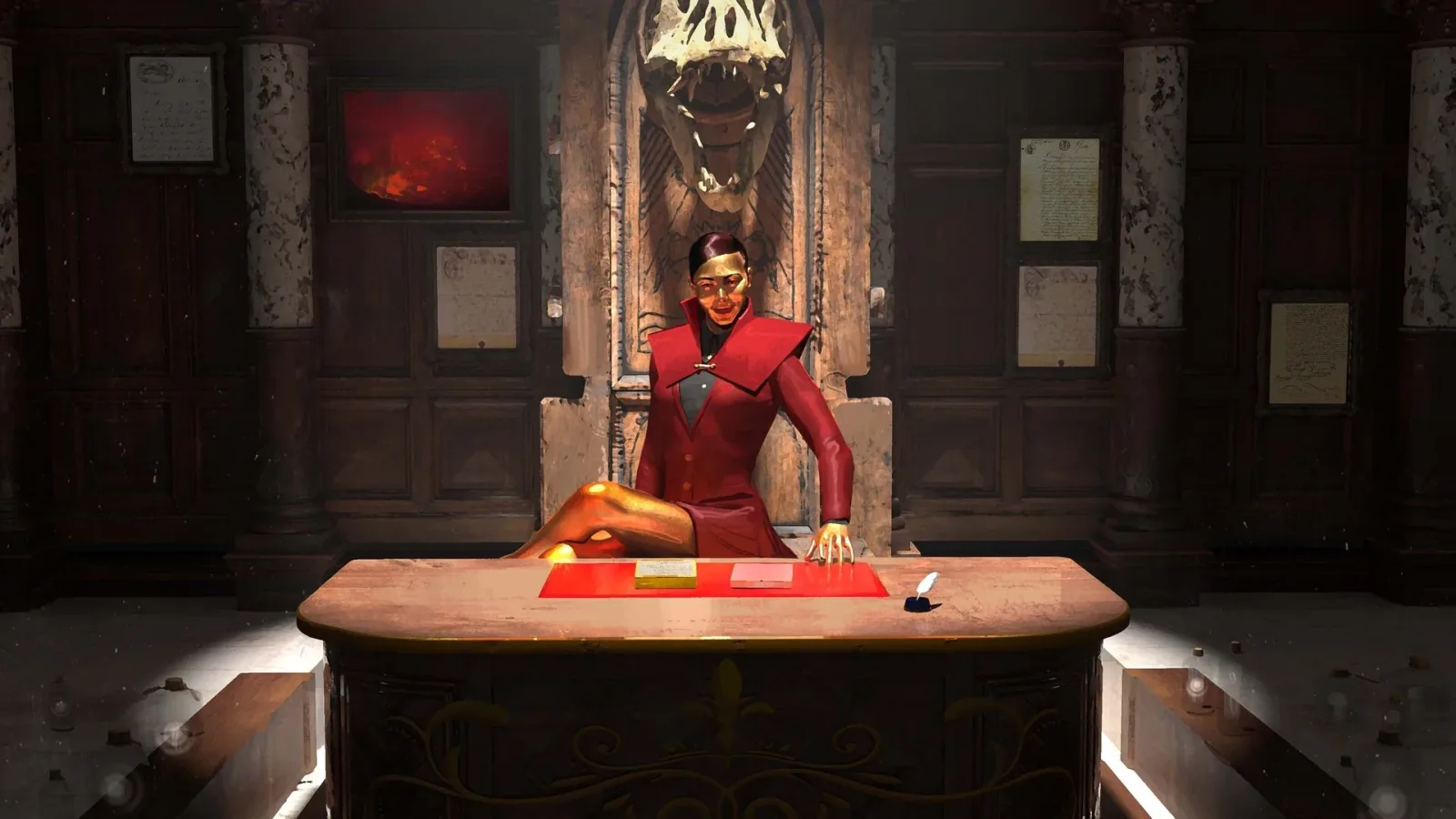
Thousand Hells: The Underworld Heists, the latest game from King of Dragon Pass creator David Dunham, takes players beneath the world for compact but potentially chaotic narrative expeditions. Each campaign asks a small crew to infiltrate an unstable underworld, solve whatever strange problems arise, and--if possible--make it back alive.
That final requirement is an important one. Getting into the realm below is only the beginning of an operation. The deeper challenge is managing a party's abilities, fears, rivalries, and opportunities while facing a place where normal logic does not necessarily apply. A character who appears unnecessary at the outset may become vital when a problem can only be solved through poetry, seafaring knowledge, a particular kind of deceit, or an understanding of the supernatural.
The result is a more focused game than Dunham's best-known work, but one that still leans heavily on the pleasures of decisions, consequences, and unexpected narrative combinations. Rather than governing a whole community over long stretches of time, players are chiefly responsible for themselves and a handful of companions. In an underworld that changes its rules as often as its terrain, that is already more than enough responsibility.
A heist begins with the people willing to join it
At the beginning of a campaign, players select personal traits and recruit three additional members for the expedition. The pool can include figures such as difficult lockpick specialists, agile scholars, sailors, poets, and other archetypes with their own defining talents and attitudes. Each crew member contributes a set of tiles representing actions, approaches, and ideas that can be used during encounters.
For useful background on this topic, read Woman Simulator Turns Household Routines Into a Morale Management Game.
This makes party-building more than a simple question of assembling conventional combat roles. A thief may seem like an obvious answer for a locked mechanism, while an academic may look better suited to interpretation or obscure lore. Yet Thousand Hells is designed around situations that can scramble those expectations. The crew member who sounds eccentric or impractical in a conventional fantasy party might carry precisely the tool needed to survive an encounter in a realm governed by symbolism, stories, and cruel irony.
Players appoint one person to lead during each challenge, with that leader able to draw on a limited number of tiles supplied by the rest of the group. The choice is consequential, and there is no easy undo button after an assignment has been made. Selecting a philosopher when a troublesome thief was ready to handle a mechanical door, for example, can leave the expedition dealing with the fallout of an avoidable mistake.
That tension is central to the game's appeal. The system invites players to plan, but it refuses to promise that planning will be sufficient. Even a well-balanced team can stumble if the wrong person takes charge at the wrong time, if a useful option has already been spent, or if the underworld decides to demand a solution that no sensible surface-dweller could have predicted.
For another perspective on this story, read Thousand Hells Makes Crew Selection a Dangerous Storytelling Tool.
An underworld that does not obey familiar rules
Thousand Hells draws on a broad mixture of early civilizations' beliefs about the worlds of the dead, creating an underworld with a deliberately mutable character. This is not simply a dark cave system inhabited by monsters. It is a place where language and narrative can carry material force, where the meaning of an object may matter as much as its physical construction, and where the environment may transform to suit a punishment or a story.
Words may be able to reshape stone. A dry channel can become a violent sea if that outcome suits the realm's sense of justice or mischief. The rules beneath the surface are therefore less about stable physics than association, implication, and the dangerous power of telling the wrong tale.
That approach gives the adventure-book structure room to produce unusual problems. Instead of repeatedly asking whether a party has enough damage output for the next enemy, the game can ask whether the crew has the social awareness to placate a god, the nerve to bargain with the dead, or the right person to understand why an apparently impossible landscape has changed around them.
Dunham's earlier King of Dragon Pass became a cult favorite after its 1999 release by presenting kingdom management through narrative events and decisions. Players weighed the needs of their people rather than merely shuffling abstract resources, and choices could define the future of a defiant society. Thousand Hells narrows the scale considerably, shifting from a clan and its kingdom to a group that may contain no more than five people. But it preserves an interest in how decisions create a story that cannot be cleanly separated from its consequences.
Forty-minute descents with many ways to go wrong
A typical Thousand Hells campaign is expected to run roughly 40 minutes to an hour. That scope makes each descent feel like a complete expedition rather than a single open-ended campaign, while the shifting setups and crew combinations create reasons to return after a victory or defeat.
One early run demonstrates how unpredictable those outcomes can be. In a mission involving the Eternal City's queen, the player was hired to retrieve two princes who had been killed by their uncle and taken into the nether realm. Mercenaries, giant spiders, and even a poetry contest stood in the crew's way. The entire team ultimately emerged unharmed, though only one prince was recovered.
Dunham noted during a call that the unusually successful first attempt had been flagged on the development side, and asked whether it had been played on a Steam Deck. It had. The implication was not that the handheld PC made the challenge easy, but that such a clean result was exceptional enough to stand out. Later expeditions proved much rougher, including one in which trouble with the god of the raging ocean began by the third encounter of a second descent.
Failure, then, is not treated as an interruption to the intended experience. It is a natural part of exploring an underworld built from permutations and hazards. Players will likely have to get back up after a series of bad turns, rethink their crew choices, and decide whether a previously ignored specialist deserves a place on the next job.
The threats can vary widely. A crew may need to win favor from major gods or lesser divine beings, interrogate shades for directions through labyrinths, fend off packs of howling creatures, pass unnoticed among marching armies, or outmaneuver ghouls. Some of those supernatural dangers combine ancient ghostly ideas with newer folklore and body-horror-inflected strangeness. The game's premise supports a flexible mix of eerie mythology, black humor, and bizarre adventure.
Personality is another resource to manage
The party's condition is not measured only by whether its members are alive or equipped for the next obstacle. Exposure to a formless and hostile afterlife can make companions manic, and players will need to keep their emotions under control as well as manage their practical strengths.
Character preferences and aversions can become ominous pieces of foreshadowing. If a recruit makes it clear that they dislike alcohol, insects, or seductive demons before the party heads underground, there is a good chance that one of those concerns will matter later. That creates a subtle reason to pay attention during recruitment: personal details are not merely flavor text, but signals about the kinds of dangers and complications the game may bring to the surface.
It also reinforces the game's smaller scale. In a kingdom-management story, a difficult individual can be one concern among many. In Thousand Hells, every member of the party is close at hand. Their capabilities affect the available options, their state of mind can complicate an expedition, and their dislikes may turn an otherwise manageable encounter into a crisis.
There is an appealing thematic fit between the crew system and the setting. A heist party is often defined by complementary skills, but Thousand Hells makes those skills unstable in value. The sailor, poet, philosopher, or scholar is not simply an alternate route through a standard obstacle. They can change the kind of story the crew is able to tell the underworld--and, because this underworld responds to stories, that may change reality itself.
Small-scale choices, large consequences
Thousand Hells: The Underworld Heists looks set to offer narrative-game fans a tightly contained alternative to the broad communal concerns of King of Dragon Pass. Its campaigns are shorter, its parties are smaller, and its immediate objective may be as direct as recovering treasure, retrieving someone lost to death, or escaping with the spoils of a dangerous job.
Yet the straightforward goal hides a dense web of decisions. Crew selection determines which ideas are available. Choosing a leader determines who can act. Personal weaknesses can become plot complications. The setting itself may reward a clever interpretation while punishing an assumption imported from the living world.
For players, that means each trip below is likely to become a story about the choices that seemed reasonable at the time. A mission can begin with a confident lineup and a clear objective, then deteriorate after an accidental assignment, a divine insult, an ill-timed fear, or a solution that works only because a poet happened to be on the payroll. In Thousand Hells, surviving the underworld is not only about bringing the right tools. It is about bringing the right people, listening to what they reveal about themselves, and accepting that the tale told on the way down may be the thing that determines whether anyone comes back.
Community
Discussion
Start the conversation.
No comments have been posted yet.