

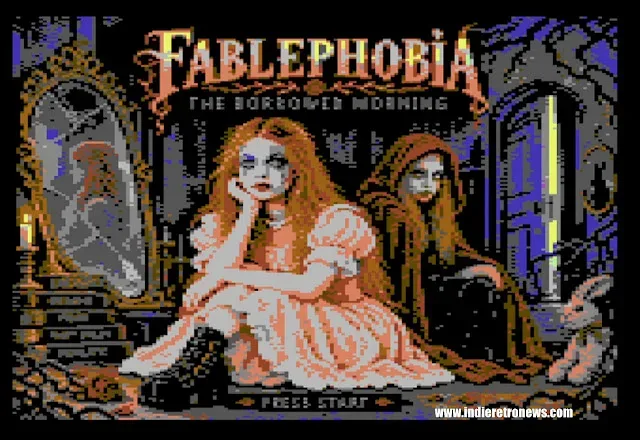
FablePhobia: The Borrowed Morning is a newly released short graphic adventure for the Commodore 64, inviting players into an uncanny domestic mystery built around quiet exploration, simple puzzles, and player choices. The game follows a protagonist named Alice as she moves through the dim corridors of a sleeping house in search of Pippa, whose trail leads through forgotten spaces, strange mirrors, and eventually toward a well illuminated by moonlight.
It is a deliberately bite-sized experience rather than a sprawling point-and-click epic. That modest scope appears to be central to its appeal: FablePhobia aims to create an atmospheric little journey with a clear premise and an approachable structure, while still taking advantage of the Commodore 64's distinctive visual character. Early player comments have been positive, particularly regarding the game's native C64-style graphics, its story, and its joystick integration.
A small mystery in a sleeping house
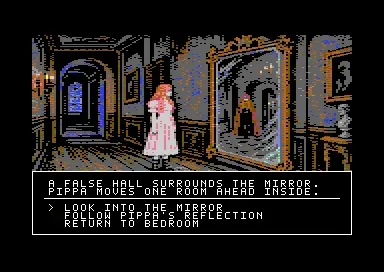
The central setup gives FablePhobia a fairy-tale-like sense of unease. Alice is not simply walking through an ordinary home; she is navigating a place that feels suspended, hushed, and faintly dreamlike. The house's rooms have been left behind or forgotten, mirrors carry an air of mystery, and the progression toward a moonlit well suggests that the adventure is interested in mood as much as conventional puzzle-solving.
That sort of environment is a natural fit for a short-form adventure. Rather than needing a large world full of locations, characters, and inventory combinations, the game can focus attention on a handful of memorable spaces and the question of where Pippa has gone. A compact setting also suits the Commodore 64, where strong color choices, carefully arranged screens, and evocative music or sound can often do more for atmosphere than visual complexity alone.
For useful background on this topic, read Thousand Hells Turns Every Underworld Heist Into a Risky Crew Story.
The available description does not establish how long a complete playthrough takes, but the game has been characterized as very short by people who have played it. That is worth keeping in mind for anyone expecting the breadth of a full-length adventure game. FablePhobia appears designed as a concise self-contained piece: a brief eerie story, a sequence of straightforward obstacles, and a focused route through its peculiar house.
Choice-driven mechanics and accessible puzzles
FablePhobia uses intuitive, choice-driven mechanics alongside its adventure-game puzzle structure. This is an important distinction from the more elaborate verb interfaces and dense inventory systems associated with many classic adventures. The game seems to favor direct interaction and clear decisions, making it easier to move through the story without needing to wrestle with an overly complicated control scheme.
Its puzzles are described as straightforward. For a shorter game, that can be a strength rather than a limitation. Difficult adventure-game logic has long been capable of disrupting pacing, especially when a story depends on an accumulating sense of mystery. By keeping the obstacles manageable, FablePhobia can maintain momentum as Alice follows clues from one unsettling location to the next.
The reported joystick integration has also received specific praise from early players. For a Commodore 64 release, comfortable joystick control matters a great deal. It helps the game feel suited to the hardware and allows players to engage with its choice-based interactions without losing the immediacy expected from a C64 adventure. The positive reaction suggests that the control implementation is not merely present, but smoothly incorporated into the experience.
Native C64 presentation stands out
One of the most encouraging points in the early feedback is the response to the visuals. Players have highlighted FablePhobia's distinct graphics, which are presented in a native Commodore 64 style rather than treating the machine as an afterthought. The C64 has a visual identity that remains instantly recognizable decades after its original era: limited but expressive color use, chunky pixels, carefully constructed scenes, and a look that can feel both playful and unexpectedly haunting.
For a story about quiet hallways, abandoned rooms, mirrors, and a well at night, those restrictions can be creatively useful. Graphic adventures depend heavily on place. A room has to communicate what it is, suggest what might be interactable, and establish an emotional tone at the same time. When a game is brief, each screen carries even more responsibility because there is less space for the adventure to build an identity gradually.
The positive comments about the graphics indicate that FablePhobia succeeds at making its locations feel distinctive. That is especially notable because the game is not being discussed solely as a technical novelty. The reaction points to an adventure whose visual presentation supports the narrative and makes the journey through the house memorable despite its limited length.
An AI-made game receiving a more favorable response
FablePhobia: The Borrowed Morning has been identified as an AI-made game, a label that understandably invites skepticism from many players. AI-assisted and AI-generated projects have become a contentious subject across games and other creative fields, with criticism often centered on low-effort releases, weak authorship, inconsistent assets, and the sheer volume of material that can be produced without much refinement.
Early feedback on FablePhobia has been more favorable than that broader reputation might suggest. Players commenting on its itch.io page have acknowledged that the game is very short, but have also said they enjoyed its story and graphics. The joystick support has been another repeated positive. In other words, reactions so far have focused on the finished experience--its mood, usability, and presentation--rather than treating the project's AI designation as the only thing worth discussing.
That does not erase the questions surrounding AI-made work, nor does it mean every player will respond to the game in the same way. But it does underline a useful point for retro enthusiasts: a project's methods and its final playability are not necessarily identical conversations. In this case, the initial reception suggests that the game has enough personality and competent execution for players to see value in it as a small C64 adventure.
Players would like to see the idea grow
Perhaps the strongest sign that the premise has landed is that some early players have expressed hope for a larger version. Requests for a full-length expansion imply that the current release leaves people wanting more of its setting, its visual style, and Alice's strange search for Pippa. That is not a promise that an expanded edition is in development, and no such future release has been confirmed. It is simply an indication that the game's core concept has sparked interest.
There is room for that concept to grow if its creator chooses to revisit it. The existing setup could support more rooms, additional characters, more elaborate branches, and a deeper explanation of the mirrors, the house, the well, and Pippa's disappearance. Yet the current game's small scale is also part of its identity. A short adventure can leave an impression precisely because it does not overextend itself.
For now, FablePhobia: The Borrowed Morning stands as a concise Commodore 64 curiosity with an eerie premise and an encouraging early response. Its journey through a sleeping house may be brief, but its native C64 imagery, accessible interactions, and smooth joystick support have given retro players reasons to take a look. Anyone approaching it should do so expecting a compact atmospheric tale rather than a lengthy adventure, but the response from those who have already played suggests that Alice's moonlit search is more than a passing novelty.
Community
Discussion
Start the conversation.
No comments have been posted yet.