

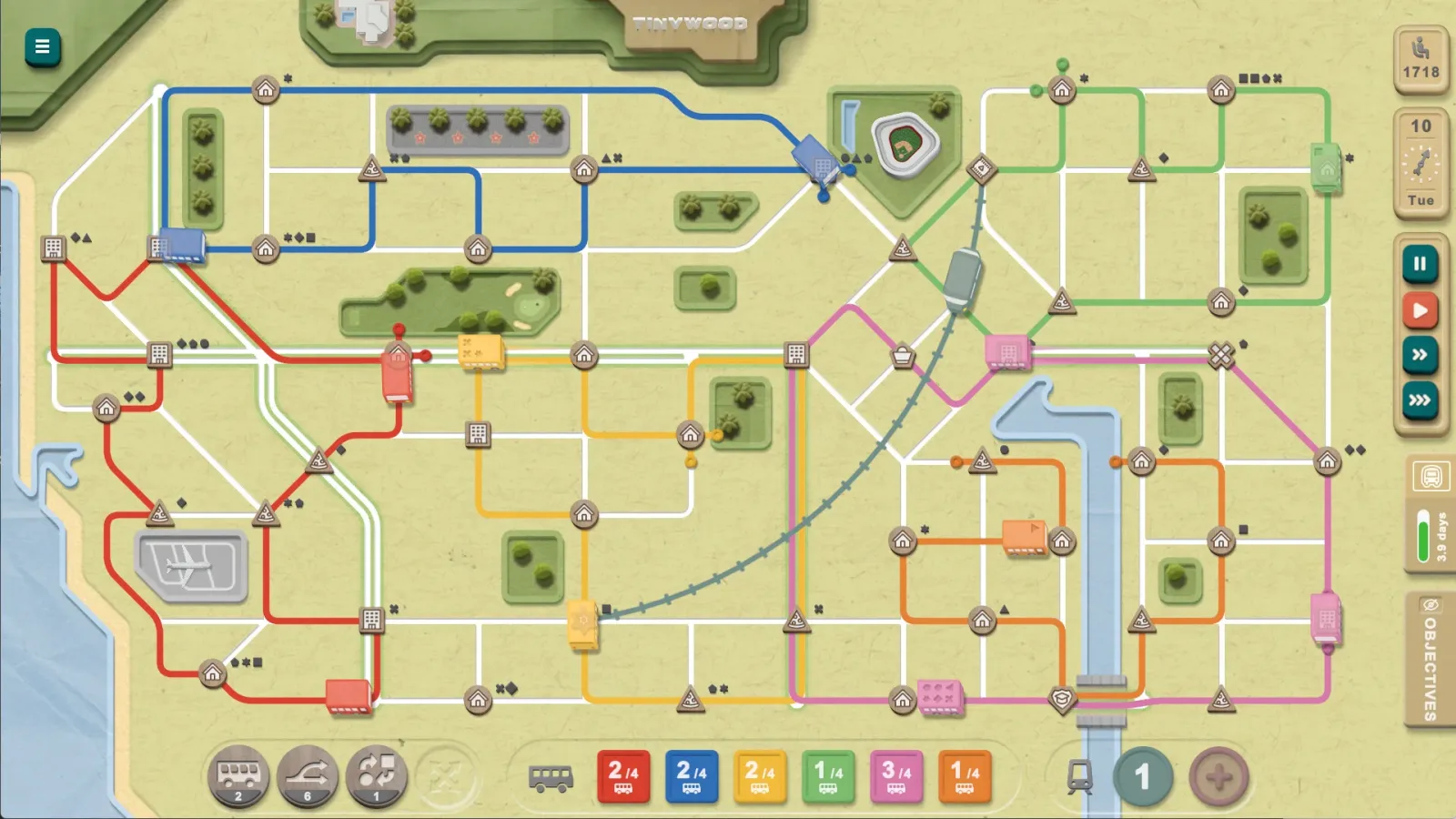
Tiny Routes, a minimalist traffic-management and route-planning strategy game from Aniki Games, is heading to Steam in early 2027. The newly announced project puts players in control of a public transport system that begins simply, then steadily expands into a demanding city-wide operation where every route, stop, vehicle and upgrade can affect the flow of commuters.
The central premise is immediately familiar to anyone who has watched a carefully built management-game network collapse under its own success. Players will draw and revise transit lines, link stations, manage buses and trains, create extra lanes, and try to keep passengers moving as a city becomes denser and more difficult to serve. Congestion is not merely cosmetic: failure to move people efficiently will lead to backed-up traffic and unhappy riders.
Rather than framing that challenge through an enormous, open-ended metropolis simulation, Tiny Routes is built around a clean, pared-back approach to planning puzzles. The focus is on readable decisions and the constant balancing act between a network's capacity, its coverage and the pressures created by growth. It is a format that could make each new station feel deceptively significant, particularly once several intersecting lines begin competing for the same urban space.
Building a network one connection at a time
At its foundation, Tiny Routes asks players to turn disconnected stops into a functioning transport network. That means deciding where lines should travel, how passengers should transfer between services, and when a reliable early-game route has become too limited for a larger population. Buses and trains are both part of the available toolkit, giving networks different ways to address capacity and distance.
For useful background on this topic, read Lenny Kravitz Joins HITMAN World of Assassination in Free The Mutiny Elusive Target.
The game's listed upgrade set suggests that expansion will involve more than simply placing another vehicle on an existing line. Eight upgrade types have been identified: buses, lines, lanes, accordion trailers, shape swaps, hubs, line boosts and trains. Each sounds positioned to solve a different operational problem.
- Buses can increase the fleet available to serve a route.
- Lines provide additional route-planning options as a city's needs become more complicated.
- Lanes offer a way to improve movement through crowded sections of the map.
- Accordion trailers appear designed to add passenger capacity to road-based services.
- Shape swaps may give players greater flexibility when working around the layout of a city.
- Hubs should create stronger transfer points between multiple services.
- Line boosts provide another means of improving a route's performance.
- Trains can directly connect any two stations, offering a potentially powerful answer to long or overloaded journeys.
That final feature could prove especially important. A train connection capable of linking any pair of stations directly has the potential to bypass busy surface networks and reshape the priorities of a map. The strongest route may not always be the shortest visible path; it could instead be the one that preserves room for future branches, minimizes difficult transfers, or keeps a key interchange from becoming a bottleneck.
Real-world-inspired cities with their own complications
Tiny Routes will include multiple city maps based on real-world street layouts and landmarks. The announced locations are New York, Los Angeles, Tokyo, Paris and Seoul. These are not intended to be interchangeable backdrops. Each city is set to introduce its own mechanics and events, meaning players will need to adapt their planning habits to the demands of a particular location.
For another perspective on this story, read Tiny Routes brings transit puzzles to Steam in early 2027.
That city-specific design is an intriguing part of the announcement. Public transportation challenges are rarely identical from place to place, and the selected cities evoke very different ideas about density, road patterns, transfers and metropolitan scale. A strategy that is effective on one map may be a poor fit elsewhere if the city's events, special rules or geography push passengers through the network in a different way.
For a game centered on concise sessions, distinct maps can also help prevent route construction from becoming routine. Instead of treating every scenario as a variation on the same optimization exercise, players may need to reconsider the value of direct links, hubs, added lanes and higher-capacity vehicles each time they move to a new city. The changing conditions could be particularly valuable for players who enjoy learning systems but want fresh constraints rather than a single endlessly escalating map.
Escalating choices and short-form strategy sessions
While Tiny Routes is about the satisfying visual language of connected transit lines and growing city maps, it is also designed around pressure. The game will feature weekly escalating choices, which suggests players will regularly face decisions that shape the direction and difficulty of their network. Choosing an upgrade or response that solves today's problem may create a tougher issue later, especially if it encourages more demand on a route that was already approaching its limit.
Aniki Games is also emphasizing quick sessions, objectives and global leaderboards. That combination places Tiny Routes firmly in the space between a relaxed planning game and a score-driven strategy puzzle. Players looking for a brief tactical challenge may be able to pursue clear objectives in a compact play period, while leaderboard competition gives experienced planners a reason to refine layouts, reduce inefficiencies and chase stronger outcomes.
The game's structure could make it approachable for newcomers to transport management while leaving room for a high skill ceiling. Minimalist presentation often depends on rules that are easy to grasp but difficult to optimize. Drawing a line from one stop to another is straightforward; deciding whether that line should curve around a congestion point, feed a hub, receive an expanded vehicle or be replaced by a train shortcut is where the deeper puzzle emerges.
Tiny Routes is built around the tension between expanding a city's transport coverage and preserving a network that can still handle the commuters it attracts.
A new Daily Challenge every day
Daily Challenge content is also planned, with a new city and a new set of rules each day. This mode should give Tiny Routes a recurring reason to revisit its systems outside the main map progression and standard objectives. A daily scenario can put everyone on the same footing, asking players to solve a defined problem under the same restrictions before comparing their results with the wider community.
The changing-rule component is especially promising for a route-planning game. One day's challenge might reward direct, efficient passenger movement, while another could make lane availability, vehicle capacity or unusual map conditions more important. Even without knowing the exact rule variations yet, the format should encourage players to question their usual habits rather than relying on a single preferred network blueprint.
Global leaderboards will support that competitive angle. The appeal is not only in completing a difficult transit puzzle, but in finding the cleaner, faster or more efficient solution. For players who enjoy strategy games with repeatable score attack elements, Daily Challenges could become one of Tiny Routes' most enduring features.
Steam Workshop support opens the door to custom cities
Beyond its official city selection, Tiny Routes is planned to support the Steam Workshop. Players will be able to design and share custom cities, extending the game's route-building framework beyond the maps created by the development team.
Workshop integration can be a major asset for a puzzle strategy game because it invites the community to create exactly the kinds of scenarios they want to solve. Some creators may focus on recognizable urban-inspired layouts, while others could build tightly tuned challenge maps filled with chokepoints, awkward station placement and demanding objectives. Players who prefer experimentation may make wide-open spaces meant for elaborate rail systems and sprawling interchanges.
Custom-city support could also add considerable variety after players have become familiar with the official maps. Since the game's core is based on responding to the unique needs of a layout, a steady stream of community-built cities may give Tiny Routes a long tail without losing its central identity.
Early 2027 is the current Steam target
Tiny Routes is currently planned for Steam in early 2027. No precise release date, pricing details or console versions have been announced. A reveal trailer is available alongside the game's announcement, offering an initial look at its minimalist transport-planning concept.
For now, Tiny Routes appears to be aiming for a compelling mix: the calm readability of a minimalist puzzle game, the mounting tension of traffic management, and the replayability of score-focused challenges and community-made maps. Its success will likely depend on how clearly it communicates the consequences of each planning decision as cities grow more crowded. If it can make a well-timed train link, a carefully placed hub or one extra lane feel like a genuinely clever rescue, it may offer strategy fans a satisfying new way to keep a city moving.
Community
Discussion
Start the conversation.
No comments have been posted yet.