

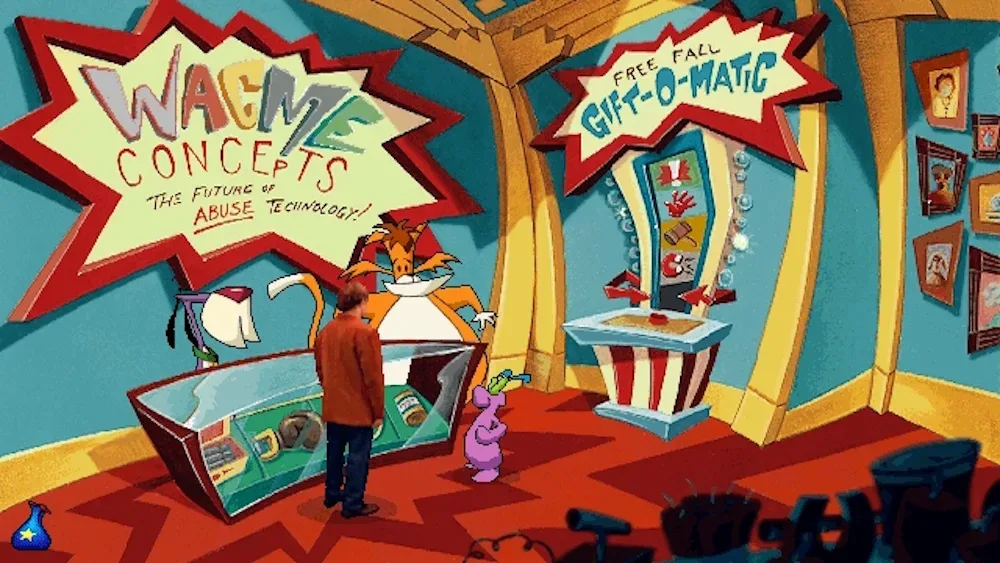
Toonstruck is 30 years old, and it remains one of the most unusual survivors of the 1990s point-and-click adventure boom. Released in 1996, Burst Studios' only adventure game paired live-action footage of Christopher Lloyd with a densely animated cartoon universe, surrounded him with an exceptional voice cast, and committed completely to a premise that is both knowingly absurd and remarkably elaborate.
When players remember the genre's golden age, the conversation often starts with LucasArts and Sierra. Those studios earned that place through an enormous run of influential games, while companies such as Westwood and Revolution also contributed memorable adventures. Yet Toonstruck deserves a much larger place in that history than it usually receives. It was an expensive-looking, ambitious production built around traditional animation at a time when CD-ROM games were eagerly experimenting with full-motion video. Rather than choosing between the two, Burst Studios attempted to make the contrast its central attraction.
Three decades later, that gamble is still the reason the game is worth revisiting. Its technology may carry the seams of its era, but its comic energy, craft, and willingness to be strange have aged far better than many attempts at interactive cinema from the same period.
A cartoonist trapped in the wrong cartoon
Lloyd plays Drew Blanc, an unhappy cartoonist whose career has taken a painfully commercial turn. Instead of creating the kind of wild character work he wants to make, he is stuck producing The Fluffy Fluffy Bun Bun Show, a relentlessly sweet project that is pushing him toward a breakdown. His boss, played by Ben Stein, sends him back to work with an overnight demand for more rabbit characters.
For useful background on this topic, read Dark Souls' Bonewheels Show Why FromSoftware's Slapstick Still Works.
Drew's imagination is elsewhere. He would rather be working with his own creation, the purple, unruly Flux Wildly. Before long, he is pulled through his television and deposited in Cutopia, an animated city where Flux is very real and very talkative. The story expands from there into a trip across a cartoon realm divided between Cutopia, Flux's home of Zanydu, and the ominously named Malevolands.
The threat comes from Count Nefarious, who is corrupting cute things and turning them evil. It is a setup deliberately built from exaggerated cartoon logic: adorable creatures become menacing, place names announce their tone before anyone has entered them, and every new screen can introduce a fresh visual gag. Drew is ostensibly the grounded human perspective, but Lloyd is too expressive a performer for the role to become a passive straight-man routine. His increasingly exhausted reactions are a major part of the joke.
The basic concept naturally recalls the live-action-and-animation collision popularized by Who Framed Roger Rabbit, another film featuring Lloyd. Toonstruck does not hide that influence. Instead, it transforms the idea into an adventure-game framework, letting the player explore a cartoon setting in which almost every prop, character, and background detail might be part of a puzzle.
For another perspective on this story, read Toonstruck Turns 30: The Wild FMV Cartoon Adventure Still Stands Apart.
An extraordinary cast for an unruly world
The production's voice work is one of its greatest strengths. Flux Wildly is voiced by Dan Castellaneta, whose performance gives the character a rapid-fire, elastic personality that feels made for the game's manic world. Tim Curry brings theatrical menace to Count Nefarious, lending the villain an appropriately grand presence without undermining the comedy.
The supporting cast is just as striking. David Ogden Stiers, Dom DeLuise, and Jeff Bennett are among the recognizable performers who populate the game's many odd corners. Their involvement matters because Toonstruck is not a game that relies on one or two major scenes. Its humor is spread through conversations, incidental encounters, throwaway lines, and the personalities of creatures that may only appear briefly. Strong performances keep those encounters from feeling like simple puzzle dispensers.
The animation meets that standard as well. Toonstruck draws on the visual language of classic American cartoons, evoking the broad physical comedy associated with artists and studios such as Tex Avery and Disney while maintaining a more irreverent edge. It loves squash-and-stretch movement, exaggerated expressions, sudden transformations, and backgrounds full of visual business. The game's handmade appearance gives it a richness that is hard to replicate with the more uniform presentation of many contemporary animated games.
Its mix of formats is not always seamless. The border between filmed footage and animation can make its technical limitations apparent, especially for players accustomed to modern compositing. But the imperfect fit has become part of Toonstruck's character. It feels like a major 1990s multimedia experiment, one made by creators determined to put a real actor inside an animated world even when the process made every scene more complicated.
More than a technical showcase
It would be easy to remember Toonstruck chiefly as an FMV novelty, but that would undersell its work as an adventure game. The game is substantial, with a running time that can reach roughly 10 hours, a notably large commitment for a point-and-click release of its era. Its structure gives players plenty of opportunities to use inventory items, investigate scenery, speak to bizarre inhabitants, and work through multi-step problems.
Many of its puzzles are inventive and well suited to the setting. A world governed by cartoon rules can support solutions that would feel nonsensical elsewhere, and Toonstruck takes advantage of that freedom. The best moments invite players to think in terms of comic escalation rather than everyday realism. If an object seems absurd, that is often an invitation rather than a warning.
That does not mean every puzzle is frictionless. Like many adventures from the mid-1990s, the game has a few challenges that can test patience. Some progression steps are less intuitive than the strongest examples in the genre, and players accustomed to newer design conventions may occasionally need to slow down and experiment. Still, its puzzle design is better than its reputation as a curiosity might suggest. The experience is not just a guided tour through impressive animation; it asks players to engage with its world.
A product of its time, including its rough edges
A modern revisit also requires some awareness of material that has not aged gracefully. Toonstruck includes an instance of a disability slur, and there is an adult-leaning barnyard sequence involving S&M imagery that can feel notably out of place. The game's anarchic style is part of its appeal, but not every joke lands equally well three decades later.
Those moments are worth acknowledging rather than ignoring, particularly because they contrast with the game's otherwise buoyant, all-ages cartoon aesthetic. They do not erase the imagination evident throughout the project, but they are reminders that Toonstruck arrived from a particular moment in comedy and game development.
The sequel that never arrived
Toonstruck's legacy is also shaped by what did not happen. A follow-up was intended, but the first game endured a troubled development and did not find the commercial audience it deserved at launch. With its poor sales, the planned continuation never materialized. That left the story and the larger ambitions around the property in an unusually unresolved state.
The commercial disappointment is especially unfortunate in hindsight. Toonstruck was not a routine production: it combined a sizable cast, extensive animation, filmed performances, and a long adventure-game structure. Such projects were difficult to mount even during the CD-ROM era, and the game's failure made it less likely that its particular blend of animation and interactive comedy would receive another chance.
Its reputation has improved with time, however. Players who return to it often find far more than an artifact of FMV experimentation. They find a game that understands how much personality a point-and-click adventure can carry when every location has a distinctive comic point of view.
Playing Toonstruck today
For years, revisiting Toonstruck could be more trouble than it should have been. Older PC compatibility concerns and awkward reliance on DOSBox made the game feel stranded between generations of hardware and operating systems. That situation is much better now.
The Steam version uses ScummVM to handle the technical work, allowing the game to launch cleanly on modern systems without requiring players to manually configure the old software environment. That accessibility is important for a game whose legacy has been hindered by availability as much as by its original sales performance.
At $20, it is not priced like a disposable retro curiosity. But for players interested in classic adventures, its length, voice cast, and production scale make a persuasive case for the investment. More importantly, it offers an experience that has not been easily replaced. There are many excellent comic adventures, many games built around animation, and many ambitious FMV productions. There are very few that combine all three with Toonstruck's confidence.
On its 30th anniversary, Toonstruck stands comfortably beside celebrated genre contemporaries such as Day of the Tentacle and Space Quest IV, not because it imitates them, but because it pursues its own increasingly bizarre direction. Burst Studios made only one adventure game. It just happened to make one memorable enough to keep talking about 30 years later.

Community
Discussion
Start the conversation.
No comments have been posted yet.