
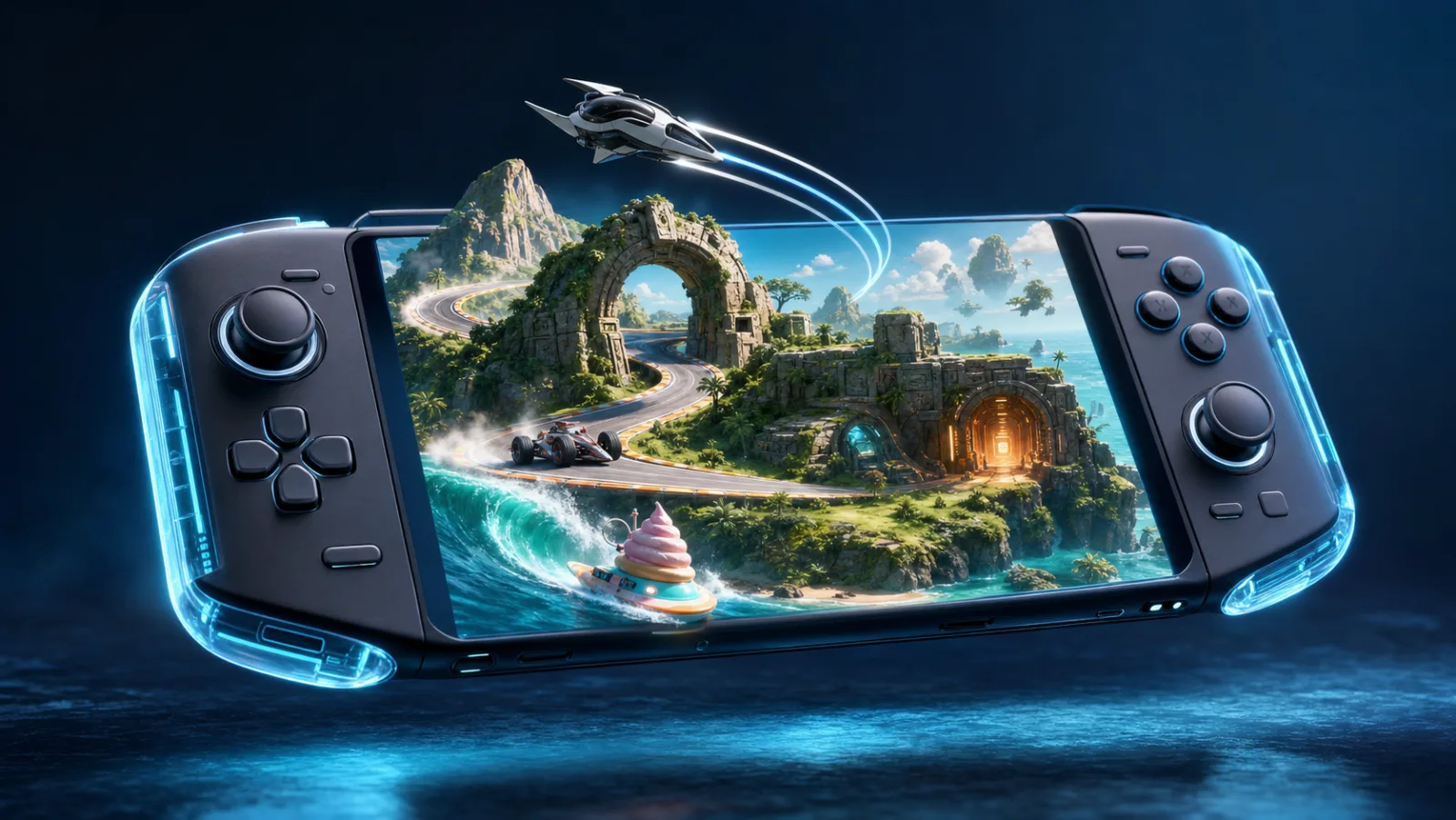
Handheld gaming is not one genre, one piece of hardware, or even one kind of play session. Its real strength is flexibility. A great portable game can give you a meaningful challenge in a short break, support a longer evening session without losing its clarity, or make local multiplayer feel immediate and sociable. The ten games below cover all of those possibilities. They include modern Nintendo Switch and mobile-friendly choices, older games with handheld connections, compact arcade experiences, demanding shooters, thoughtful puzzle games, and a forthcoming roguelite built around repeat runs.
This ranking is about how well each game's design translates to the habits of handheld players: readable goals, satisfying stop-and-start structure, replay value, and a reason to return. It is not a claim that every entry suits every player equally. Some of these games are intentionally difficult, some are best shared with friends, and some are rooted in older design conventions. That variety is the point. Whether you want a puzzle you can turn over in your head, a colorful race with family-friendly multiplayer, or a run-and-gun game that rewards teamwork, there is a distinct recommendation here.
How these handheld picks were ranked
Portability is more than platform support. A game can work on a handheld device yet still demand long uninterrupted concentration, while another can be played in quick bursts but offer little to learn after the first hour. The strongest handheld candidates balance immediate appeal with depth. They clearly communicate what the player is doing, use controls that suit focused screen time, and provide structure that makes returning after a pause feel natural.
The list also weighs the kind of player each game serves. A ranked feature should not imply that the number-one choice is automatically the best purchase for every reader. A high-pressure vertical shooter will be perfect for one audience and exhausting for another. Conversely, a logic game may lack spectacle but become the most enduring option for someone who enjoys mastering systems. Use the rankings as a route through ten different moods, then start with the entry that matches your own.
Human Resource Machine
Best for: players who enjoy logic puzzles, experimentation, and learning how systems fit together.
Human Resource Machine earns the top spot because it turns a potentially intimidating subject--programming--into a clean, playful series of office tasks. You direct a small office worker to complete each job assigned by a boss, gradually building solutions that automate the task at hand. The premise is approachable, but the appeal is not limited to beginners. Every successful solution feels like a small act of engineering: break down the problem, identify the available instructions, test an idea, and refine it.
That loop is especially effective for handheld play. A single job provides a natural session boundary, while a stubborn challenge can be revisited later without losing its purpose. The game is designed to make programming approachable, and its extra challenges give experienced puzzle players room to pursue more elegant work. On Nintendo Switch, Android, and iOS, it belongs in the category of games that can occupy a quiet commute or an entire weekend because progress comes from understanding rather than simple repetition.
Ittle Dew
Best for: adventure fans who want exploration and puzzles without being locked into one rigid route.
Ittle Dew follows Ittle Dew and Tippsie after they crash on a strange island filled with loot, odd inhabitants, secrets, and puzzles. Its key handheld advantage is flexibility. The island can be explored at your own pace, and its tools can be combined in inventive ways. That makes it a strong fit for players who like to poke at the edges of a map, leave a challenge for later, and find shortcuts that make the world feel increasingly familiar.
The game's progression is also welcoming to speedrunners, an important detail even for players who never intend to chase fast completion. Flexible progression means a return visit can feel different from an earlier one. You may spot a shortcut, recognize an overlooked secret, or approach a puzzle with a new understanding of your tools. On Nintendo Switch, Android, and iOS, Ittle Dew offers the satisfying feeling of a classic action-adventure while maintaining a compact, immediately readable focus.
Ikaruga
Best for: arcade enthusiasts who want a demanding shooter built around precision and mastery.
Ikaruga is a vertical shooter with a high-concept mechanical hook: the Ikaruga fighter can integrate and switch between two energy polarities. That single idea transforms the usual arcade-shooter relationship with enemy fire. The objective is not merely to dodge everything on screen; understanding and managing polarity becomes fundamental to survival and attack. The result is an experience that rewards attention, composure, and repeat practice.
Its setting follows Shinra, the last hope of the nearly destroyed freedom federation Tenkaku, after he is rescued in the village of Ikaruga and entrusted with the specially engineered fighter. The narrative establishes stakes, but the lasting draw is the demanding arcade action. Nintendo Switch and Android support make it relevant to portable-minded players, though this is not a casual recommendation. Small screens can intensify the focus, and the game asks players to learn from failure. Choose Ikaruga if the appeal of a hard-earned improvement matters more than relaxed sightseeing.
Hive Jump
Best for: players looking for energetic co-op platform shooting with repeatable missions.
Hive Jump puts players in the J.U.M.P. Corps during a conflict against a hostile alien race that outnumbers humanity a million to one. Its run-and-gun platforming is shaped by procedurally generated alien hives and planets, so entering a mission is not simply a matter of memorizing one fixed route. Players battle aliens, navigate traps, gather treasure, uncover lost relics, and work toward confrontations with alien bosses.
The biggest reason to consider it for a handheld-oriented library is multiplayer. Up to four players can cooperate locally or online, turning the hunt through hostile hives into a game of shared panic, rescue, and reward. Nintendo Switch support makes the local angle particularly attractive, while its solo play still offers a clear arcade-platform structure. Hive Jump is for players who prefer momentum over deliberation and who enjoy a game that can produce a fresh tactical problem each time procedural generation rearranges the danger.
Hello Kitty Kruisers with Sanrio Friends
Best for: approachable racing, Sanrio fans, and groups that want easy local multiplayer.
Hello Kitty Kruisers with Sanrio Friends is a 3-D racer starring Hello Kitty alongside other Sanrio characters. Its courses are not limited to ordinary roads: competition happens on land, through the air, and over water. That variety gives the racing a playful, travel-through-different-terrain character rather than reducing every event to a single type of circuit.
The game supports solo races and multiplayer for up to four players, with an Adventure Mode for players who want a structured test of their racing skills. Unlockable outfits and vehicles provide an additional reason to keep playing and trying different favorites from the roster. On Nintendo Switch, it is a natural recommendation for a household or group setting, especially when the goal is friendly competition instead of technical racing simulation. It ranks below the more mechanically deep solo games because its greatest strength is the social occasion it creates--but for the right group, that can make it the best pick on this list.
Ice Cream Surfer
Best for: fans of cheerful pixel-art shooters who want a concentrated arcade campaign.
Ice Cream Surfer takes a deliberately silly setup and drives it toward classic arcade energy. Evil Broccoli and an army of vegetables threaten the Flavor galaxy, and the Ice Cream Surfer joins four super tasty friends to fight through the Gourmet Universe toward the No-Flavor Zone. The tone is colorful, but the structure is serious about arcade progression: six different worlds, distinct enemies, and a giant final boss in each world.
Its 16-bit-inspired pixel visuals and arcade-inspired soundtrack fit the game's direct, old-school identity. This is a useful handheld choice when you want to sit down, shoot, move forward, and enjoy a clear sequence of challenges without needing to manage a large open world or a dense ruleset. It is available on Nintendo Switch and PlayStation Vita as well as other platforms. Choose it if a visually playful shooter with a finite world-by-world journey sounds more appealing than the severe intensity of Ikaruga.
I Have No Mouth, and I Must Scream
Best for: mature players seeking a dark, narrative-heavy point-and-click puzzle adventure.
I Have No Mouth, and I Must Scream is far removed from the cheerful arcade games elsewhere in this ranking. Based on Harlan Ellison's collection of short stories, it presents a bleak future in which the computers of the United States, Russia, and China take control after the Cold War. The Allied Mastercomputer, AM, holds the last five humans captive and subjects them to virtual adventures shaped around their pasts, fears, and weaknesses.
As an adventure, point-and-click, and puzzle game, it asks for patience and attention rather than reflexes. That can work remarkably well in portable sessions: investigate a scene, consider a character's situation, make progress, then return later to untangle the next problem. Nintendo Switch, Android, and iOS platforms make it a relevant option for this category, but its subject matter is central to the recommendation. This is not comfort gaming. It is for players who want unsettling science-fiction atmosphere and difficult human themes alongside their puzzles.
Heavy Barrel
Best for: retro action fans and pairs who want straightforward cooperative combat.
Heavy Barrel comes from the arcade-minded tradition of forceful, direct action. In its post-apocalyptic setting, a commando infiltrates a secret enemy base to recover the Heavy Barrel, a powerful weapon capable of changing the course of an ongoing war. Armed initially with a machine gun, the player fights through enemy-filled levels in a search defined by forward movement and sustained pressure.
The game's appeal rests in its intense combat and cooperative gameplay. Its NES version retained the action-packed elements of the arcade predecessor, which makes it a useful historical pick for readers who enjoy older games that put the mission first and keep the mechanics easy to explain. The Handheld Electronic LCD platform connection places it on the portable side of gaming history, even though the NES version is its stated focus. Pick Heavy Barrel when you want an unapologetically retro shooter where coordination and persistence matter more than elaborate customization.
Ikari Warriors
Best for: classic scrolling-shooter players who enjoy weapon pickups, vehicle threats, and two-player action.
Ikari Warriors sends one or two players into enemy territory as soldiers Paul and Vince. Its vertically scrolling action moves through jungles, rivers, and ancient ruins while enemy soldiers, tanks, helicopters, and other obstacles close in. Machine guns, grenades, rocket launchers, extra lives, and health packs create an old-school survival rhythm: keep moving, grab what helps, and react quickly to the next threat.
It is a foundational kind of action game rather than a modern convenience-driven experience. The attraction is the density of combat and the pleasure of tackling hostile terrain with another player. Nintendo Switch and PlayStation Portable are included among its platforms, while its original arcade and NES identity defines its spirit. It ranks here because it offers fewer of the flexible modern conveniences found above, but it remains a strong choice for anyone who wants a raw, fast-paced co-op shooter built around quick reflexes and escalating battlefield chaos.
Warhammer Survivors
Best for: players keeping an eye on future roguelite action centered on swarms and evolving weapons.
Warhammer Survivors is the one game on this list framed as a true radar pick. Its listed release date is December 31, 2026, so it should be approached as an upcoming prospect rather than a game to assume is ready to play. The concept is promising for players who enjoy survivors-style roguelites: choose characters from the Warhammer 40,000 and Warhammer: Age of Sigmar universes, collect and evolve iconic weapons, and face endless enemy swarms in bullet-hell combat.
Its planned platform list includes Android, iOS, Nintendo Switch, and Nintendo Switch 2, alongside PC and console versions. That makes handheld interest easy to understand. Roguelite runs and escalating swarms can fit naturally into repeat-session play, while weapon evolution gives each attempt a changing sense of momentum. Still, a ranking should respect the difference between a released game and a future one. Keep Warhammer Survivors on a watchlist if its universe and fast-paced format appeal to you, but let the games above satisfy the immediate urge to play.
Choosing the right game from the list
If you want the safest all-around starting point, begin with Human Resource Machine for thoughtful, clearly structured puzzles or Ittle Dew for a more exploratory adventure. Both offer strong reasons to return without relying solely on raw reflexes. For an action-first pick, decide whether you want polished, punishing shooter mastery in Ikaruga, procedural co-op mayhem in Hive Jump, or bright arcade shooting in Ice Cream Surfer.
For local play, Hello Kitty Kruisers with Sanrio Friends and Hive Jump are the clearest group-friendly choices. One channels playful racing across land, air, and water; the other asks a team to survive alien hives and bosses. For retro-minded players, Heavy Barrel and Ikari Warriors deliver the appeal of scrolling combat, weapon pickups, and arcade pressure. Finally, choose I Have No Mouth, and I Must Scream when you want a far darker, story-led puzzle experience.
The lasting appeal of a varied handheld library
The healthiest portable library is not built around a single massive game. It is built around options. A logic puzzle for quiet concentration, a racer for a shared evening, an arcade shooter for an adrenaline rush, and an adventure for slower exploration can coexist without competing for the same mood. These ten picks demonstrate that handheld gaming works best when it meets players where they are: sometimes ready for a full challenge, sometimes looking for twenty focused minutes, and sometimes hoping to pass a controller to someone else.
That is why the ranking favors range as well as quality of fit. Keep a few games with different tempos in mind, choose based on how you want to play today, and do not overlook the older or stranger entries. The next great portable session may come from solving an office automation puzzle, escaping an alien hive, navigating a surreal island, or surviving a screen full of bullets with a carefully timed polarity switch.
Community
Discussion
Start the conversation.
No comments have been posted yet.