
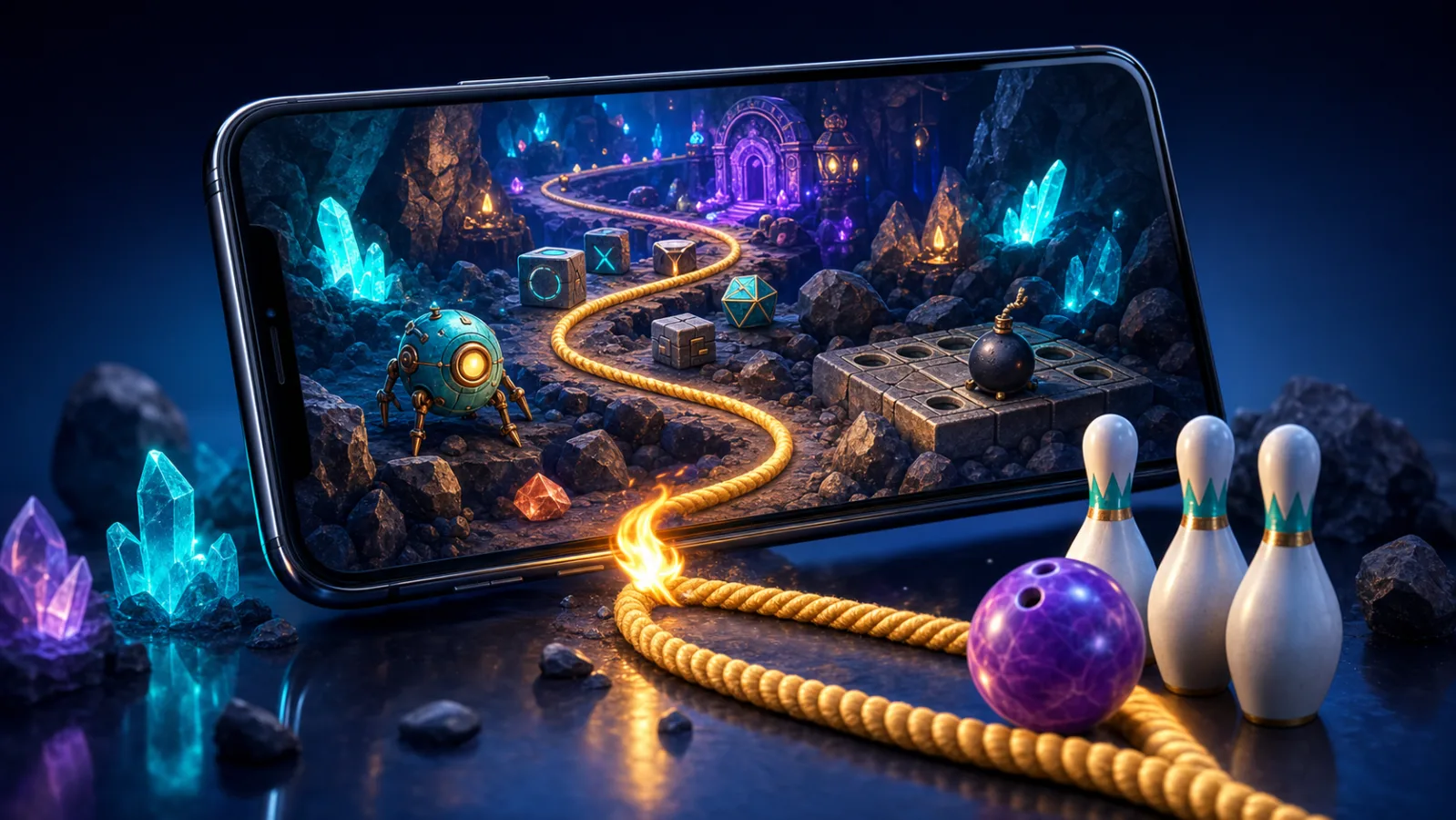
Mobile gaming is often at its best when it makes a clear idea immediately playable. A drawn line becomes a moving tool. A single dart becomes a carefully judged solution. A rotating screen turns into the central rule of a fire puzzle. Yet the strongest portable games do more than fill a few spare minutes: they create systems that are easy to understand, difficult to master, and satisfying to revisit.
This ranking looks at ten games with mobile connections, weighing the strength of their core design, the variety of their challenges, their replay value, and the kind of player each one suits. The list deliberately spans different eras and formats. Some were built around direct touch-friendly interactions, while others bring arcade, sports, tactical, or retro sensibilities to portable play. That variety is the point. A great mobile pick does not need to be the same kind of game as the one before it.
Platform history is also worth keeping in mind. Several of these games appeared across legacy mobile devices, iOS, Android, handhelds, consoles, or PC, so the best fit may depend on the version a player can access. Rather than treating every title as a current storefront recommendation, think of this as a durable guide to the games and design ideas most worth seeking out.
10. Brunswick Pro Bowling
Best for: players who want an approachable sports game with a career structure and a simple local-session appeal.
Brunswick Pro Bowling takes one of the clearest real-world sports formats and gives it the familiar framework of videogame progression. Its career mode starts with an avatar and computer-controlled opponents, then pushes players from amateur competition toward the professional level. Strength and accuracy can improve over time, while money earned through play can be spent on clothing and bowling balls. Because equipment can influence skills, the game gives its steady improvement loop more texture than a basic sequence of exhibition matches.
The shot process is also more involved than simply choosing a lane and pressing a button. Players line up a throw, determine spin, and handle release. Different versions interpret that process in platform-appropriate ways: Wii play uses a Remote swing and trigger release, while other editions use a meter and analog-stick inputs to control accuracy and release strength. That makes it a useful example of a game whose basic sport translates across control schemes without losing its identity.
It ranks tenth because bowling naturally has a narrower tactical range than the puzzle and strategy games higher up the list. Still, that limitation is part of its appeal. A quick round can be understood by nearly anyone, while career progression gives solo players a reason to keep improving. It is a solid choice for players who prefer measured timing over complicated rulebooks.
9. Block Breaker Deluxe
Best for: arcade fans who want a classic brick-breaker with extra spectacle, power-ups, and a generous number of stages.
Block Breaker Deluxe begins with a timeless arcade premise: keep a ball in play, break every brick, and manage the chaos as the board changes. Its nightlife theme gives the formula a distinctive frame, moving through locations including a bar, dance club, and casino. More importantly, the game builds variety into the action with more than 50 levels across six locations, 11 brick types, 14 power-ups, secret weapons, and adjustable paddle and ball-speed options.
Those details matter because brick-breakers live or die by how often they force the player to adjust. Different brick behaviours, power-ups, and speed settings create a meaningful gap between simply returning the ball and reading the whole board. Boss encounters and an original storyline add further structure, while random level generation is designed to extend replayability beyond the handcrafted stage set.
An exclusive multiplayer mode makes this a notably broad package for its genre. It is not the most contemplative game in this ranking, nor is it the deepest strategic experience, but it knows precisely what it wants to be: fast, animated, colourful arcade action. Choose it when the goal is immediate momentum rather than a long planning session.
8. Brain Dead 13
Best for: retro adventure enthusiasts who enjoy animated set pieces, rapid reactions, and spectacular failure states.
Brain Dead 13 is a very different proposition from the compact puzzle games surrounding it. This animated action-adventure follows Lance, a computer repairman called to the castle of Dr. Nero Neurosis, a talking brain housed in a vat of goo. Once inside, Lance faces a succession of dangerous cartoon threats, most notably Fritz, an extremely durable half-man, half-animal henchman armed for mayhem.
Its gameplay takes inspiration from Dragon's Lair and Space Ace. The key challenge is reacting correctly to danger as it appears. Success depends on reading the moment and choosing the right response; failure leads to comically violent death scenes. That structure is not for everyone. Players looking for open exploration, stat building, or flexible problem-solving may find its demands restrictive. But for an audience drawn to the theatrical side of classic interactive animation, its directness is the appeal.
The game earns a place here because its presentation and arcade-like response test offer a reminder that portable gaming does not have to mean small-scale systems. It can also mean a concentrated, memorable visual experience. Its wide platform history, including iOS, PC, Mac, PlayStation, Sega CD, Sega Saturn, and several older systems, reinforces its status as a cross-generational curiosity. Go in expecting a retro action-adventure built around learning through repetition, not a modern branching narrative.
7. Bomberman '94
Best for: action-strategy players who like clear objectives, tactical movement, and classic Bomberman tension.
Bomberman '94 gives its explosive action a campaign premise: after Bagulaa and the Robot Army destroy the Spirit Pictures, Planet Bomber splits into five pieces. Bomberman must travel through each area and recover the pictures to restore the world, with companion Louie available to provide help during the journey.
That story supplies a purposeful structure, but the reason to play is the familiar Bomberman balance of movement, positioning, and calculated risk. The action and strategy labels both fit. Navigating a space while accounting for bombs and hazards demands quick thinking, while every decision about where to move and when to commit carries consequences. It is an especially good fit for players who appreciate rules that are easy to explain but generate tense situations through level layout and timing.
Its place in the lower half is not a criticism of its heritage; rather, the titles above it offer either more extensive progression, more explicitly touch-oriented creativity, or a broader range of problems. Bomberman '94 remains a strong selection for anyone who wants a concentrated tactical-action game and enjoys the clean, readable style of 1990s design. Its platform record includes legacy mobile devices alongside PC Engine, PlayStation 3, PlayStation Portable, Wii, and Wii U.
6. Bloons
Best for: puzzle players who enjoy aiming challenges, short stages, and designing their own balloon-popping problems.
Before the tower-defense branch takes over later in this list, Bloons focuses on a more immediate puzzle format. Players receive a limited supply of darts and must use them to pop balloons arranged in increasingly tricky patterns. The central question is elegantly simple: what angle, timing, and sequence will get the job done with the darts available?
That limitation is the source of the game's appeal. A restricted dart count makes every launch meaningful, while special balloons, blocks, and new dart behaviours expand what a level can ask of the player. The 70-level campaign gives the concept room to develop, but the level editor is the feature that makes Bloons particularly interesting as a long-term pick. It turns players from solvers into creators, encouraging them to think about how arrangements, obstacles, and limited shots shape a satisfying puzzle.
Bloons is a strong mobile-style game because its main interaction is readable at a glance and its stages support both quick attempts and perfectionist replay. It is ideal for anyone who likes arcade feedback but wants the deliberate satisfaction of a puzzle. Players wanting escalating management and defensive planning should look to Bloons TD, but those who want the purity of a single well-placed shot should begin here.
5. Bobby Carrot Forever
Best for: players seeking a friendly, substantial puzzle adventure with a traditional level-by-level journey.
Bobby Carrot Forever makes a convincing case for the value of a warm, accessible puzzle campaign. Across more than 70 levels, players guide Bobby through dream worlds, collecting every carrot, using useful items, avoiding obstacles, and gradually uncovering the secret of the six golden carrots. New friends appear along the way to assist him, giving the adventure a welcoming storybook quality without distracting from the puzzles themselves.
Its classic 2D console inspiration is central to its charm. Instead of treating portable play as an excuse for disposable challenges, it offers a structured adventure with an approximate length of 15 hours. Simplified controls keep the focus on planning, while quicksave and three save slots make it easier to play at a comfortable pace. Those practical features are especially valuable in a game built around many individual stages: a player can step away without turning a puzzle campaign into a commitment.
Additional levels are available as add-on content, but the main attraction is already clear in the core design: a generous number of brain-teasing stages in a family-friendly setting. Bobby Carrot Forever is for players who want more continuity than an arcade score chase provides. It is a fine fit for newcomers to strategy puzzles, but it also has enough scale to reward anyone who simply enjoys steadily working through a large set of handcrafted problems.
4. Boulder Dash
Best for: retro-minded players who want demanding cave puzzles where every move can reshape the level.
Boulder Dash remains influential because its premise creates tension from a handful of interlocking elements. As cave explorer Rockford, the player moves through underground environments collecting diamonds while trying to avoid falling rocks and dangerous creatures. The challenge is not merely to gather resources; it is to predict the environmental consequences of movement. A route that looks safe can become perilous when a rock shifts. A rushed decision can close off a route or create a hazard where none existed before.
Originally released for Atari 8-bit computers, Boulder Dash later appeared on a formidable range of systems, including Android and iOS alongside arcade machines, home computers, Game Boy, NES, and Wii. That long platform history speaks to the resilience of its design. It does not need elaborate presentation to create pressure. The caves themselves are puzzles, and the hazards turn every small action into a potential turning point.
It reaches the top four because it rewards both planning and split-second adaptation. Players who enjoy carefully mapping a solution before acting will find plenty to appreciate, while those who like recovering from sudden complications will enjoy its more reactive side. The older presentation is part of the package, so it is best suited to people open to classic game design. For them, it remains one of the most compelling mining and maze-puzzle experiences in the group.
3. Burn the Rope
Best for: puzzle fans who want a clever, tactile rule that changes how they look at the entire screen.
Burn the Rope takes a wonderfully compact idea and explores it with real discipline. The goal is to burn as much rope as possible, but the flame only travels upward. That one restriction transforms the display into a spatial puzzle: players rotate the level to keep the fire moving in a productive direction, preserving the flame and finding routes through the rope layout.
The result is more active than it initially sounds. Rather than only tapping an object or choosing a path, the player continually changes the orientation of the puzzle. Every rotation asks whether the fire will still have somewhere viable to travel. Bugs crawling along the rope add further variation, and their different reactions to flame prevent the core idea from becoming repetitive. The game therefore combines visual clarity with increasingly nuanced level reading.
Burn the Rope is one of the most natural fits for portable play in this ranking. Its challenges are self-contained, its primary rule is instantly understandable, and the rotational interaction makes each level feel physical without requiring complicated controls. It also appeared on iOS, WiiWare, PlayStation Vita, Wii, and Windows Phone. Pick it if you value puzzles that teach their language quickly, then demand that you become inventive with it.
2. Bloons TD
Best for: strategy players who want approachable tower defense with escalating waves, upgrades, and mastery goals.
Bloons TD takes the balloon-popping theme in a more strategic direction. Instead of aiming a limited number of darts at a static arrangement, players build a defensive force of monkeys, towers, weapons, and traps to stop waves of Bloons from escaping. The objective is clear from the first match, but the strategic questions grow as the waves become harder: which defenses belong on a particular track, when should resources go toward upgrades, and how should a player prepare for the next pressure point?
The game includes 50 levels across eight tracks, offering enough distinct ground for placement choices to matter. Towers and traps can be upgraded, creating a satisfying loop between immediate survival and long-term strength. Gold medals offer a focused goal for players who want to demonstrate mastery rather than simply finish a stage.
It ranks this highly because tower defense is exceptionally well suited to portable sessions. A player can approach a level methodically, evaluate an arrangement, and enjoy the payoff as a plan handles an incoming wave. The structure supports repeat attempts too: when a defense fails, the solution is rarely just faster input. It is a new arrangement, a better upgrade decision, or a stronger understanding of the track. Bloons TD is the choice for players who want strategic depth without the intimidating entry barrier of a sprawling simulation.
1. Blek
Best for: anyone who loves elegant touch-driven puzzles, personal experimentation, and solutions that feel authored by the player.
Blek takes the number-one spot because its interaction is both simple and unusually expressive. Players draw a line, and that line continues moving. The task is to guide it through every coloured circle while avoiding black holes. There are 60 levels, but the defining feature is not just the quantity of puzzles. It is the number of possible answers each puzzle can accept.
A small gesture may solve one stage; a more intricate drawing may solve the next. The game is built around imagination, movement, and elegant problem-solving, allowing players to discover approaches that feel distinctly their own. That flexibility distinguishes Blek from puzzle games with one rigid answer. It still has firm constraints--coloured circles must be reached and black holes avoided--but it gives the player a creative instrument within those rules.
This is why Blek is such a strong mobile recommendation in principle. Drawing is an intuitive action, and the game makes that action meaningful rather than ornamental. It is approachable for people who rarely play games, because the first step is simply to make a line. It is rewarding for experienced puzzle players, because the continuing motion turns every mark into a prediction about future movement.
Available across Android, iOS, Nintendo 3DS, and Wii U, Blek also illustrates how a well-conceived input idea can travel beyond one device. It is not the longest game here, nor does it offer the campaign management of Blood Bowl or the wave-based longevity of Bloons TD. What it offers is rarer: puzzles that make the player feel less like they are selecting a predetermined answer and more like they are discovering an original motion. For inventive, touch-friendly design, it is the standout pick.
One More Game for Deep Strategy: Blood Bowl
Blood Bowl narrowly misses the numerical ranking not because it lacks depth, but because it serves a more specialized audience than the ten games above. Its dark fantasy version of American football puts teams of 11 players in violent touchdown contests, drawing on the Living Rulebook 5.0 ruleset. Eight races bring different strengths and weaknesses: Goblins are fast but fragile, Humans are versatile, and Orcs are powerful but slow.
For the right player, its team management may be the most absorbing system in this entire collection. Campaign teams can be built from scratch, with recruiting, sponsor-contract negotiation, purchases, bribed referees, and player advancement. Players gain experience through touchdowns and taking down opponents, then learn new skills as they level up. It supports quick matches with pre-defined teams as well, but its enduring appeal is in shaping a team over time.
The choice between turn-based and real-time modes broadens its appeal. Turn-based play follows the tabletop format with eight rounds per half, turnovers, and manual dice rolls. Real-time play allows orders for multiple players, with dice rolls and skill checks resolved behind the scenes; Concentration mode can pause that action for planning. Multiplayer includes hot-seat matches and online leagues. Choose Blood Bowl when you want a dense, rules-driven sports strategy game rather than a quick mobile-style puzzle.
How to Choose Your First Pick
- Choose Blek for creative, gesture-based puzzles and multiple possible solutions.
- Choose Bloons TD for accessible tower defense, upgrades, and satisfying long-term mastery.
- Choose Burn the Rope for compact levels built around screen rotation and spatial planning.
- Choose Boulder Dash for tough retro caves where hazards and movement constantly interact.
- Choose Bobby Carrot Forever for a lengthy, welcoming 2D puzzle adventure.
- Choose Bloons for shot-planning puzzles and a level editor.
- Choose Bomberman '94 for tactical action with an energetic classic-game feel.
- Choose Block Breaker Deluxe for power-up-heavy brick-breaking arcade action.
- Choose Brunswick Pro Bowling for casual sports sessions and career progression.
- Choose Brain Dead 13 for animated retro adventure and reaction-based set pieces.
The enduring lesson from this group is that portable-friendly gaming has room for almost every pace and preference. Some players will want Blek's freedom, others the orderly defenses of Bloons TD, the physical screen rotation of Burn the Rope, or the unforgiving cave logic of Boulder Dash. The best pick is not necessarily the most complex one. It is the one whose central action you want to repeat: drawing, aiming, building, rotating, rolling, reacting, or planning one more move.
Community
Discussion
Start the conversation.
No comments have been posted yet.