
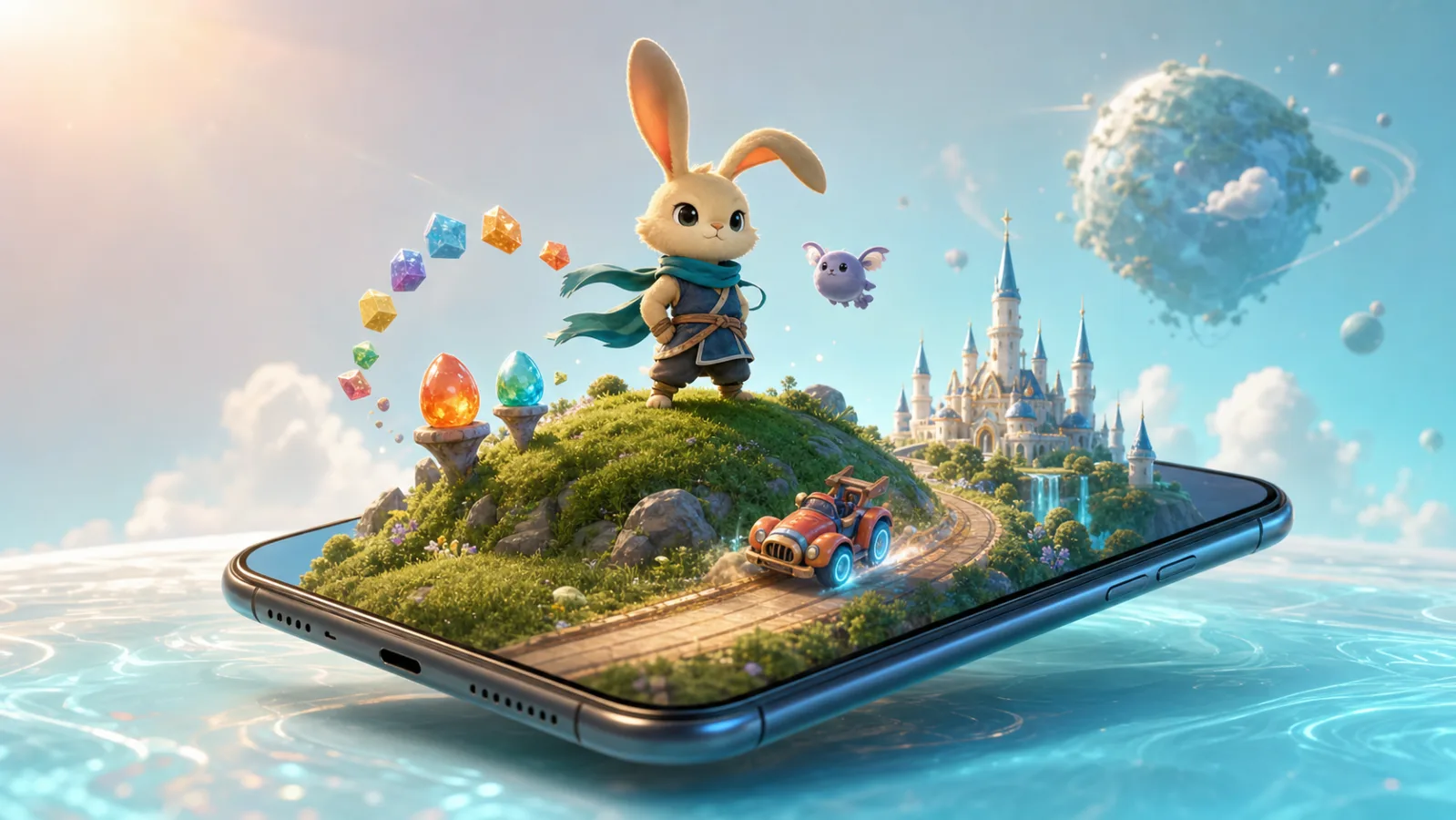
Mobile gaming is not one genre, one control scheme, or one kind of commitment. The strongest mobile shortlist can include a huge cross-platform world built for longer sessions, a compact arcade challenge that rewards quick reactions, and a puzzle game that fits into a few quiet minutes. This list ranks 10 games connected to Android or iOS, weighing the clarity of their core idea, the appeal of their mechanics, and the kind of player each one can serve.
There is an important distinction to make before diving in: a game appearing here is not automatically a recommendation to download it immediately. Several entries are upcoming, while others are older games with mobile platforms among their listed releases. That makes this a radar rather than a storefront checklist. It is a useful guide to the kinds of experiences worth following, revisiting, or investigating further based on your preferred platform, pace, and play style.
1. Petit Planet
Best for: Players who want a relaxed, social life simulation with home-building and a cosmic setting.
Petit Planet earns the top spot because its premise maps naturally to the strengths of mobile play while also aiming beyond it. It is a free-to-play adventure, role-playing, and simulator experience centered on building a home, sharing a planet with fuzzy neighbors, and discovering the possibilities of everyday life in a cosmic setting. Rather than asking players to chase a single combat objective, its identity is built around a personal space, community life, and steady discovery.
That combination matters. Home-building gives players a practical creative outlet, while the emphasis on neighbors suggests a setting designed to feel lived in instead of merely visited. A life simulation also has the potential to work across different session lengths. One player may prefer to make a small change to a home or check in on community life, while another may settle in for a longer exploration-focused session. Petit Planet is described as a cross-platform experience, with Android, iOS, Nintendo Switch 2, and PC platforms listed.
The cosmic framing helps it stand apart from a conventional village or domestic simulator. It promises ordinary routines and social connection, but places them within a much larger imaginative backdrop. For players who value atmosphere, customization, and a gentler rhythm more than constant pressure, that is an appealing foundation. Petit Planet is set for release on December 31, 2026, so the right approach is to keep it on a watchlist and pay attention to how its home-building, discovery, and free-to-play structure ultimately take shape.
2. Silver Palace
Best for: Action-RPG players who want detective fiction, city exploration, and cinematic real-time combat.
Silver Palace is one of the most ambitious games in this group on paper. This upcoming free-to-play detective action-adventure RPG takes place in Sylvanea, a sprawling Victorian-style city transformed by a revolutionary element called Silver Liquid. The player takes the role of a detective pursuing criminal conspiracies and hidden truths, giving the game a strong narrative hook before combat or character progression even enters the picture.
Sylvanea is not presented as a static backdrop. Exploration includes horseback movement, aerial wire-grappling, and free-running across its districts. That variety is especially important for an open-world game, since a city becomes more memorable when moving through it is part of the appeal. Horseback travel suggests scale, wire-grappling adds vertical mobility, and free-running points toward a more immediate relationship with streets and structures.
Combat is real time and includes character switching, skill combos, and QTE-style finishers. Players looking for a mobile game with active input and a more dramatic battle presentation will find the concept compelling. There is also a clear progression consideration: Silver Palace is planned as a free-to-play game with gacha mechanics for character and gear progression. Players interested in the setting should go in with that structure in mind and decide whether character and equipment collection is part of what they want from a long-running RPG.
Android, iOS, PC, and PlayStation 5 are listed platforms, and the game uses Unreal Engine 5 for anime-inspired visuals and cinematic battle sequences. It is scheduled for December 31, 2026. For players who want a mobile game that still aims for the scope of a major action adventure, Silver Palace is a prominent game to watch.
3. Azur Promilia
Best for: Fantasy adventure fans who enjoy creature companionship and the promise of a personal journey.
Azur Promilia ranks highly because it leads with a clear fantasy appeal: a world of magic, varied civilizations, and incredible creatures that players can encounter and bond with. It is framed as a fantasy world RPG adventure, and its central image is a journey guided by shooting stars, moving from the sky into the ocean and toward new forms of life.
Creature companionship can give exploration an emotional purpose. Instead of traveling solely to clear a map or defeat an obstacle, players have the prospect of meeting creatures and building bonds along the way. That makes Azur Promilia a particularly good radar pick for players who prefer wonder, collection, and companionship over a purely competitive or combat-first structure.
The listed platforms are Android, iOS, PC, and PlayStation 5. That cross-platform footprint is valuable for players who like the idea of a fantasy adventure fitting into mobile sessions but also want the option of a larger-screen platform. Its scheduled release date is November 26, 2026. Until more is known about its exact systems, the safest expectation is to focus on what the game already communicates well: fantasy travel, diverse societies, a star-filled atmosphere, and creatures that are more than scenery.
4. Kung Fu Rabbit
Best for: Players who want a level-based platformer built around movement precision, rescue objectives, and collectibles.
Kung Fu Rabbit is a lively action-adventure platformer with a simple, effective setup. The rabbit hero sets out to rescue kidnapped disciples from Universal Evil, moving across roofs, sliding along walls, sneaking up on opponents, and fighting through a large set of stages. Its 70 levels are designed to test logic, precision, agility, and combat skill, making it the best fit here for players who want a structured platforming campaign rather than an open-ended world.
The movement vocabulary is the real attraction. Roof-to-roof leaps and wall slides encourage momentum, while stealthy approaches and direct combat prevent the experience from becoming a purely technical jumping exercise. Babies to save, carrots to collect, and trophies to earn give the levels extra goals beyond reaching an endpoint. For completion-minded players, those layers can make a familiar platforming format more satisfying.
Originally released in 2013, Kung Fu Rabbit is listed for Android and iOS alongside Nintendo 3DS, Nintendo Wii U, PlayStation 3, and PlayStation Vita. Its design is especially easy to understand: it is about learning a stage, moving carefully, and refining performance. That directness gives it durable appeal for anyone who misses focused platformers with clear challenges.
5. Jumping Flash!
Best for: Players who want an unusual first-person platforming concept centered on vertical movement.
Jumping Flash! remains a distinctive entry because it approaches platforming from a first-person 3D perspective. Players control Commander Robbit, a robotic super-bunny trying to save the world after Baron Aloha and the Muu-Muus steal Earth's greatest locations for a private retreat. It is an immediately playful setup, but the key mechanical feature is Robbit's triple-jump.
A triple-jump changes how a platform game can feel. It puts attention on height, landing position, and the confidence to move through 3D space. Special weapons add action and shooter elements to the platforming structure, while the mission against Baron Aloha provides a clear goal. This is a good choice for players who want something more eccentric than a standard side-scroller and who appreciate games whose identity is anchored by one memorable movement system.
Jumping Flash! was released in 1995 and is listed for Android, PlayStation, PlayStation 3, and PlayStation Portable. Its age makes it a retro-minded pick, but its concept still stands out. A first-person platformer about a super-bunny using a triple-jump is not the kind of design that blends into a crowd.
6. Kid Chameleon
Best for: Retro platforming fans drawn to a virtual-reality premise and a long rescue mission.
Kid Chameleon puts a darker arcade-game twist on its platforming adventure. Casey enters a virtual reality arcade game after its rogue boss, Heady Metal, starts kidnapping players unable to complete it. Taking the name Kid Chameleon, Casey must clear every level, defeat every boss, and ultimately confront Heady Metal to save the missing kids.
This is a straightforward high-stakes platforming premise, and its value is in the determination it asks of the player. The mission is not a quick detour: success means making it through every level and boss. That makes it a natural pick for those who enjoy a classic, goal-driven structure with a final antagonist waiting at the end.
Released in 1992, Kid Chameleon is listed for Android, iOS, Linux, Mac, PC, Sega Genesis, Sega Mega Drive/Genesis, and Wii. Players should choose it for its old-school platform-game identity rather than expecting a modern progression loop. It is about confronting the game's virtual world on its own terms and pushing toward completion.
7. Krypton Egg
Best for: Arcade players who enjoy brick-breaking action with random power-ups, hazards, and boss encounters.
Krypton Egg takes the basic Breakout-style formula and fills it with instability. The essential task is to bounce a ball with a paddle and clear every brick in a level, but the bricks can produce random power-ups that help or hurt. Paddle size can change, balls can multiply or grow, paddle thrusters can alter movement, and weapons can let the paddle shoot bricks.
The random element gives every stage a little tension. Not every pickup is a reward, so reacting wisely becomes as important as keeping the ball in play. Monsters can enter the field, interfere with the ball, or destroy the paddle on contact. Every few levels, special action sequences shift the focus toward defending against incoming monsters or fighting a boss while dodging missiles. Those interruptions keep Krypton Egg from being only a brick-clearing routine.
Released in 1988, it is listed for iOS as well as Amiga, Atari ST, DOS, Mac, PC, Windows Mobile, and Windows Phone. It is ideal for players who want fast, replayable arcade sessions where success depends on tracking multiple moving threats and adapting to unpredictable power-ups.
8. Konami Krazy Racers
Best for: Racing fans who want compact courses and a crossover cast of Konami characters.
Konami Krazy Racers offers a different kind of nostalgia: a racing game built around eight classic Konami characters. The lineup includes Ninja from Metal Gear Solid, Dracula from Castlevania, and Goemon from Mystical Ninja, while the 16-course selection features locations such as Cyber Field, Ice Paradise, Pop 'n Beach, and Skybridge.
The appeal here is straightforward competition. Players race toward the checkered flag across a defined selection of courses, and the crossover roster gives the game a celebratory arcade tone. It is particularly well suited to players who value recognizable character-driven racing more than simulation detail.
Released in 2001, Konami Krazy Racers is listed for Game Boy Advance, iOS, and Wii U. Its mobile relevance comes from its portable roots: it is built around quick course-based races rather than an expansive racing career. If you want a concise retro racer with an unusual cast, it deserves a place on the radar.
9. Jewel Keepers: Easter Island
Best for: Puzzle players who want match-three action with a travel-and-mystery theme.
Jewel Keepers: Easter Island is the most directly puzzle-focused game on this list. It is a match-three arcade action game that takes players across Easter Island to help unveil its mysteries. That combination of accessible matching mechanics and a themed journey makes it a natural option for players who want a less demanding entry point than an action RPG or precision platformer.
Match-three games are often strongest when they communicate their objective immediately and offer a satisfying rhythm of small decisions. Jewel Keepers fits that profile while using an Easter Island setting to give the progression a sense of place. It is not trying to be a massive open world or a highly technical action game. Its strength is being a focused puzzle experience with an engaging premise.
The game was released in 2010 and is listed for iOS, Nintendo DSi, Nintendo Wii WiiWare, Sony PSP Minis, and Wii. Choose it when you want short-form puzzle play, a clear loop, and a thematic adventure wrapper around the matching action.
10. Karateka
Best for: Players interested in foundational martial-arts game design and a focused one-versus-many journey.
Karateka closes the list as a historically important-feeling martial-arts adventure with an extremely direct dramatic setup. A returning martial artist finds his village destroyed and Princess Mariko taken by the warlord Akuma. Armed only with karate, the hero must fight increasingly powerful warriors through Akuma's mountain fortress before facing Akuma himself.
There is no need for a complicated premise when the objective is this clear. Karateka is about advancing through danger with hand-to-hand combat as the central tool. Its fighting, beat 'em up, hack and slash, and sports genre labels reflect a game built around physical confrontation and the pressure of a final showdown.
Released in 1983, Karateka is listed for Android and iOS among a wide range of systems including Apple II, Atari platforms, Commodore systems, DOS, Family Computer, MSX, PC-9800 Series, Amstrad CPC, and Sinclair ZX Spectrum. It is best approached as a retro selection for players interested in the roots of martial-arts action games and in a compact rescue story driven entirely by combat.
How to Choose the Right Game From This List
If you want a future-facing, cross-platform world to follow, start with Petit Planet, Silver Palace, or Azur Promilia. Petit Planet favors home-building, community, and daily-life discovery. Silver Palace is the choice for detective intrigue, urban movement, and real-time action with character and gear progression. Azur Promilia is best for players drawn to fantasy travel and creature companionship.
If you want immediate mechanical clarity from a classic-style design, look toward Kung Fu Rabbit, Jumping Flash!, Kid Chameleon, or Krypton Egg. Kung Fu Rabbit is for stage-by-stage agility and collection. Jumping Flash! is for inventive 3D movement. Kid Chameleon is for a determined retro rescue quest. Krypton Egg is for brick-breaking tension and chaotic power-ups.
Finally, Konami Krazy Racers, Jewel Keepers: Easter Island, and Karateka cover three very different compact tastes: racing, match-three puzzles, and martial-arts combat. The best mobile pick is rarely the one with the broadest feature list. It is the game whose central activity matches the time, attention, and mood you bring to it. This group offers an unusually broad reminder that mobile gaming can support cozy routine, ambitious exploration, exacting movement, arcade pressure, and enduring retro ideas.
Community
Discussion
Start the conversation.
No comments have been posted yet.