

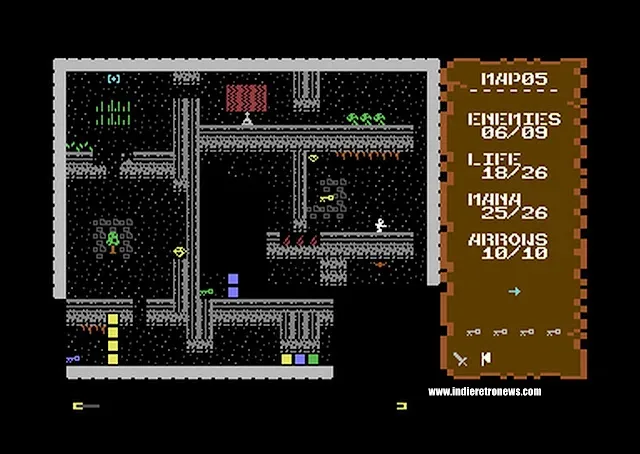
Warlock, a newly released top-down action slasher for the Commodore 64, asks players to fight through a dark fantasy world built around deliberate level design rather than endlessly shuffled runs. Created by Haplo, the developer behind Shift and Tenebra, the game takes inspiration from the forceful, eerie character of classic first-person fantasy shooters such as Heretic, then translates that energy to an overhead perspective suited to the C64.
Its most important promise is also a useful clarification for players approaching it with modern action-game expectations: Warlock is not a roguelike. There is no stated focus on procedural maps or a permadeath loop that sends players back to the beginning after defeat. Instead, it offers 25 hand-crafted levels, each designed as a specific space to explore, survive, and learn. Secret areas, hazards, teleporters, treasures, enemy encounters, and progression choices all sit within authored stages rather than a randomly assembled dungeon crawl.
That approach gives Warlock a distinct identity on a machine whose library has always rewarded developers who can make a small amount of memory feel like a much larger adventure. It is an action game first, but its collection of combat tools, enemies, hidden locations, upgrades, perks, and curses suggests a design that wants players to experiment as they advance.
A fantasy shooter spirit from above
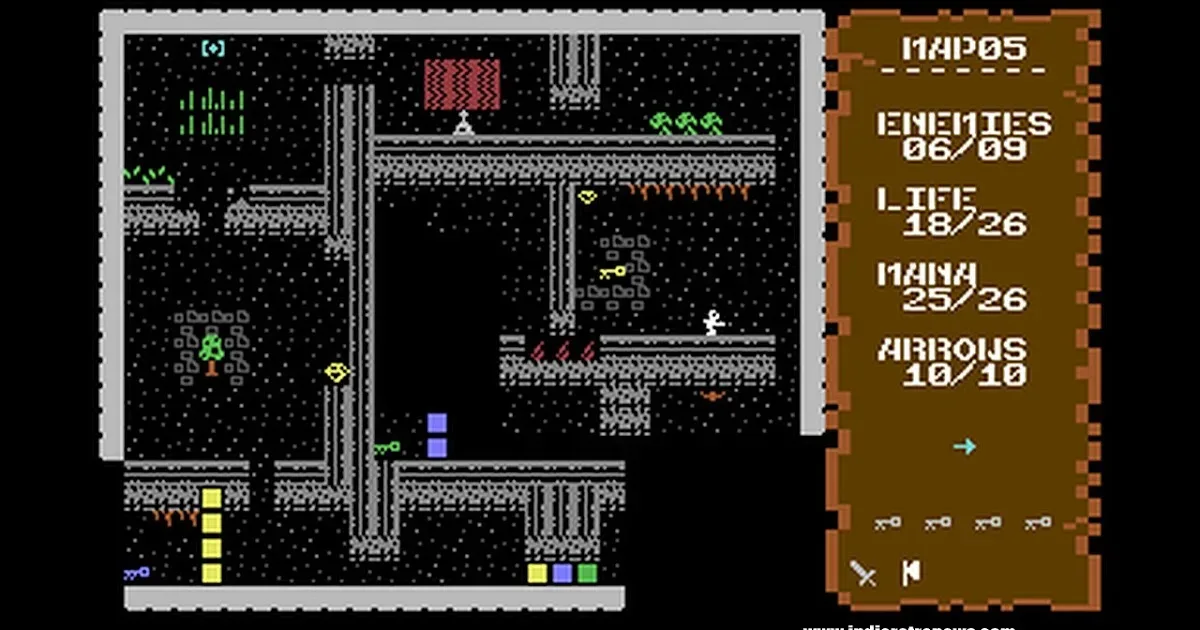
The comparison to old-school fantasy shooters is not about camera position. In Warlock, the player sees the battlefield from the top down rather than through the eyes of the protagonist. The connection is in the mood and the combat intent: a hostile fantasy setting, dangerous creatures, weapon-based fighting, and a progression structure that encourages the player to become more capable while pressing deeper into threatening territory.
For useful background on this topic, read PlatinumGames Signals Bayonetta Could Return in Future Projects.
Moving the action overhead changes what matters moment to moment. Enemy placement, clear movement routes, environmental hazards, and awareness of nearby threats become fundamental. A top-down view can make an arena instantly readable, but it can also make a crowded encounter more demanding when players must balance positioning against attacks, obstacles, and the urge to look for a hidden path. Warlock's event-triggered spawning system is particularly relevant here, because it means combat pressure can change as a player reaches a location or activates part of the environment.
Rather than simply filling each stage with enemies from the outset, triggered spawns can make exploration unpredictable in a carefully controlled way. A corridor that appears safe may become contested when an event occurs. A treasure route may require a fight before it can be completed. Teleporters can redirect the player into another part of a map, while hazards turn the terrain itself into a concern. These are familiar ingredients for action-adventure design, but their use in a purpose-built Commodore 64 game gives them a welcome retro context.
25 levels built by hand
Warlock contains 25 handcrafted levels, each with secret areas for players to find. That figure gives the game a substantial campaign structure, while the emphasis on hidden spaces encourages more than a straight run from entrance to exit. Searching walls, checking unusual passages, and revisiting suspicious corners have long been part of the appeal of fantasy action games. Here, those discoveries are also part of the case for replaying levels and engaging with the game beyond a first completion.
A handcrafted campaign means encounters can be arranged with intention. A designer can introduce an enemy in a controlled setting, then later combine it with a hazard or place it in a more complicated arena. A teleporter can be positioned to create surprise, route planning, or an escape option. Secret treasure can reward curiosity without requiring the entire game to depend on randomized luck. The result is a structure where players can gradually understand the game's spaces and systems.
This is a notable contrast with the procedural format increasingly associated with compact action games. Procedural generation can support enormous variation, but it often puts the focus on adapting to unfamiliar layouts and accepting the consequences of a failed run. Warlock instead emphasizes authored progression. Players are not presented with a disposable sequence of levels; they are entering a planned adventure with discoverable details and repeatable places.
The absence of permadeath is equally meaningful. It lowers the penalty for learning difficult sections and makes the game's secrets, weapon choices, and build-oriented systems easier to engage with on their own terms. A player can spend time trying to understand a level or refine an approach without the constant expectation that one mistake will erase the larger journey. That does not automatically make the game easy, but it does establish a different relationship between challenge and progress.
Weapons, enemies, and reactive encounters
Combat is driven by an arsenal of five distinct weapons and a roster of eight enemy types. The exact usefulness of any weapon will naturally depend on the situation: open rooms, narrow routes, enemy groups, environmental threats, and the player's chosen upgrades can all affect which tool feels most valuable. Five weapons is enough to support meaningful choice without losing the focus expected from a tightly made retro action game.
The eight enemy types provide the foundation for escalation across the campaign. A well-paced action game can get substantial mileage from a limited enemy roster when enemies are introduced gradually and then recombined in increasingly demanding situations. Because Warlock uses event-triggered spawns, those combinations need not be visible before they become a problem. Players may have to respond quickly when a new threat enters the room, reconsider their position, or change weapons to control the encounter.
Interactive level features broaden the challenge beyond direct attacks. Teleporters can alter navigation and produce surprise transitions. Environmental hazards force players to recognize danger in the floor plan rather than only in monsters. Hidden treasure offers a positive reason to investigate every level closely. Taken together, these components suggest stages intended to be played as active spaces, not merely as scenery between fights.
Progression without the roguelike framework
Warlock's progression is built around upgrades, perks, and a curses system. The game describes these mechanics as allowing highly customized playstyles, which may be one of its strongest features for players who enjoy making a character build their own rather than relying on a single fixed combat pattern.
Upgrades can give a player a sense of growing strength over the course of an adventure. Perks can further shape priorities, potentially favoring one style of offense or survivability over another. Curses add a more intriguing layer because the term usually implies a trade-off, drawback, or condition that must be managed. Whatever forms those options take in practice, their presence indicates that Warlock is not limited to collecting a weapon and moving on. It wants players to consider how systems interact.
Importantly, this character customization exists in a game that does not frame itself as a roguelike. Players can therefore approach build decisions within a structured campaign of fixed, discoverable maps. That distinction may appeal to anyone who enjoys the variety of upgrades and modifiers found in newer action games but prefers designed levels and a conventional sense of forward progression.
Sound, atmosphere, and the appeal of new C64 releases
The game also includes five original music tracks and custom sound effects. For a fantasy action game, audio has a major role in sustaining the atmosphere between battles and making weapons, hazards, teleporters, and enemy appearances feel responsive. Original music gives individual portions of the campaign room to establish their own mood, while dedicated effects can help keep moment-to-moment action clear amid the visual constraints of the hardware.
Warlock arrives as another example of how active the Commodore 64 development scene remains. New games for the system are not simply exercises in nostalgia when they are designed around ideas that fit the hardware while still drawing on decades of genre evolution. A top-down fantasy slasher with secrets and environmental interactions would have been an appealing concept in the C64's original era. Adding build customization, perks, curses, triggered encounters, and a deliberately non-roguelike campaign gives the project a more contemporary design perspective.
For fans of Haplo's previous work, Shift and Tenebra, Warlock represents another game built for Commodore 64 players rather than a retrospective port or a stripped-down imitation of a current release. For action fans more broadly, its appeal is clear: a dark fantasy campaign, 25 planned levels, five weapons, eight enemies, secrets to uncover, and enough progression systems to make the route through its world feel personal.
Warlock is available now for Commodore 64. Players looking for a retro action game with authored maps, a fantasy-shooter attitude, and customization beyond the usual arcade-style score chase have a new dungeon-bound adventure to investigate.
Community
Discussion
Start the conversation.
No comments have been posted yet.