

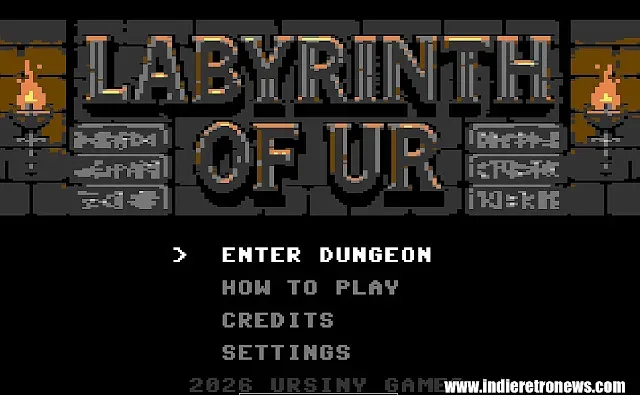
Labyrinth of Ur is taking the Commodore 64 into the depths with a first-person, 3D dungeon-crawling adventure that draws inspiration from genre landmarks including Dungeon Master and Eye of the Beholder. Developed by Ursimon, the game places players in control of a solitary warrior named Lance as he ventures down through a dangerous subterranean maze in search of survival, treasure, and ultimately a high final rank.
The project has been built from scratch in C for unexpanded PAL Commodore 64 machines. It also uses AI as part of its development process, an especially notable detail for a game targeting one of home computing's most enduring 8-bit platforms. Rather than requiring added memory or expanded hardware, Labyrinth of Ur is designed around the base capabilities of PAL C64 systems, making its technical ambitions central to its identity.
Seven Floors Beneath Ur
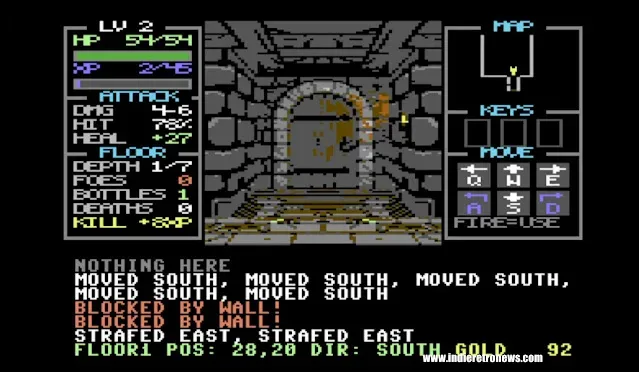
Lance's journey spans seven procedurally generated dungeon floors. This means the underground layouts are not simply presented as one fixed sequence of rooms and corridors. Instead, each descent can reshape the spaces players need to understand, explore, and survive. The game's floors range from tighter, maze-like chambers to much larger halls, creating a changing sense of scale as the warrior pushes deeper into the labyrinth.
That structure suits the traditional dungeon-crawler loop well. Exploration is not just about moving forward; it is about making decisions with incomplete information. A corridor may conceal a useful route, a guarded obstacle, or an area that costs valuable resources to investigate. When layouts are procedurally generated, learning the overall rules of the dungeon becomes more important than memorizing a single map.
For useful background on this topic, read Warlock Brings Handcrafted Fantasy Slashing to Commodore 64.
For a Commodore 64 game, the promise of a first-person 3D view also gives the exploration a different character from top-down action adventures or side-scrolling platformers commonly associated with the system. The player sees the world through Lance's perspective, emphasizing passages, doors, chambers, and the uncertainty of what might be immediately ahead. The dungeon itself becomes the focus: an environment to be read, navigated, and gradually conquered.
Keys, Doors, Potions, and Gold
Labyrinth of Ur's objectives are built around familiar but effective dungeon-delving essentials. Lance carries a sword for confronting the dangers in his way, while colored keys are needed to open corresponding doors. Those doors are heavily guarded, so finding a key is not necessarily the end of a problem. It can instead be the beginning of a new challenge, requiring the player to decide how and when to advance.
Healing potions are another vital part of the expedition. In an underground crawl where progress depends on surviving multiple floors, recovery items naturally become valuable. Players will need to scavenge for potions while continuing to search for keys and routes through the maze. The available details do not specify a broader inventory system, enemy roster, or combat mechanics beyond Lance being armed with a sword, but the stated design makes clear that health management is intended to matter.
Gold serves as an additional incentive to investigate the dungeon thoroughly. Hoards can be collected during the journey, and the amount gathered contributes to the player's final rank on the victory screen. That gives treasure more purpose than decoration: reaching the end is important, but how efficiently and completely the labyrinth has been plundered can affect the result.
This ranking approach fits the arcade-minded and replayable spirit often found in retro games. A player who survives a run may still have reason to descend again, seeking a better haul and a stronger finishing performance. Since the floors are procedurally generated, another attempt is positioned to offer a new arrangement of spaces even as its core goals remain recognizable.
A Genre Built on Tension and Orientation
First-person dungeon crawlers have long relied on the tension between limited visibility and deliberate exploration. Their worlds often turn simple elements into meaningful obstacles: a closed door, a branching hall, a needed key, or the decision to spend a healing item can all shape a run. Labyrinth of Ur leans into that tradition by making colored locks, guarded passageways, healing supplies, and treasure gathering part of its central structure.
The references to Dungeon Master and Eye of the Beholder establish the kind of experience Ursimon is pursuing. Both are closely associated with navigating enclosed fantasy dungeons from a first-person perspective, where positioning, mapping, resource awareness, and careful movement are as important as combat. Labyrinth of Ur does not need to replicate every system from those classics to inherit their appeal. Its seven descending procedural floors, lone protagonist, sword, keys, potions, and score-focused gold collection point toward a more focused take on the same foundational fantasy.
There is also a useful contrast in having one named warrior, Lance, rather than an explicitly described party of adventurers. The premise frames the descent as a solitary ordeal. Without companions mentioned in the game's setup, every locked door and looming hall becomes part of one fighter's personal push through the underground. That can make the journey feel more immediate: there is no larger group to fall back on, only the player's navigation and the resources found along the way.
Built for Base PAL Commodore 64 Hardware
The Commodore 64 remains a popular platform for contemporary homebrew development, but its age and technical constraints continue to make ambitious new projects noteworthy. Labyrinth of Ur has been written in C from the ground up for unexpanded PAL machines. PAL compatibility is significant because Commodore 64 software can be shaped by differences between PAL and NTSC systems, including timing and display behavior. Here, the stated target is specifically the unexpanded PAL configuration.
Developing a first-person 3D dungeon crawler within that environment involves working inside a limited hardware profile rather than assuming modern memory, processing, storage, or graphics resources. The game's feature set is therefore notable not because it attempts to imitate modern high-detail 3D, but because it adapts a perspective-driven dungeon experience to classic 8-bit hardware.
AI assistance is also part of the project's stated development story. That does not change the game's platform target or its retro design, but it makes Labyrinth of Ur an example of modern development tools being applied to a machine from the 1980s. The combination is unusual in a productive way: a contemporary workflow element sits alongside an effort to make a game run on an unexpanded PAL C64.
Labyrinth of Ur centers its challenge on descending through seven shifting dungeon levels, staying alive with the help of healing potions, opening color-coded routes, and collecting enough gold to improve the final victory rank.
Why Procedural Design Matters Here
Procedural generation is particularly well suited to a labyrinth theme. A fixed dungeon can reward mastery through memorization, while a generated dungeon asks players to master navigation principles instead. They may learn to prioritize keys, conserve healing, search for gold, and approach guarded doors with care, but they cannot rely entirely on remembering an exact room sequence from a previous attempt.
That is a strong fit for a game designed around a final rank. The player's success can be measured not merely by whether Lance gets through the seven floors, but by how much wealth he carries into victory. A changing dungeon layout can keep that pursuit from becoming routine. Some expeditions may make treasures easy to reach, while others may place valuable finds behind longer or more hazardous routes. The available information does not define the exact generation rules, so how dramatically runs differ remains to be seen, but the procedural format gives the game a natural replay hook.
It also strengthens the atmosphere implied by the title. A labyrinth should feel difficult to fully know. Even in a game with a clearly defined number of floors and straightforward goals, uncertainty is part of the appeal. Players are not simply completing a checklist; they are descending into an underground space that must be explored on its own terms.
An Old-School Descent with a Modern Development Angle
Labyrinth of Ur has a clear pitch for Commodore 64 enthusiasts and dungeon-crawler fans alike. It is a newly made game for original-style PAL C64 hardware, it uses an iconic first-person maze format, and it structures its adventure around procedural floors rather than a single fixed dungeon. The result is a concept rooted in classic computer role-playing traditions while also carrying an unmistakably contemporary development detail through its AI-assisted creation.
Players will take Lance from cramped passages into vast halls, collecting colored keys to move beyond locked doors, looking for healing potions to stay alive, and gathering gold to improve their standing at the end of the descent. With seven generated levels standing between the warrior and victory, Labyrinth of Ur is shaping up as a compact but potentially repeatable C64 excursion into dark fantasy dungeon crawling.
Community
Discussion
Start the conversation.
No comments have been posted yet.