

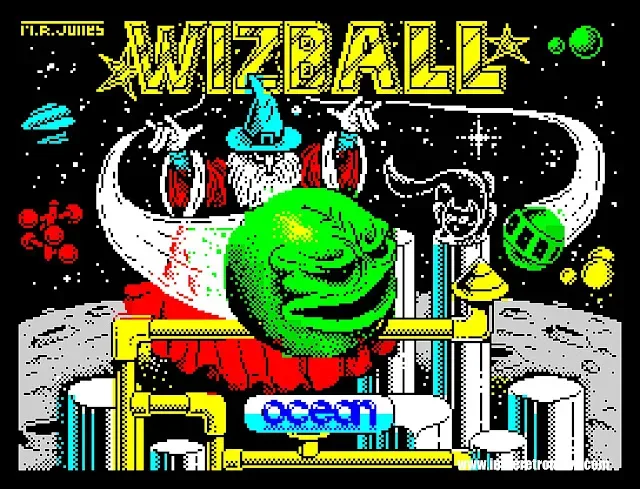
Wizball Enhanced Edition has been launched by Gravious for the ZX Spectrum 128K, giving one of the Spectrum era's most distinctive arcade shooters a carefully revised return. The new edition revisits the 1987 game created by Jon Hare and Chris Yates at Sensible Software and originally published by Ocean, while preserving its unusual premise, scrolling action, and colourful restoration mechanic.
The release is more than a straightforward reissue. Gravious describes it as a fully decompiled and bug-fixed edition that restores material removed from the original release. It also includes gameplay balancing changes and modern quality-of-life additions. The result is intended to make the old game more complete and more convenient to play, whether it is being loaded through emulation, a flash cartridge, or original Spectrum hardware.
A surreal shooter with a mission to restore colour
Wizball remains an especially memorable game from the 8-bit period because its premise is not limited to simply clearing waves of enemies. Players take control of Wiz, a bouncing green sphere sent to stop the villain Zark. Zark has drained colour from the world, leaving its stages in a monochrome state. The objective is therefore both destructive and restorative: battle hostile creatures while working to return colour to each area.
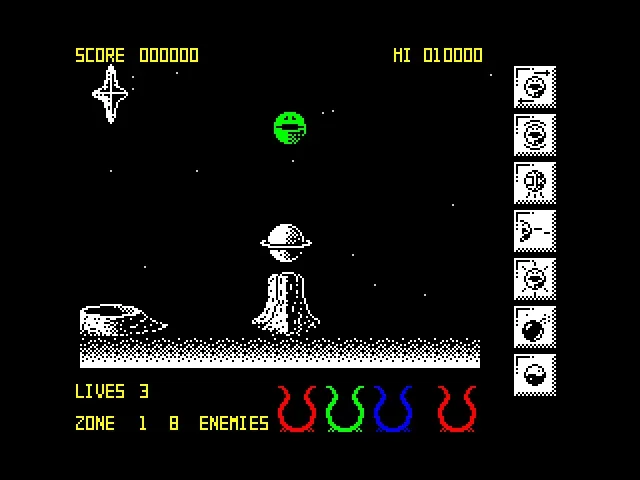
The game plays as a horizontally scrolling shooter, but its central character and systems lend it a far stranger personality than the genre's more conventional spacecraft-led games. Wiz moves through a surreal environment, firing on bizarre enemies and collecting power-ups that are vital to making progress. The bouncing movement and the game's visual identity are inseparable from its appeal, creating an arcade experience that feels deliberately unlike a typical military or science-fiction shooter.
For useful background on this topic, read Stranger Than Heaven Pushes Like a Dragon Into a Harder, More Personal Era.
Colour recovery is handled with help from Catellite, Wiz's feline companion. Catellite gathers coloured droplets, supporting the effort to bring life back to the otherwise drained landscape. That partnership is one of Wizball's defining ideas: success involves more than surviving enemies and shooting accurately. Players must also understand the role of the companion and the collection systems that drive the restoration of each world.
That blend of fast action, unusual movement, companion-based collection, and visual transformation has helped the game retain a following long after its original arrival. Its world begins without colour, but the player's progress changes the appearance of the environment. In a genre commonly focused on score chasing and enemy patterns alone, that visual payoff gave Wizball a distinct sense of purpose.
What the enhanced edition changes
Gravious' version is built from a full decompilation of the original game. That work has enabled bugs to be addressed and cut content to be reinstated. For a title with roots in 1987, restoration is particularly notable: the new release is not presenting itself merely as a repackaged archive file, but as an effort to revisit the original software and deliver a more complete edition for the Spectrum 128K.
The release also makes balancing adjustments. Precise details of every individual change have not been outlined, but the stated goal is to provide a more balanced play experience while retaining the core structure that made Wizball recognisable. That is a delicate task for an enhancement of a classic game. Difficulty, scoring, movement, and item systems can all shape how a shooter is remembered, so even modest revisions can have a meaningful effect on its rhythm.
In addition, the package includes quality-of-life features aimed at present-day players. These types of improvements can be important for retro software, especially when a game is used through emulators and modern loading methods rather than solely through its original retail format. The focus appears to be on reducing friction without removing the game's original identity or turning it into an entirely different project.
For returning players, the most interesting aspect may be the prospect of seeing content that did not make it into the 1987 release, alongside fixes to longstanding issues. For newcomers, the enhanced version offers an approachable route into a game whose concepts remain unusual even by current standards. The original's colourless setting, bouncing protagonist, feline helper, and power-up-driven play are all still at the heart of the experience.
Designed for both emulation and real hardware
Wizball Enhanced Edition is available as downloadable .z80, .tap, and .tzx files. Those formats provide several ways for Spectrum enthusiasts to use the release, rather than confining it to one setup.
- .z80: A format commonly used with ZX Spectrum emulators, offering a convenient option for players using contemporary computers and emulation software.
- .tap: A tape-image format suited to Spectrum loading setups and compatible tools.
- .tzx: A more detailed tape-image format that can be used for Spectrum software preservation and playback scenarios.
The available files mean players can use modern emulators, but the release is also suited to flash cartridge use. DivMMC is specifically identified as one such option, giving owners of compatible Spectrum setups a practical way to load the enhanced edition without relying on the original cassette distribution model.
There is also a particularly authentic option for owners of original ZX Spectrum hardware. The downloadable files can be recorded to a conventional cassette tape, allowing the game to be loaded on an original machine in a manner close to the way Spectrum games were commonly experienced during the 1980s. That option reflects the continuing appeal of the platform's tape-based culture, where loading software is part of the ritual as much as the game itself.
Support for emulation, flash-based loading, and cassette recording makes the project flexible without changing its target machine. This is firmly a ZX Spectrum 128K release, built for a community that ranges from players discovering the machine through software emulation to collectors maintaining functioning original systems.
Why this kind of revival matters
Classic-game enhancements can take many forms. Some are simple compatibility updates; others are entirely new interpretations that use an older engine or visual style. Wizball Enhanced Edition occupies a more preservation-minded middle ground. It returns to an existing landmark game, repairs defects, restores removed material, and introduces measured refinements while keeping the original design as the foundation.
That approach is especially valuable for games from the home-computer era. Many releases of the period were shaped by strict technical limits, development deadlines, and distribution constraints. When an enhanced edition can investigate the original program, correct faults, and restore omitted elements, it creates an opportunity to revisit a familiar game from a different angle. It does not replace the historical 1987 version; instead, it offers another way to experience the design on the hardware family for which it was known.
Wizball is also well suited to that treatment because its concept is so visually and mechanically specific. The task of returning colour to a world emptied by Zark remains immediately understandable, while the interaction between Wiz and Catellite gives the action a character absent from many scrolling shooters. Its systems ask players to manage combat and collection at once, and its transformation of the environment provides a visible record of progress.
For those who remember the original, Gravious' release offers restored content, fixes, and rebalanced play in a package that can still be loaded onto cassette for use on a real Spectrum. For players interested in exploring 8-bit design beyond the genre's most familiar names, it presents an opportunity to try a distinctive 1987 shooter in an updated form tailored to the ZX Spectrum 128K.
A new route back to Wizball
Wizball Enhanced Edition arrives as a respectful update rather than a replacement. The bouncing green hero, the threat posed by Zark, the bizarre foes, the power-up hunting, and Catellite's droplet collection all remain central. What changes is the condition in which the game can now be played: with bugs fixed, previously cut content restored, balance adjustments applied, and quality-of-life considerations included.
Its availability in .z80, .tap, and .tzx formats gives retro players a choice in how they return to the world of Wizball. They can run it through an emulator, use a DivMMC or similar flash cartridge arrangement, or record it to tape and let original hardware handle the experience. In every case, the aim is the same: bring a celebrated, eccentric Spectrum adventure back into colour.
Community
Discussion
Start the conversation.
No comments have been posted yet.