

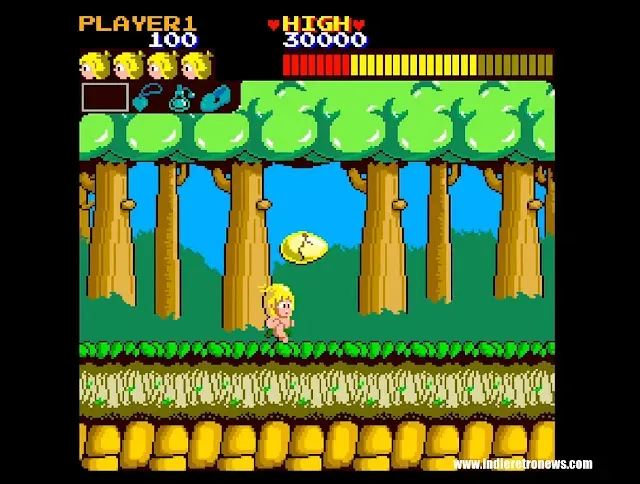
Wonder Boy, Sega's landmark 1986 arcade platformer, is heading back to two of the most beloved 16-bit-era machines. Developer ShinobiZ has created new versions for the Commodore Amiga and Sega Mega Drive, rebuilding the game in native 68000 assembly while aiming to retain the pace, rules, and distinctive personality of the original System 1 arcade release.
The project is notable not simply because it revisits a famous coin-op, but because it targets original hardware rather than treating those platforms as an afterthought. Wonder Boy's simple-looking run-and-jump action relies on relentless forward momentum, tightly timed jumps, quick enemy reactions, and a constantly declining vitality meter. Reproducing that feel convincingly on systems with their own graphics, memory, and audio constraints is a much bigger task than placing familiar sprites on a screen.
ShinobiZ describes the release as a rewrite built directly around the original Sega System 1 game logic, with AI assistance used during development. The stated goal is full arcade-speed performance, alongside faithful enemy behaviour, collisions, and score handling. Those are meaningful claims for a game where even minor changes in timing can dramatically affect how a stage feels, whether a skateboard section remains manageable, or whether an enemy can be cleared with the same practiced jump players remember.
Tom-Tom's Race Against Time
The core adventure remains intact. Players take control of Tom-Tom as he journeys through eight areas and 32 rounds in an effort to save his kidnapped girlfriend, Tanya, from the evil King. It is an immediately readable premise, but Wonder Boy's staying power has never rested on story alone. Its identity comes from the pressure created by its survival systems and from the way its colourful environments conceal demanding routes.
For useful background on this topic, read Street Fighter II's Bonus Stage Car Has Been Rebuilt, and One Fan Can Win It.
Tom-Tom's health steadily ticks away, making fruit pickups essential rather than decorative. Every banana, apple, carrot, mushroom, or other food item represents precious additional time. That design turns the game into a race even when no on-screen timer is dominating the display. Players must press forward, learn where supplies appear, and decide when it is worth risking a difficult jump for food or a higher-value item.
The familiar set of tools and hazards also returns. Tom-Tom can leap over obstacles, ride on a skateboard, and throw stone axes at enemies. Skateboard segments are particularly memorable because they change the rhythm of play: a mistake can become harder to correct once momentum carries the character toward an obstacle. The arcade game's mixture of direct controls and unforgiving consequences is a large part of why it remains such a recognizable platform game decades later.
There is also a goal for players who want more than a straightforward run to the ending. The port includes the original-style hidden doll hunt. Finding all 28 dolls unlocks the secret eighth area, giving experienced players a reason to revisit levels, investigate alternate paths, and sharpen their understanding of each round. In a game defined by repetition and mastery, that kind of concealed objective adds another layer beyond simply reaching the next checkpoint.
Two Versions, Built Around Their Hardware
Although the Amiga and Mega Drive releases share the same arcade foundation, they are not presented as identical builds with one soundtrack copied across both. Each version has music and sound effects tailored to its respective machine. On Mega Drive, the game uses the console's dedicated sound hardware; on Amiga, it makes use of the celebrated Paula audio chip.
That distinction matters to retro hardware fans. The Mega Drive and Amiga have very different sonic signatures, and each has inspired decades of discussion among musicians, programmers, and players. A port that acknowledges those differences has the opportunity to feel at home on both systems instead of sounding like a compromise designed around only one target. It also gives curious fans a reason to compare the two editions even if the gameplay remains closely aligned.
The Amiga version has a broad stated compatibility range. It is intended to run on OCS and ECS Amigas with Kickstart 1.3 or later and 1 MB of memory, split between 512 KB chip RAM and 512 KB additional memory. It also supports AGA machines, including the Amiga 1200 and Amiga 4000, through an enhanced mode. The game can boot from floppy disk, start through Workbench, or be installed to a hard disk, offering welcome flexibility for users with different setups.
For Mega Drive players, compatibility covers PAL and NTSC Sega Mega Drive or Genesis hardware. That includes original consoles and compatible setups, while emulation options named for the release include Genesis Plus GX, BlastEm, and MAME. On the Amiga side, WinUAE and FS-UAE are among the listed emulator choices. In practical terms, the project is aimed at both collectors maintaining vintage equipment and players who prefer to explore older software through contemporary emulation.
Arcade Conveniences Without Losing the Challenge
The new version includes several features that suit a home release while preserving the competitive arcade character of Wonder Boy. A complete demo mode is included, as is free play and a taking-turns multiplayer option. The latter is especially appropriate for a game rooted in the arcade era, recreating the social rhythm of passing the controller after a lost life and trying to outscore a friend.
High-score saving is also part of the package. Scores can be retained through cartridge memory on Mega Drive hardware or floppy disk on Amiga. That may sound basic by modern standards, but it is a valuable addition for a score-driven game. Persistent records encourage repeat attempts, friendly competition, and the long-term pursuit of cleaner routes through the game's many rounds.
An arcade settings menu further lets players adjust variables including starting lives and difficulty. Automatic PAL and NTSC detection is included as well. These options should be useful for anyone looking to approximate a particular arcade challenge level, while also giving newcomers room to become familiar with the game before committing to its harsher demands. The approach respects the original design without insisting that every player begin from precisely the same conditions.
A Fresh Take on a Frequently Revisited Classic
Wonder Boy has a complicated and unusually wide-reaching legacy. The original arcade game spawned sequels, regional adaptations, home conversions, and a family of related games that evolved in radically different directions. Its basic formula was influential enough to travel well, yet its exact arcade mechanics have remained a point of interest for preservation-minded developers. That makes a ground-up 68000-focused release for Amiga and Mega Drive especially intriguing.
There is already another route for Amiga players interested in the 1986 game. A version from developer Acidbottle, made with the Scorpion Engine, arrived in 2023. ShinobiZ's project therefore joins an existing scene of fan-driven efforts rather than filling a completely empty space. The coexistence of different versions is a reminder that retro development is not a single pursuit: some projects emphasize accessible modern tools, while others pursue low-level coding, specific technical approaches, or different interpretations of authenticity.
For this new release, the emphasis is firmly on reproducing the original arcade experience across two machines closely associated with the 16-bit generation. The combination of native assembly development, hardware-specific sound, configurable arcade rules, score saving, and compatibility with real systems gives it a strong preservation angle. At the same time, the options for demo play, multiplayer turn-taking, and easier configuration make it more approachable than a strictly archival build would be.
Ultimately, the appeal comes down to whether the port can capture Wonder Boy's deceptively sharp balance of momentum, memory, and pressure. The game asks players to keep moving, collect food before their vitality disappears, react instantly to hazards, and gradually turn difficult stages into familiar routines. If the promised speed and behaviour translate cleanly to both platforms, Tom-Tom's rescue mission could become a compelling new excuse to power up an Amiga or Mega Drive.
Community
Discussion
Start the conversation.
No comments have been posted yet.