

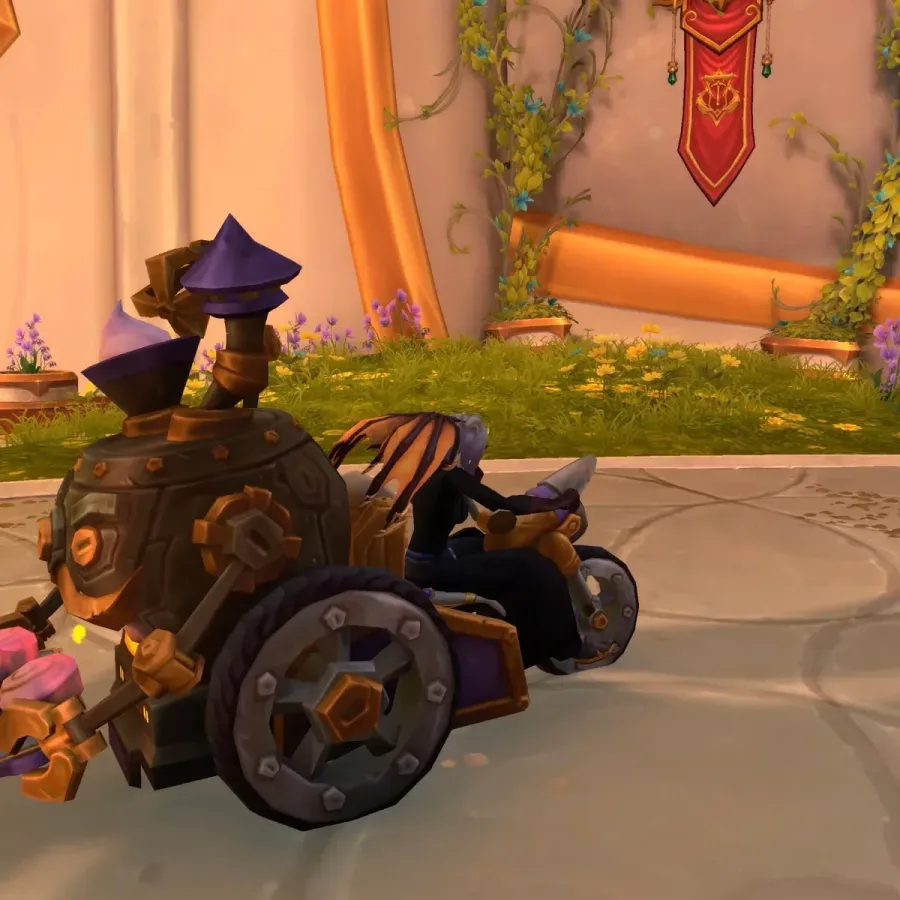
A Thanksgiving-themed tricycle mount would normally be a small, whimsical addition to World of Warcraft. Instead, the Hot Motocross Bunmover 4000 has become an unlikely focal point for a much larger argument about Retail WoW's current condition.
Added through the November Trading Post selection, the mount is designed as a compact tricycle with an oven fastened to its rear. It is a deliberately silly cosmetic item, fitting the seasonal tone of the Trading Post. But players quickly noticed that its wheels do not animate while moving. Worse, they appear to pass through the terrain, leaving the vehicle looking as if it is sliding across the ground rather than rolling over it.
On its own, that is the sort of visual defect that might usually draw a few jokes before being corrected in a later hotfix. In this case, though, the issue has arrived after months of complaints surrounding the updates that followed World of Warcraft: Midnight. For a vocal segment of the community, the Bunmover is not merely a broken novelty mount. It is an easily understood visual example of concerns that have been building around bugs, repeated activities, pacing, and the consistency of recent story developments.
A Small Cosmetic Problem With a Bigger Meaning
One widely shared Reddit screenshot brought the problem into focus, with user iamShorteh pointing out that the Bunmover's wheels remain in their faulty position permanently. The post framed the issue as "literally unplayable," a familiar joke for minor videogame defects. The replies, however, quickly moved beyond humor.
For useful background on this topic, read Andy Weir Sees AI as a Tool, but Wonders If Human-Only Writers Are Nearing Their End.
Community members connected the mount's broken movement to dissatisfaction with the broader Retail experience. One reply referenced Blizzard's eight-week patch schedule and questioned whether that cadence could really have no effect on quality. Another bluntly argued that the team no longer cares about Retail. Elsewhere, Reddit user Jocic asked how so many things could seem broken and argued that the update timetable alone no longer explained the issue.
The response is revealing because mounts are highly visible in World of Warcraft. Players spend enormous amounts of time traveling through hubs, zones, events, and group content, often on the same favorite cosmetic rewards. A mount that looks unfinished is encountered repeatedly, in public, and at a glance. It does not require a deep knowledge of class balance, raid design, or endgame systems to see what has gone wrong.
That visibility has turned the Bunmover 4000 into a kind of confectionary mascot for an already unhappy player base. It is an amusing object, but the reaction to it is serious: players see a basic presentation flaw on a newly introduced reward and wonder what it says about testing priorities across the game.
Midnight's Strong Start and the Harder Test After Launch
The frustration is particularly notable because Midnight did not begin under a cloud of universal negativity. At launch, the expansion received a positive reception, with praise directed toward its zones and the structure of its endgame loop. The early impression was that Blizzard had delivered a compelling foundation.
For an MMO, however, launch is only the beginning of the evaluation. Players do not judge an expansion solely on its opening campaign, first batch of dungeons, or initial raid tier. They also judge the rhythm and reliability of the patches that follow: whether activities evolve, whether stories feel earned, whether recurring systems stay fresh, and whether new rewards work properly when they arrive.
Critics of the current Retail cycle believe that follow-up patches have struggled in several of those areas. The fast flow of content has included invasions that some players feel are too similar to activities from earlier seasons. Complaints have also been directed at the writing, particularly in the current patch, where the death of a much-liked Horde character has been seen by some fans as abrupt and insufficiently developed.
Individual players will naturally disagree on story choices and the value of a given seasonal system. But the Bunmover episode has made it easier for those separate objections to merge into a single narrative. A wheel clipping through the ground cannot settle debates over writing or event design, yet it reinforces the perception that new material is reaching live servers before it has received enough refinement.
The Eight-Week Cadence Debate Returns
At the heart of many reactions is Blizzard's established eight-week patch cadence. The approach began during Dragonflight as an answer to one of World of Warcraft's longest-running problems: lengthy content gaps between major updates. For years, players had criticized expansions that seemed to go quiet for extended stretches, especially late in their life cycles.
The appeal of a steadier schedule is clear. Regular patches give players reasons to return, sustain momentum between larger releases, and make the world feel actively maintained. They can also offer more frequent narrative beats, rewards, events, and adjustments. In principle, this is a player-friendly response to the droughts that had defined some earlier periods of the game.
Yet consistency of timing is not the same as consistency of quality. The current criticism is that the schedule may be exerting too much pressure on the teams building and testing each update. If every patch must hit a narrow window, there may be less room to delay a feature that needs additional work, revise content that feels overly familiar, or ensure a cosmetic reward has basic animation behavior in place.
That conclusion has not been officially established by the Bunmover bug alone, and no single defect can prove why it happened. Software problems can emerge for many reasons. Still, perception matters in a live-service game. When players encounter repeated bugs or content they regard as recycled, a visible error in a new Trading Post item can make existing doubts feel validated.
The debate has also spread beyond Reddit. Windows Central executive editor Jez Corden shared video of the mount and described Blizzard as having "phoned it in" with Retail World of Warcraft. Such reactions are not a definitive measure of the entire player base, but they show how rapidly an easily demonstrable bug can travel once it fits an existing community concern.
Why a Slower Approach May Look More Appealing
The timing of the backlash is especially interesting because World of Warcraft Forever is approaching its November 4 release. Developers associated with that Classic+ mode have indicated that it will use a slower update schedule. That does not automatically mean slower updates are inherently better, nor does it guarantee that Forever will avoid technical or design issues. It does, however, establish a meaningful contrast with Retail's current pace.
A slower cadence can give a team more time for polish, iteration, and testing. It can also permit content to remain in development until it better meets expectations. The trade-off, of course, is that players may face longer waits and less frequent novelty. World of Warcraft's history shows that content droughts can be just as damaging to enthusiasm as rushed releases.
The challenge is not simply to choose between rapid patches and slow patches. It is to find a release rhythm that supports both dependable updates and the level of finish players expect from a game with World of Warcraft's scale and history. For Retail, that may mean reassessing which kinds of content truly need to arrive every eight weeks, which features need more testing time, and where repetition is beginning to wear down seasonal enthusiasm.
Retail Has Endured Difficult Eras Before
Despite the intensity of the current conversation, World of Warcraft has survived much worse periods of player dissatisfaction. Warlords of Draenor and Shadowlands both faced major criticism in their respective eras. Retail continued through those lows, even with the launch of WoW Classic occurring shortly before the latter expansion's release.
That history does not make present complaints irrelevant. If anything, it illustrates the resilience of the game and the importance of responding when patterns of dissatisfaction become clear. Players criticizing the Bunmover are not necessarily declaring that Retail is beyond recovery. Many are arguing that the current direction needs adjustment before the gap between quantity and quality becomes more pronounced.
There is also a difference between a game being fundamentally doomed and a game needing a course correction. Retail has a vast audience, years of accumulated systems, and an established ability to evolve. The immediate question is whether Blizzard treats the reaction as a brief flare-up around a funny mount bug or as feedback about a wider loss of confidence in the patch pipeline.
A Tricycle That Needs to Roll
The Hot Motocross Bunmover 4000 is, in the end, a very small part of World of Warcraft. It is not a raid, a new zone, or a major class redesign. It is a seasonal cosmetic built around a tricycle and an oven. But it has landed at a moment when many players are already scrutinizing how Retail content is made and delivered.
Fixing the wheels would address the immediate issue. Rebuilding player confidence will require more: cleaner patches, content with a stronger sense of purpose and variety, and stories that feel carefully prepared rather than rushed toward the next beat. As World of Warcraft Forever prepares to open its doors, Retail's noisy little oven-trike has become a reminder that even the smallest rough edge can carry outsized weight when the community is already asking whether the game's current pace is sustainable.
Community
Discussion
Start the conversation.
No comments have been posted yet.