

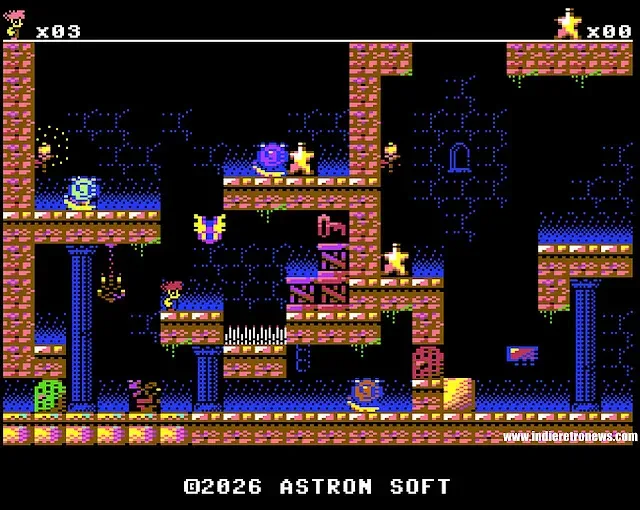
Commodore 64 players have another original platforming adventure to watch in Zezito and the Lost Stars, an upcoming game from developer Iapetus. Built for Commodore's enduring 8-bit home computer, the game follows a deceptively simple but wonderfully storybook-like mission: recover the stars that have disappeared from the night sky before darkness loses its shine.
A playable demo is already available, offering a meaningful early look at the adventure. Rather than serving as a tiny technical sample, the demo includes 36 of the game's missing stars to find, giving retro fans a substantial slice of its castle-bound platforming challenge while they wait for the complete release.
A castle break-in for the sake of the sky
The premise of Zezito and the Lost Stars begins with Malandra, a witch who has locked away 99 stars inside her castle. With those stars gone, the night sky is in danger of becoming a far less magical place. It is up to Zezito to put things right and return every stolen light to its proper place.
Fortunately for Zezito, Malandra has temporarily left her home to attend the annual general witch meeting. That absence creates the opening for the game's central act of heroism: sneaking into her castle, searching its rooms, and reclaiming every last star before the night is stripped of its sparkle for good.
For useful background on this topic, read Pitfall II: Lost Caverns Is Being Rebuilt for Commodore Amiga OCS Hardware.
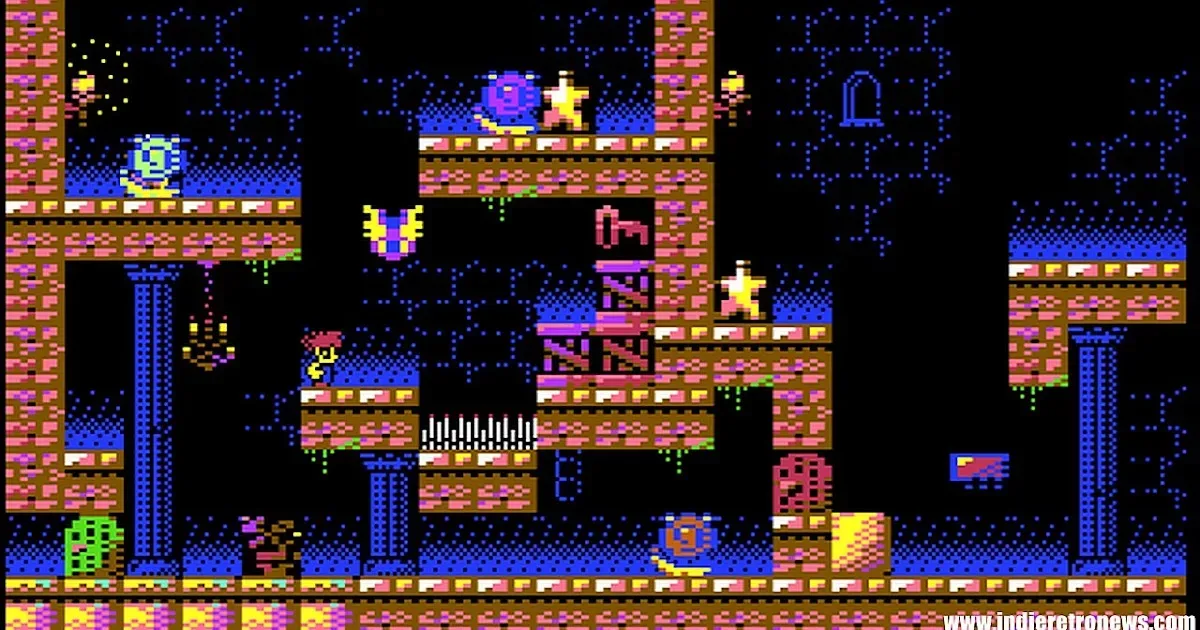
That does not mean the castle is unguarded. Malandra may be away, but she has left troublesome creatures behind. Zezito will need to navigate past swarms of wild bats and hazardous spiked snails during the search. The setup gives the game a clear platformer structure, pairing collectible hunting with enemy avoidance in a setting that sounds tailored to compact, replayable C64 stages.
36 stars to collect in the demo
The currently playable demo contains 36 of the 99 stars from the full quest. That number is notable because it suggests the preview is more than a brief first level or a visual teaser. Players can begin learning how Zezito moves through the castle, get a sense of the enemy threats, and take on a sizable portion of the wider star-recovery objective.
For classic platformer fans, a star total also provides an immediate reason to explore and replay. Collectible-driven games often invite players to weigh safe routes against riskier detours, especially when hazards stand between the player and a desired item. The available details do not specify the game's level count, save system, scoring rules, power-ups, or the exact mechanics used to overcome its enemies. Still, the promise of 36 recoverable stars indicates that the demo gives players a concrete goal beyond simply reaching an endpoint.
That approach fits the Commodore 64 especially well. The machine's game library remains celebrated for direct arcade-style design, demanding platform challenges, memorable music, and a willingness to let players improve through repeated attempts. A focused objective such as rescuing stars from a witch's castle can make an immediate impression without requiring an elaborate setup, while the total of 99 lost stars gives the full game a satisfying overarching purpose.
An original game for enduring C64 hardware
Zezito and the Lost Stars is part of the long-running modern homebrew and independent development scene surrounding the Commodore 64. Decades after the system's original era, developers continue to create new games that work within, and often creatively push against, the limits of its hardware. New C64 releases come in many forms, from cartridge projects and disk releases to downloadable editions intended for use with original machines or compatible setups.
What makes announcements like this appealing is not merely nostalgia. New retro games offer developers the opportunity to build around a tightly defined platform, where visual readability, level layout, responsive controls, and sound all need to serve the experience efficiently. For players, that can mean games with a strong identity and little excess: a character, a goal, a set of hazards, and an increasingly demanding series of obstacles.
Iapetus has also stated that the project is not being developed with AI assistance. That is a specific point of interest at a time when discussions around the use of generative tools in creative work have become increasingly prominent. In this case, the developer is presenting Zezito and the Lost Stars as a traditionally made project, with its own handcrafted platforming adventure at the center.
A lighthearted premise with classic platforming stakes
The game's story has a cheerful fantasy angle, but the stakes are easy to understand. The stars are gone, the sky needs them back, and the only path forward runs through the castle of the witch responsible. Zezito's decision to act while Malandra is away adds a playful sense of mischief to the quest. He is not confronting the witch directly, at least based on the information currently available; he is taking advantage of a rare window to undo her work.
Bats and spiked snails make for recognizable platforming dangers, but they also fit the atmosphere. Bats naturally belong in a dark castle, while snails equipped with spikes turn a normally harmless creature into a clear obstacle. Their inclusion should help communicate danger at a glance, something particularly important in games designed for quick reactions and compact screen space.
There is no confirmation yet of whether the final game will introduce further enemy types, boss encounters, additional environments beyond the castle, or new abilities for Zezito. The available announcement concentrates on the star-saving premise, the witch's castle, and the demo's 36-star selection. That leaves room for players to discover how broad the final journey becomes when it arrives.
Why the demo matters
Demos remain valuable for retro projects because they let a game prove itself on the strength of its fundamentals. Screenshots and descriptions can establish a mood, but platformers ultimately depend on how they feel in motion. Players need to see whether jumps are readable, whether hazards create fair challenges, how collectible placement encourages exploration, and whether the game's audiovisual character holds together during play.
With 36 stars included, the Zezito and the Lost Stars demo can also help establish the rhythm of its progression. A player who begins with a simple rescue objective may gradually find that the harder-to-reach stars demand more confidence, more accurate movement, or a better understanding of the castle's dangers. Even without further mechanical specifics, the collectible count suggests a demo designed to give prospective players time to engage with the game rather than merely sample its opening moments.
For developers working in the C64 space, a public demo can additionally build interest among players using different kinds of hardware. Some will approach it on original Commodore 64 equipment, while others may use modern-compatible systems or emulation. The important part is that the game is being made for the C64 and is inviting the community to try an early portion before the full adventure is ready.
What to expect from the full adventure
The full version of Zezito and the Lost Stars is planned to arrive soon, although no precise release date, price, distribution format, or additional platform availability has been announced. At present, the confirmed focus is Commodore 64, and the clearest way to experience the project ahead of launch is through its playable demo.
Players interested in fresh software for classic hardware should keep an eye on Zezito's mission. Its central idea is immediately appealing: break into a witch's castle, evade bats and spiked snails, and bring 99 stolen stars back to the sky. The demo's 36-star offering should provide a generous introduction to that goal, while the remaining stars give the forthcoming full release a clear reason to look forward.
In an era when huge maps and long feature lists often dominate game announcements, a carefully focused 8-bit platformer can stand out through charm, clarity, and purposeful design. Zezito and the Lost Stars appears to be aiming for exactly that kind of appeal. Its night-sky rescue story, castle setting, and collectible-driven demo make it one of the more inviting new projects on the Commodore 64 horizon.
Community
Discussion
Start the conversation.
No comments have been posted yet.