

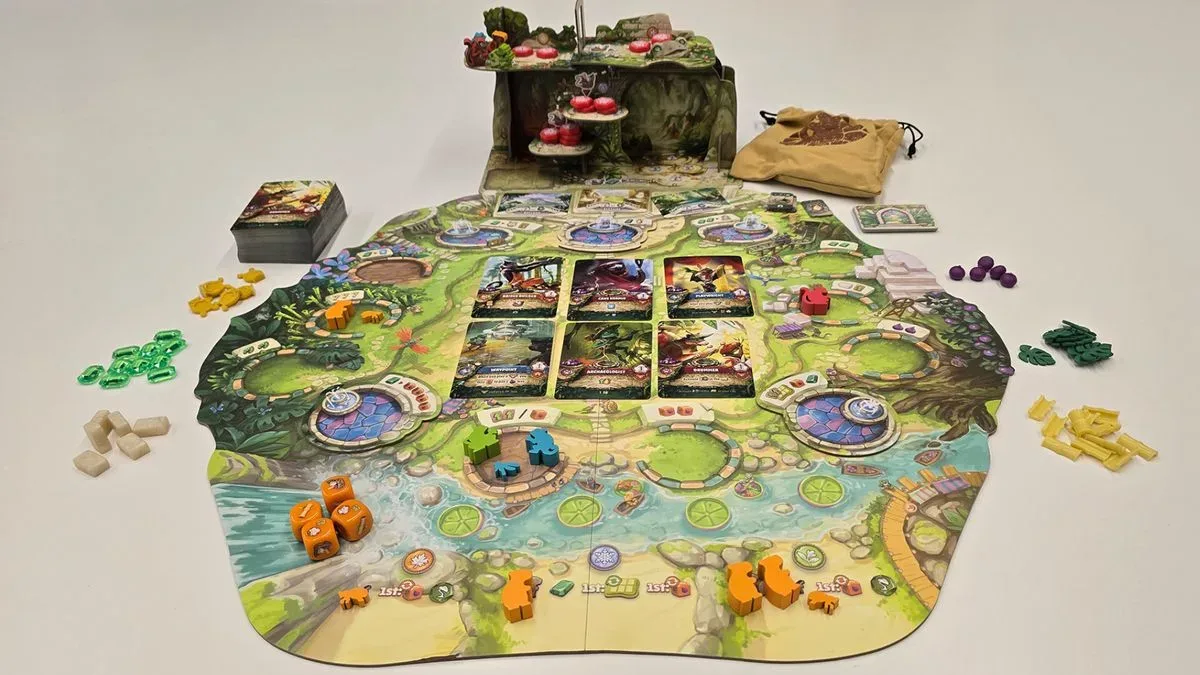
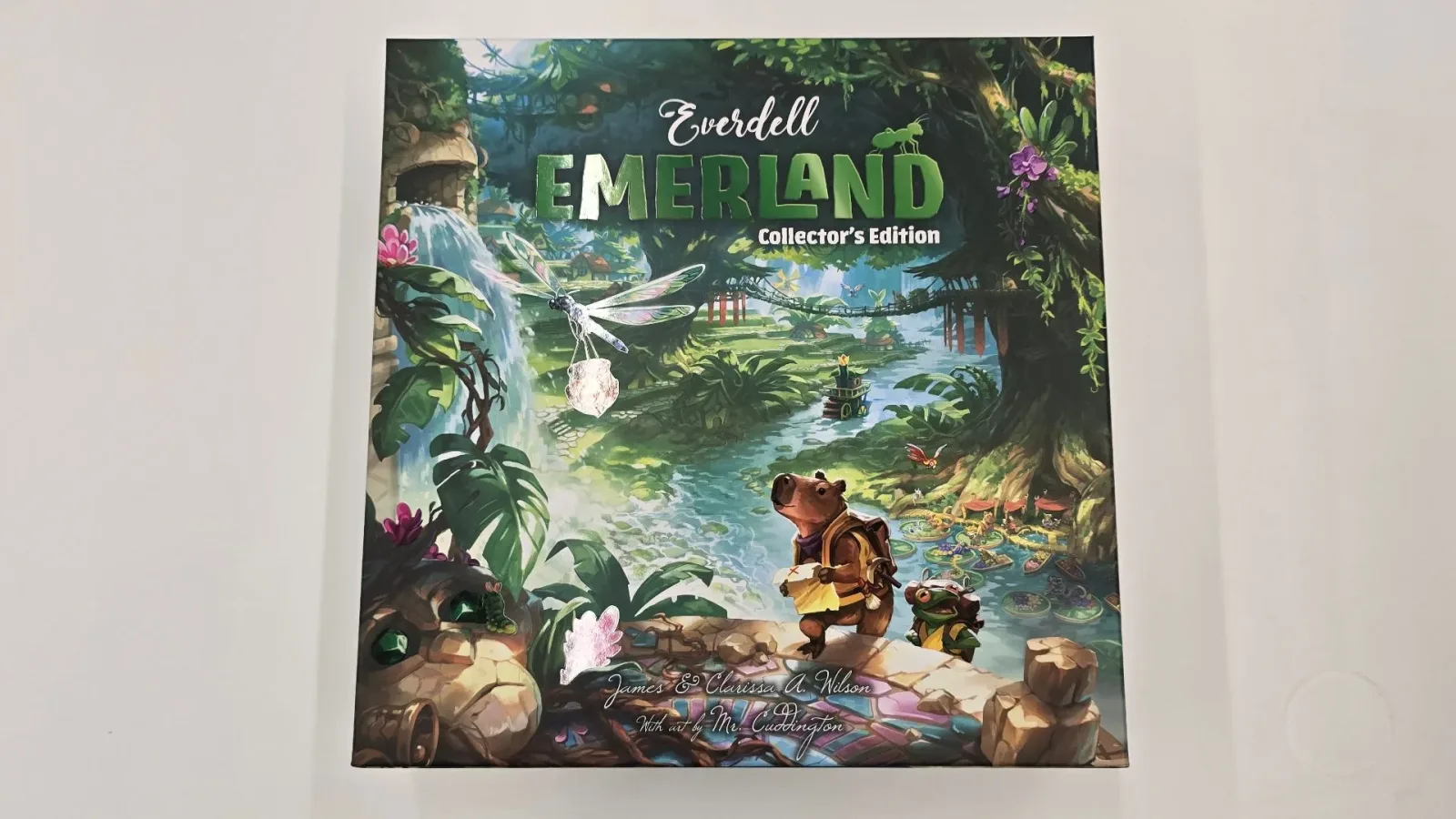
Emerland is not merely Everdell with a different backdrop. This standalone jungle-themed strategy game keeps the familiar pleasures of gathering resources, deploying workers, recruiting charming animal citizens, and assembling a high-scoring city. Yet it also reshapes that foundation with enough new systems to make each turn feel newly charged with possibility. It is a thoughtful expansion of an established design rather than a cosmetic reskin, and it gives experienced Everdell players a strong reason to return to this style of woodland-and-wilderness city building.
At its best, Emerland preserves the approachable appeal of its predecessor while widening the strategic space around it. New helper pieces alleviate the occasional frustration of blocked locations. The ruins offer an alternate route toward endgame points. Double-sided cards and upgrades ask players to think further ahead. Meanwhile, a flatter centerpiece option solves a small but meaningful practical annoyance that can affect whether a game reaches the table at all.
There are a few rough edges, particularly in the relationship between Artisan cards and upgrades, and the growing menu of actions can slow down players prone to overthinking. Still, Emerland's additional layers usually feel purposeful. This is a deeper, more flexible take on Everdell's formula, not a replacement that loses sight of why that formula worked in the first place.
A familiar city-building engine, now in the jungle
Emerland supports one to four players, is recommended for ages 10 and up, and generally lasts from 30 to 120 minutes depending on player count and decision speed. Designed by James Wilson and Clarissa A. Wilson and published by Tycoon Games, it sits in the moderate-to-high complexity range. It should particularly appeal to players who enjoy Everdell, Wingspan, and strategy games where seemingly modest early decisions create powerful combinations later.
For useful background on this topic, read Pokémon Card Convention Videos Spark Backlash Over Puppy Trade Offers.
The fundamental rhythm remains recognizable. Across rounds represented as seasons, players place workers at locations to collect resources, acquire useful effects, and develop their personal city. Those resources are spent to construct buildings and recruit Critters, with the cards in each player's town forming the primary engine for generating benefits and scoring points. Workers can also visit cards in other players' cities, creating interaction without turning the game into an openly hostile contest.
That balance is one of the series' most attractive qualities. Competition matters because desirable spaces can be occupied before an opponent reaches them, but the game does not rely on direct attacks or destructive take-that effects. Emerland continues that approach. It asks players to adapt to the evolving board and anticipate what others may need, while leaving room to pursue their own plans rather than constantly defend against sabotage.
Special Realm cards take the place of event cards, providing ways to expand the number of buildings or townsfolk that can be brought into a city. This helps frame Emerland as its own game rather than a simple remix. The core objective remains familiar, but the paths available to a flourishing settlement have shifted.
Bug helpers make crowded spaces more interesting
The most immediately memorable new system is the collection of smaller bug helper meeples available to each player. Alongside the main wooden animal workers--capybaras, tree frogs, chameleons, and monkeys--players have color-matched beetles, caterpillars, dragonflies, and ants. They are delightful components, but their importance is far greater than decoration.
A helper paired with a regular worker can double the goods received from a location. More importantly, helpers can be used to access a space another player has already occupied. By placing a bug for each player already present at that spot, a player can negotiate their way into the location and gain its benefit despite the crowd.
This is an elegant answer to one of worker placement's recurring tensions. In many games, losing access to a key location can derail a carefully timed turn. Emerland does not remove that tension entirely, because bypassing an occupied space costs valuable helper pieces, but it prevents a blocked location from becoming a complete dead end. Players gain flexibility while still having to decide whether a particular action is worth the extra expenditure.
Helpers also increase as the seasons progress, much like the regular workers. That creates another resource to manage. Spending bugs early may provide a major burst of materials or save a turn, but it can leave fewer options for contesting powerful locations later in the season. The result is more freedom without a loss of consequence. This is a strong example of Emerland adding choice while respecting the appealing structure of Everdell's worker-placement design.
Ruins, upgrades, and more ways to plan ahead
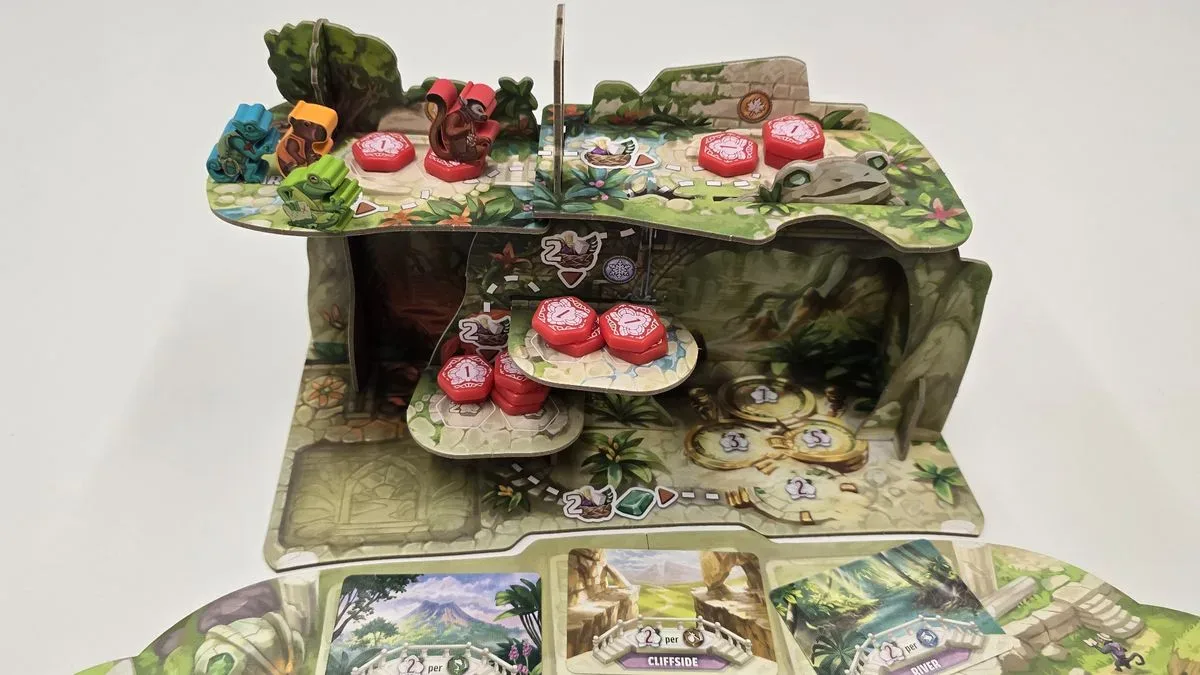
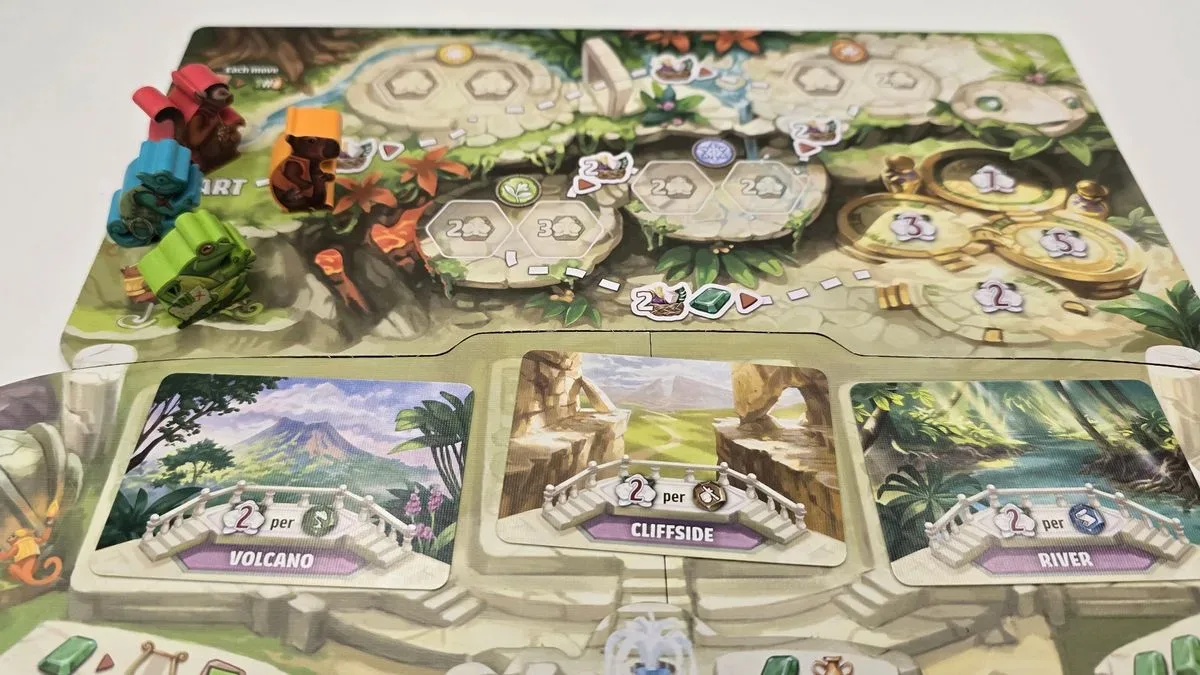
The jungle setting introduces mysterious ruins, a separate area that can be explored by using an action. Advancing through the ruins uncovers artifacts that can award a variety of endgame points. This track supplies another strategic consideration beyond simply constructing the most efficient card engine. A player may decide that investing actions in exploration is more valuable than competing for immediate resources, especially if their city already produces what it needs.
Emerland also makes several structural adjustments that initially appear restrictive. Hand limits drop from eight cards to six, while the starting city limit falls from 15 cards to 12. The central plateau no longer stacks common or unique Critters and Constructions in the same way, either; similar cards are presented as distinct options. These changes narrow certain possibilities at the outset, but they are offset by other new mechanisms and tend to make choices more pointed rather than simply more limited.
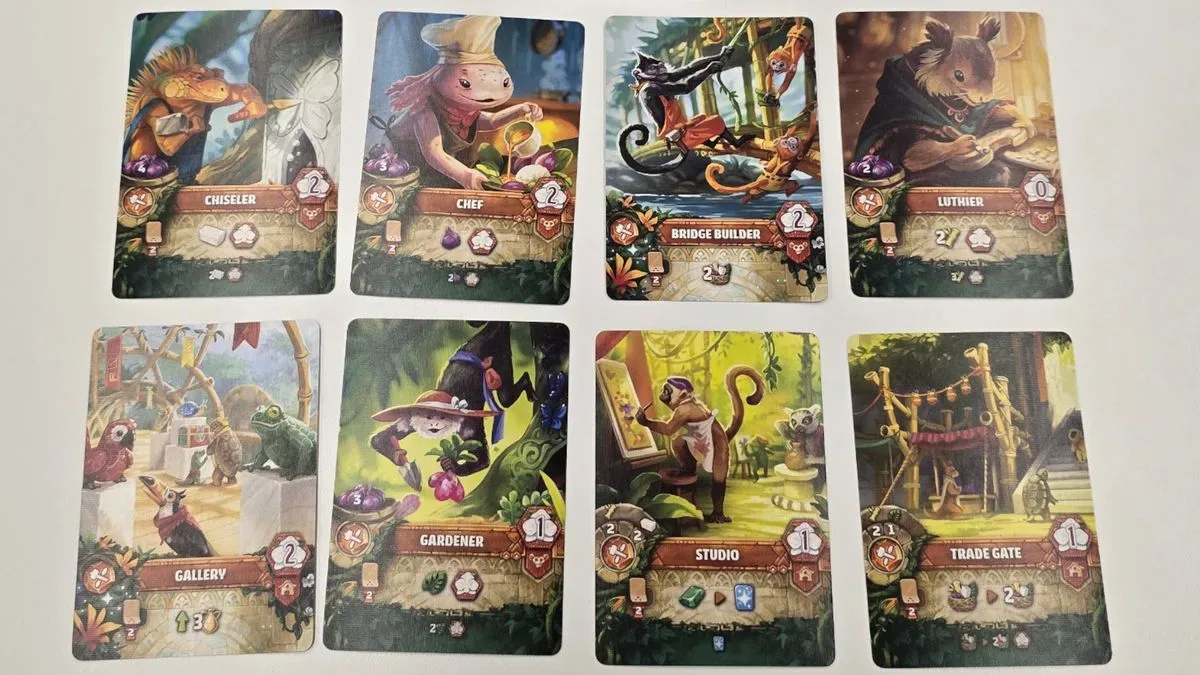
Every card is double-sided, with an enhanced version offering a stronger effect. The game's new upgrade system therefore adds timing questions to card play. Is it better to establish an effect now, or wait for an opportunity to make it more powerful? Can an upgraded card become the centerpiece of a larger engine? These are meaningful decisions in a game already built around sequencing cards and resources efficiently.
Artisan cards, a new orange card category, offer benefits when other cards are tucked underneath them. In concept, this is a welcome addition that creates another way to convert cards into value. In practice, the interaction with upgrades is the game's least satisfying element. Upgrading an Artisan does not clear the cards already tucked beneath it, nor does it provide additional tuck slots. That makes using the un-upgraded side feel less appealing, because it can be difficult to justify committing cards to a version that may later become inconvenient. Allowing players to remove a tucked card when upgrading, or increasing the tuck capacity, would have made the system feel more naturally connected.
More actions mean deeper turns--and slower ones for some groups
Emerland is notably more involved than the original base game. Where the earlier design generally centers on placing a worker, playing a card, or preparing for a new season, Emerland offers six possible action types. Players may place a worker with or without a helper, send a helper alone, play a card, tuck a card beneath an Artisan, explore the ruins with an archaeologist, or prepare for the next season.
This greater breadth is largely a virtue. It is possible to remain productive after the main workers have been placed, and there are more opportunities to recover from an imperfect draw or a contested board. The game gives players several avenues to pursue a strategy instead of requiring a single narrow route.
However, the added options also bring a clear warning for groups affected by analysis paralysis. A crowded board, a hand of six cards, possible upgrades, helper costs, Artisan decisions, and the ruins can make a turn surprisingly dense. Emerland is not in the same heavy strategic category as Brass: Birmingham, but it demands more consideration than casual gateway games such as Catan. Groups that prefer quick, instinctive turns may find its growing decision tree a little intimidating. A timer can be a useful tool for maintaining momentum when necessary.
A centerpiece that respects setup time
Emerland's ruins serve as the game's signature visual centerpiece, but one of its best practical decisions is that they are available in both a three-dimensional and flat-board form. The 3D option looks impressive on the table and continues the series' flair for presentation. The flat version, though, may be even more valuable for regular play.
Elaborate table presence is often appealing, yet it can create setup and teardown chores that discourage a game from being selected on a busy evening. Offering a simple flat alternative means Emerland can retain its visual identity without requiring players to construct and dismantle a decorative object every session. It is a small quality-of-life feature with a large impact on accessibility, especially for players who want a substantial strategy game that can still be set up with relatively little fuss.
Who should explore Emerland?
Emerland is an easy recommendation for established Everdell fans. It offers the familiar satisfaction of developing a personal city full of interlocking effects, but the bug helpers, ruins, realms, and upgrade possibilities make the process feel fresh. Crucially, these additions do not dilute the original game's pleasant blend of competition and low-conflict planning. They enrich it.
Players looking for an accessible but tactical strategy game should also take note. Emerland has enough depth to reward experimentation and repeat play, while its adorable animal citizens and inviting jungle world soften the learning curve. It works best for people happy to consider several possible lines on a turn and willing to learn a moderate number of interacting systems.
Those entirely new to the series may want to begin with the original Everdell instead. Emerland does a good job explaining why the formula is worth expanding, but it is still the more complex version. Players seeking a straightforward, casual worker-placement game may find its added decisions excessive, particularly if their group already tends to deliberate at length.
Final takeaway
Emerland earns its place as a standalone Everdell game by making meaningful changes rather than relying on a new theme alone. The bug helpers are a standout innovation, preserving the tension of contested spaces while creating welcome tactical flexibility. The ruins and upgrade systems offer new strategic routes, the expanded action list gives players more ways to stay engaged, and the optional flat centerpiece is an unusually considerate touch for a game likely to see repeat play.
Not every experiment lands perfectly: Artisan cards could integrate more gracefully with upgrades, and the expanded decision space will not suit every table. But Emerland consistently understands the appeal of its foundation. It remains a charming, satisfying engine-builder with smart worker placement at its heart, now equipped with more tools, more paths to points, and more reasons for longtime fans to venture back into its world.


Community
Discussion
Start the conversation.
No comments have been posted yet.