

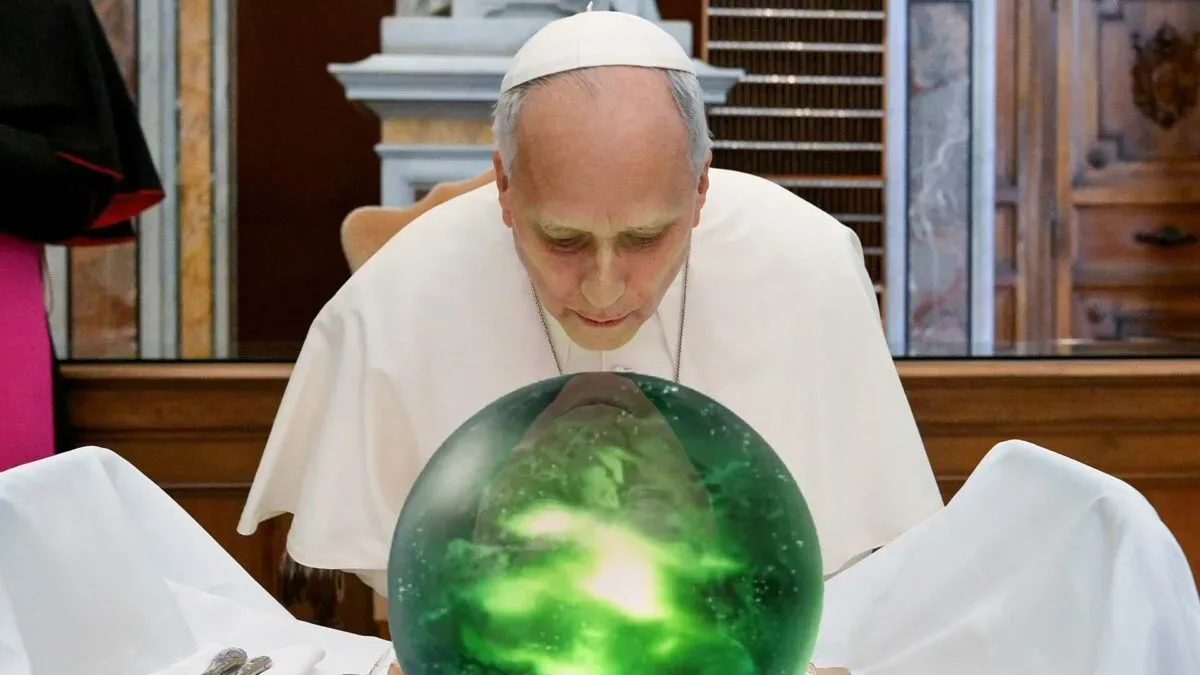
Pope Leo XIV has received an unusual cultural gift: a large green Murano glass sphere, hand-blown by artisans and presented as a reflection on humanity's place in an increasingly AI-driven world. It is a serious symbolic object with a serious intended message. It also looks, to a great many video game players, extraordinarily like a giant piece of Final Fantasy VII Materia.
The resemblance is difficult to ignore. In Square Enix's landmark role-playing game, Materia is generally depicted as rounded, glowing magical orbs that can be slotted into weapons and armor. Green Materia in particular is associated with magic, making the Pope's new sphere appear less like a ceremonial art piece and more like the kind of rare equipment a party member might discover after defeating a difficult boss.
That visual overlap has naturally invited affectionate jokes about what Pope Leo XIV might do with it. Is it Magic Materia? Which spell is stored inside? Should it be equipped to a weapon, passed to a cardinal, or held in reserve for an emergency? The answer, in reality, is considerably more grounded, but the gaming comparison has given an otherwise formal presentation a memorable pop-culture afterlife.
A Symbol of Human Craft in the Age of AI
The green sphere was brought to Pope Leo XIV by Saint Peter for Humanity, a Vatican-affiliated nonprofit organization. The group describes its broader purpose as preserving, promoting, and sharing humanity's cultural, spiritual, and material heritage for the common good.
For useful background on this topic, read Activision Puts the Video Game Cheat Economy at $8.5 Billion a Year.
Its gift was designed as a symbol rather than a game reference. The work is intended to emphasize the value of human creativity and human presence at a moment when artificial intelligence is becoming a central concern across art, work, media, education, and public life.
Olivier François, the head of Saint Peter for Humanity, explained the object's meaning in a video shared with Fox News. He described it as a Murano sphere made through hand-blown glasswork, with the human breath involved in its creation forming the core of its symbolism. A sphere may be an ideal, perfect form, but a handmade version carries the marks and slight irregularities that come from human labor.
The point is not machine-like precision. It is the idea that people can create things that are imperfect in technical terms yet richer, more expressive, and more beautiful because they are made by living human beings.
That distinction is central to the gift's message. Machines do not breathe, while a glassblower does. The breath that helps give the object its final shape is also a reminder that art can be personal, physical, and unpredictable. The green orb is therefore meant to stand for the human element that Saint Peter for Humanity believes must remain protected as new technologies advance.
Pope Leo XIV's Recent Focus on Artificial Intelligence
The timing of the presentation connects directly to Pope Leo XIV's recent writing on AI. In his encyclical Magnifica Humanitas, he addressed the relationship between technology and the human person, warning against allowing artificial intelligence to dominate humanity.
His argument was not framed as a total rejection of technology. Instead, Pope Leo called for AI to be "disarmed," using language that stresses the need to prevent systems and tools from taking control over human dignity, judgment, and life. Technology can have value, but it should remain in service to people rather than becoming a force that defines or diminishes them.
The hand-blown sphere is a compact visual expression of that idea. It is technologically simple, but it represents a long tradition of skilled craft. It is carefully made, but not designed around sterile uniformity. Its message is that human imperfection is not necessarily a flaw to be eliminated. In art, culture, and faith, it can be part of what gives an object meaning.
For gamers, though, the green color and orb-like form immediately point somewhere else: the world of Final Fantasy VII.
Why It Looks So Much Like Materia
Materia is one of the most recognizable systems in RPG history. Introduced in the original Final Fantasy VII and revisited through the Final Fantasy VII Remake project, the system allows characters to equip colored orbs that grant spells, summon creatures, add commands, or alter combat abilities.
The color of a Materia orb matters. Green Materia is tied to magic, giving characters access to offensive and restorative spells depending on the specific orb equipped. In practical game terms, that can mean fire, ice, lightning, healing, barriers, time magic, and other abilities. A glowing green sphere is therefore immediately legible to longtime players as something magical rather than merely decorative.
The exact spell represented by Pope Leo XIV's gift is, of course, not known because it is not actual Materia. But its handmade origin has led to one especially fitting fan interpretation: it could be Wind Materia.
Wind magic has been a recurring part of the broader Final Fantasy tradition, including spells such as Aero, Aerora, and Aeroga. Since the Murano sphere's symbolism is rooted in the breath of its maker, the association is almost too neat. If the object were translated into game logic, a hand-blown green orb would make an excellent home for air-based magic.
That said, Materia has never been solely about flashy attacks. The mechanic's deeper appeal is that it makes character customization feel tangible. A small object changes a fighter's role, expands the party's options, and represents accumulated potential. For a game series so concerned with memory, spiritual energy, the planet, and the consequences of powerful systems, it is unsurprising that players have found a thematic connection between the fictional item and an art object presented in an AI-focused discussion.
A Funny Image, but a Familiar Cultural Bridge
The image of a pope receiving what appears to be oversized Magic Materia is amusing because it brings together two visual languages that rarely meet: Vatican ceremony and Japanese role-playing game iconography. Yet the joke works because Materia itself has become a cultural shorthand far beyond its mechanics.
Players do not simply see a green glass sphere. They see inventory management, weapon slots, party setups, spell menus, and the question of which character should receive the best equipment. They remember the glow of Materia resting in a weapon, the sound effects of menu selections, and the strategic satisfaction of adjusting a build before a major encounter.
There is also a more unexpected thematic fit. Final Fantasy VII is famously concerned with the extraction and exploitation of planetary life energy. Its heroes live in a world shaped by giant corporate and technological systems, while the game repeatedly returns to questions of responsibility, ecological harm, community, and spiritual connection. Pope Leo XIV's concern that technology should not overpower humanity is not the same argument, but it shares a broad interest in ensuring power is directed toward human flourishing rather than unchecked control.
That does not turn the Murano sphere into an official Final Fantasy object, nor does it suggest that the presentation was intended as a gaming nod. It simply explains why the resemblance has been so immediately compelling. Fiction often gives people a vocabulary for reacting to real-world images, and few game objects are as instantly recognizable as a brightly colored Materia orb.
The Organization Behind the Gift
Saint Peter for Humanity positioned the work as an appeal for a human-centered approach to innovation. The organization's leadership has also attracted attention because its board includes prominent business and entertainment figures, including Kimbal Musk and television producer Mark Burnett.
Those connections have prompted skepticism and jokes alongside the warm reactions to the glasswork itself. Such reactions are separate from the stated symbolism of the sphere, which remains focused on handmade creation and the preservation of humanity in an age of artificial intelligence. The unusual combination of religious context, technology ethics, luxury craft, celebrity-linked leadership, and video game comparisons has ensured that the gift is being discussed from multiple angles.
For the gaming community, however, the most enduring takeaway may be much simpler: Pope Leo XIV was handed an enormous green orb that looks ready to be slotted into a Buster Sword.
No, It Is Not Cursed Materia
The online jokes have also gone in a darker direction, with some players playfully warning that the Pope should avoid equipping the sphere until its properties have been identified. That is a natural response from a fanbase trained by RPGs to be suspicious of ominous artifacts, mysterious crystals, and unusually powerful loot.
In reality, the orb is a symbolic piece of Murano glass, not a magical relic and not a piece of dangerous game equipment. Its intended function is contemplative: to evoke breath, handiwork, cultural inheritance, and the continued importance of human beings in a technological future.
Still, the fantasy framing is hard to resist. Perhaps it is Wind Materia, ready for Aero. Perhaps it is a rare support orb that boosts the creative potential of everyone nearby. Or perhaps it is simply a striking example of how one handmade green sphere can trigger memories of one of gaming's most famous RPG systems.
Whatever label fans choose, the object has accomplished something notable. It has turned a conversation about AI, faith, craftsmanship, and human identity into an image that gaming audiences immediately understand. And for anyone who has spent years arranging colored orbs in a Final Fantasy VII menu, it will be very hard to see anything else.
Community
Discussion
Start the conversation.
No comments have been posted yet.