

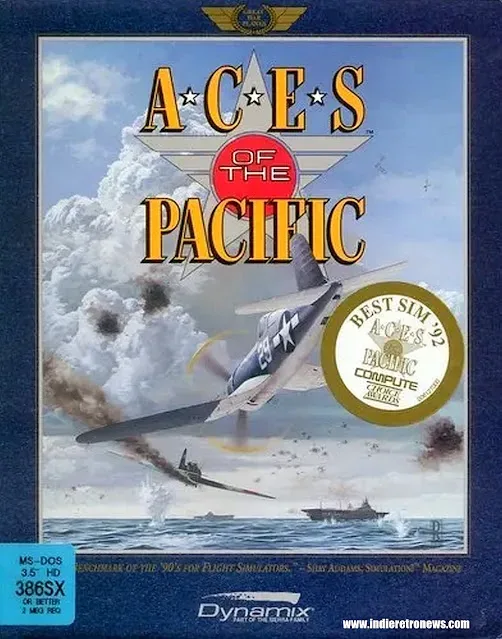
Aces of the Pacific, Dynamix's celebrated 1992 World War II flight simulation, has received an unofficial modernization for contemporary PCs. Called Aces of the Pacific: Enhanced, the project aims to retain the structure, missions and identity of the MS-DOS original while making its aerial battles substantially easier to run and enjoy on current displays and hardware.
The enhanced version was developed by Kylofon through reverse-engineering, with AI assistance cited as part of that development process. Rather than presenting a new interpretation of the game's Pacific Theater conflict, the effort is focused on preserving the original simulation and career experience in a native modern-PC form. Its changes include smoother 3D presentation, support for far higher resolutions, revised visual effects, expanded draw distance and a dedicated launcher for configuration and controls.
For retro PC enthusiasts and flight-sim players, the project is notable because Aces of the Pacific remains one of the defining combat-flight games of its era. It arrived during a period when PC simulation developers were attempting to balance historical aircraft, cockpit-level immersion, strategic campaign structure and the technological constraints of early-1990s home computers. The original game put players into air operations across the Pacific during World War II, covering American and Japanese forces and offering both individual scenarios and longer careers.
A Pacific Theater Simulation With Lasting Appeal
Developed by Dynamix and originally published by Sierra On-Line, Aces of the Pacific gave players a broad selection of wartime roles. Players can enter standalone missions or commit to the more extensive career modes, choosing American service branches including the United States Navy, Marines and Army Air Forces. The opposing side is represented through the Imperial Japanese Army and Navy.
For useful background on this topic, read Fix It Felix Jr. Brings Arcade Repairs to Amstrad CPC Plus and GX4000.
That scope mattered. The Pacific Theater provides a markedly different backdrop from the European air war often depicted in historical aviation games. Carrier operations, naval targets, long flights over open water and clashes between distinct national air forces all help give the game its own character. The appeal was not just in taking off and pursuing enemy aircraft; it was in participating in a larger historical setting where air power and naval warfare were closely tied together.
At the time of its release, the game earned a reputation as a major contender in the World War II flight-simulation field, standing alongside other well-known Pacific combat games of the period. Its combination of mission play and careers helped give players reasons to return beyond a single dogfight. Dynamix later followed the game with Aces Over Europe in 1993, extending the broader approach to a different theater of war.
Returning to the original today, however, can involve the familiar obstacles attached to classic DOS software: old rendering behavior, display limitations, input friction and the challenge of making a title designed for early PC configurations feel natural on modern systems. Aces of the Pacific: Enhanced is designed to address those issues without abandoning the original game's fundamental design.
Higher Resolution, Smoother 3D and Wider Views
The most immediate changes are visual and technical. The enhanced build offers a smooth 3D view that runs at the display's refresh rate, a substantial departure from the uneven presentation players may associate with vintage PC simulation software. High-resolution support reaches up to 2560 × 1600, and anti-aliasing is included to reduce the harsh, jagged appearance often associated with older polygonal graphics.
There is also an optional 16:9 widescreen mode. This is particularly significant for a flight simulator, where visibility and situational awareness are central to play. A wider view can make it easier to follow the horizon, keep track of a turning opponent or observe nearby ships and aircraft without constantly changing the camera direction. At the same time, the option being described as optional should be welcome news for players who prefer a presentation closer to the original display proportions.
Kylofon's modernization further increases view distance to three times the original range. Aircraft and ship models are intended to display at their finest detail at every distance, rather than transitioning as aggressively into less detailed representations. Additional atmospheric work includes distance haze, a smoother sky and a softened horizon. These adjustments should not be mistaken for a complete visual remake built around modern assets, but they do target the precise areas where an older 3D sim can look most dated on a large, sharp monitor.
Flight simulators depend heavily on the readability of space. A clearer horizon and better distance treatment are not merely decorative upgrades; they can help the sky and sea feel like a continuous combat environment instead of a limited rendering window. The enlarged viewing range may be particularly meaningful in missions involving ships or formations, where seeing activity at longer distances supports the sense of operating across the Pacific rather than within a small visual bubble.
Control Changes Intended for Current Keyboards
The project also makes several practical input adjustments. Direction keys can now be combined, meaning a command such as Left plus Down can pull an aircraft through a turn. Separate keys are available for lowering and raising flaps, avoiding the need to cycle through a single shared command. These may sound like modest refinements, but clear, reliable controls can have an outsized effect in a game where aircraft handling and rapid reactions are central to every engagement.
A launcher is included as well, with key-binding functionality. For older games, a launcher can be more than a convenience. It provides a clearer starting point for players who may not know which settings are appropriate, who need to adjust controls before flying, or who simply want an alternative to manually managing a legacy installation. In this case, the launcher and game also identify which version of Aces of the Pacific is present in a selected folder, an important detail because compatibility depends on the original release version.
The Original CD-ROM Game Is Required
Aces of the Pacific: Enhanced does not operate as a standalone replacement for the original game. It requires the CD-ROM version 1.2 of Aces of the Pacific, which includes WWII: 1946. Players who have that edition can use its game files with the enhanced project.
Not every historical release is compatible. The floppy-disk versions, including 1.0, 1.01, 1.2/Patch B and the separate 1946 expansion disk, do not run with this modernization. These releases are separate builds of the game rather than interchangeable copies of the CD-ROM edition. The version-detection information in the launcher and game should help users confirm whether a chosen folder contains the suitable files.
That requirement is worth emphasizing for anyone interested in revisiting the game. "Version 1.2" alone is not enough to guarantee compatibility if the files come from the floppy line rather than the CD-ROM package. Players will need the specific CD-ROM 1.2 release that includes the expansion content. This is a preservation-minded project, but it is still built around a particular original data set and its corresponding structure.
A Meaningful Route Back to a Classic
The arrival of this enhanced version illustrates one of the most compelling uses for fan preservation and reverse-engineering work. Many classic PC games remain historically important and mechanically rewarding, yet they become increasingly difficult to experience in a form that feels comfortable on modern machines. Compatibility layers and emulation are valuable, but a native-oriented modernization can potentially remove more friction while still respecting the original game's rules, campaigns and tone.
For Aces of the Pacific, that means players can revisit a detailed early-1990s Pacific air-war simulation with smoother motion, sharper output, broader views and more flexible control options. The project does not erase the game's age, nor does it need to. Its value is in making the original's strengths more accessible: the service choices, the career structure, the historical setting and the tense aerial encounters that made it influential in the first place.
Veterans who remember flying the original under MS-DOS may appreciate the chance to return without rebuilding an entire period-correct setup. Newcomers, meanwhile, have an opportunity to see why Dynamix's simulation endured as a landmark of its genre. With its compatibility limitations understood, Aces of the Pacific: Enhanced offers a practical bridge between a foundational flight sim and the expectations of a modern PC.
Community
Discussion
Start the conversation.
No comments have been posted yet.