
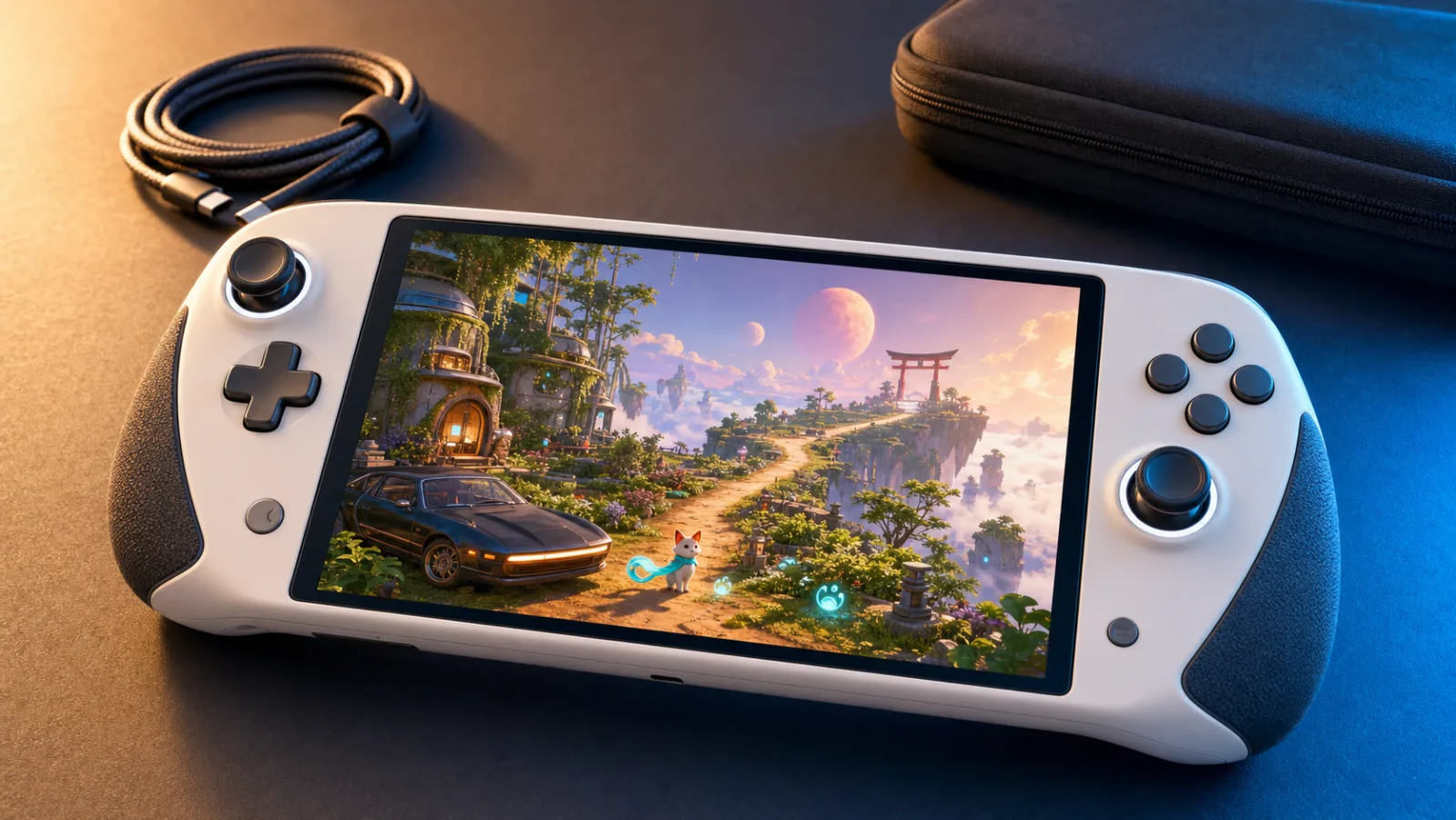
handheld gaming is not one single style of play. It is a way of fitting games into real life: a short break, a quiet evening away from the television, a trip, or a shared session with someone sitting beside you. The best place to begin is not by chasing the longest game or the loudest release. Start by deciding what you want a portable game to do for you.
Some players want a dependable ten-minute routine with low pressure. Others want a story that feels absorbing even in a short session. Some want a social game that gets people moving, while others want the deliberate challenge and compact design of older action games. This guide uses a group of Nintendo Switch, mobile, PC, and retro-connected games to explain how beginners can make smart choices without treating every handheld experience as the same.
The central rule is simple: choose for your habits before choosing for genre. A game can be excellent and still be wrong for the way you actually play. A cozy simulator may be a poor fit if you want clear endings and forward momentum. A demanding retro platformer may be exactly right if you enjoy replaying a difficult section until it clicks, but frustrating if you only want a relaxed commute game. Once you understand those differences, building a handheld library becomes much easier.
First, define what "handheld gaming" means for you
For many newcomers, Nintendo Switch is the most direct starting point in this selection because several games are listed for Nintendo Switch or Nintendo Switch 2. But handheld gaming also includes mobile play, older dedicated hardware, and games whose structure works well in portable-sized sessions. The device matters, yet the rhythm of play matters just as much.
There are four useful ways to think about your starting point.
- The comfort player: wants gentle goals, decorating, social play, exploration, or routines that can be paused and resumed without stress.
- The story player: wants atmosphere, characters, discovery, and a strong reason to see what happens next.
- The social player: wants a game that creates an occasion, whether that means cooperative play or a room full of people taking turns.
- The challenge player: wants mechanics to learn, obstacles to overcome, and the satisfaction of steady improvement.
You do not need to pick only one category. In fact, a good starter library often has one game for calm solo time, one for bursts of action, and one for friends or family. The goal is variety with purpose, not a pile of games that all ask for the same energy.
Match the game to the time you really have
Portable play is often interrupted. You may stop because you reached your destination, someone needs your attention, or your available time simply disappears. That makes a game's session structure important.
Games built around individual levels, missions, deliveries, dance tracks, or self-contained minigames naturally suit brief sessions. Kirby Super Star is particularly approachable in this regard: it is organized into several distinct adventures and challenges rather than presenting one unbroken campaign. Its core abilities are easy to understand--Kirby floats, inhales enemies and objects, and can copy powers from certain enemies--but those simple actions open into varied platforming, boss fights, puzzles, and treasure hunting.
The older action games in this selection also have a clear session shape, although they ask for more patience. Karnov combines side-scrolling action and platforming as Karnov searches for the Golden Acorn, using fireballs to fight enemies. Knight Rider is mission-based, mixing driving and on-foot sections as Michael Knight guides KITT through objectives involving criminals, puzzles, and exploration. Their concise arcade-era logic can work well for players who enjoy focused challenge, but do not mistake short-format design for effortless play.
At the other end of the spectrum are life and community games. Their strength is that there is always another small activity available, but that can also make it harder to define a natural stopping point. If your schedule is unpredictable, set a modest intention before you start: finish one delivery, decorate one part of a home, gather materials for one craft, or visit one area. A personal endpoint keeps an open-ended game from turning into accidental overcommitment.
Choose a first game by mood, not by marketing category
For bright, accessible platforming: Kirby Super Star
Kirby Super Star is an excellent entry point for a player who wants a traditional game structure without committing to a single huge adventure. The collection contains multiple games and short subsections, so it offers changing goals and mechanics. Kirby's copied abilities provide experimentation without requiring a complicated control scheme. The helper-character system adds another appealing layer: when Kirby has an ability, it can be turned into a helper character.
This is the choice for beginners who like colorful platforming, a wide range of attacks, imaginative environments, and the sense of progressing through many compact adventures. It is also a useful reminder that older games do not have to be stark or inaccessible. A strong, readable central mechanic can remain welcoming across generations.
For movement and group energy: Just Dance 2017, 2018, or 2019
The Just Dance games solve a different handheld-gaming problem: they turn a game session into a physical, social activity. The core idea is immediately clear. Players follow an on-screen dancer and earn points based on the accuracy of their routines. In Just Dance 2017, motion controller systems are supported on its console platforms, and players can also use a smartphone through the companion mobile app. That entry also includes Just Dance Machine on current-generation console and PC versions, where dancing through different styles helps recharge an alien spaceship.
The best version for you depends largely on which listed songs you want to dance to. Just Dance 2018 includes tracks such as "24K Magic," "Despacito," "Footloose," "Shape of You," and "How Far I'll Go." Just Dance 2019 has a 40-track lineup including "Havana," "Bang Bang Bang," and "No Tears Left To Cry," plus a curated homepage, personalized suggestions based on dancing habits, and eight choreographies created with help from kids' development experts. It also includes a one-month trial of Just Dance Unlimited, which provides access to more than 400 songs.
These games are best for players who want quick sessions, party appeal, and a reason to share the screen. They are less about settling into a quiet solitary world and more about participation. If that is your goal, do not overthink it: choose the soundtrack and features that most appeal to your group.
For retro action and persistence: Karnov and Knight Rider
Retro handheld-minded play is about accepting a different contract. You are often expected to learn through repetition, read the space in front of you carefully, and return to a challenge with a better plan. Karnov and Knight Rider, both associated here with Nintendo Entertainment System play, offer two distinct routes into that mindset.
Choose Karnov if you want direct action-platforming. Karnov is a strongman hero who battles through varied environments and shoots fireballs, while the game combines platforming with side-scrolling combat. It is a fit for players who want the clarity of an action game: move forward, avoid danger, defeat enemies, and master the route.
Choose Knight Rider if the mixture of vehicle-focused and on-foot gameplay sounds more interesting. Its missions echo the television series' crime-fighting premise by sending Michael Knight and KITT through objectives with driving, exploration, puzzles, and criminals to stop. It is a better match for a player who wants a little more variety than a pure platformer provides.
Neither should be your automatic first choice if you strongly dislike retrying difficult moments. But both are valuable for a beginner building historical perspective. They demonstrate how much game design can be carried by a clear hero, a single memorable ability, and levels that test attention rather than endless systems.
Plan ahead for upcoming handheld-friendly adventures
A starter guide should not only look backward. Several games in this selection are listed for future release, and each points toward a different kind of portable experience. Treat release plans as a chance to identify your preferences early rather than as a reason to commit before you know what you enjoy.
The Road of Dust and Sorrow is listed for Nintendo Switch and Nintendo Switch 2, alongside PC, PlayStation 5, and Xbox Series X|S, with a December 3, 2026 release date. It is a story-driven pixel-art thriller that blends adventure and puzzle play with survival-horror elements in a short, intense experience. This is for the player who wants portable gaming to feel tense and cinematic rather than cozy. The important question is not whether you usually play horror games; it is whether you enjoy atmosphere, puzzles, and a concentrated experience with a darker edge.
Loftia, listed for Nintendo Switch, Mac, and PC with a November 3, 2026 release date, is built around cozy multiplayer collaboration. Players farm, craft, explore, decorate, and work with others toward a brighter, more sustainable future. It is the natural choice for players who see their handheld as a connection tool as much as a personal escape. If you have friends who enjoy creating shared spaces and setting their own social goals, its collaborative focus should be especially appealing.
Petit Planet is a cosmic life simulation centered on building a home, sharing a planet with fuzzy neighbors, and exploring everyday life in a cosmic setting. It is listed as free-to-play, cross-platform, and available for Android, iOS, Nintendo Switch 2, and PC, with a December 31, 2026 release date. Its mobile and Switch 2 listings make it particularly relevant to players who want flexible access across different kinds of devices. This is for the routine-oriented player: someone who likes returning to a growing space, meeting neighbors, and discovering small possibilities rather than racing toward a final objective.
Petal Runner, listed for Nintendo Switch 2 and PC with a December 31, 2026 release date, follows Cali and Kira as they bike through Sapphire Valley. Deliveries, new friends, minigames, and a wholesome slice-of-life story about growing up and learning to let go give it a strong identity. Pick this one if you want a story-led adventure RPG with a sunny city to explore and a gentler pace than a thriller or action game.
Kitsune: The Journey of Adashino is listed for Nintendo Switch, Nintendo Switch 2, Mac, and PC with a June 30, 2027 release date. Kitsune, a fox girl, travels across Adashino Island with her Frog friend. Neon signs provide light and color across its Japanese-inspired atmosphere, while an unseen presence draws closer. That balance of companionship, place, and looming unease makes it a promising option for players who want an adventure with mood but do not necessarily want the survival-horror framing of The Road of Dust and Sorrow.
Haunted Paws, listed for Nintendo Switch and Nintendo Switch 2 as well as PC, PlayStation 4, PlayStation 5, and Xbox Series X|S, has a May 1, 2027 release date. Two customizable puppies explore spooky environments and face evil creatures while trying to rescue their human friend from a haunted mansion. Its cozy co-op horror premise makes it an obvious candidate for pairs of players who want a shared adventure with playful charm and action-focused encounters.
Build a small, balanced first library
Beginners often make one of two mistakes: buying only massive games that demand a lot of uninterrupted time, or buying several games that all deliver the same mood. A more useful first library has clear roles.
- One reliable solo game: Choose Kirby Super Star for platforming variety, or a life-simulation option such as Petit Planet if routine and home-building are more your speed.
- One social game: Choose a Just Dance entry for movement and group sessions, or look toward Loftia and Haunted Paws if cooperative exploration is what brings people together.
- One game outside your comfort zone: A thriller such as The Road of Dust and Sorrow, a moody island adventure such as Kitsune, or a classic challenge game such as Karnov can keep your collection from becoming repetitive.
Do not feel obligated to complete every game before trying another. Handheld gaming works best when the game you choose matches your current energy. A platformer may be right after a long day when you want clear goals. A community simulator may be right when you want to settle in. A dance game may be right when sitting still sounds unappealing. This flexibility is not a lack of commitment; it is one of portable gaming's greatest strengths.
Practical habits that make portable play better
A few simple habits can dramatically improve your experience. First, protect the kind of session you want. If you are playing a story-heavy title, use headphones when possible so atmosphere and dialogue are not lost to distractions. If you are playing a social or movement-driven game, prioritize an open, comfortable space rather than trying to force it into a cramped moment.
Second, make stopping easy. Before beginning an open-ended game, decide on one meaningful task. Before beginning an action game, decide whether you want to practice a particular section or simply play until the next natural pause. This prevents the common feeling that you have started something but cannot safely leave it.
Third, let difficulty be information. If a retro action game feels harsh, it may be telling you that you currently want a more forgiving experience, not that you are bad at games. If a cozy simulator feels aimless, it may be telling you that you prefer stronger structure. Taste is not a test you pass. It is something you discover by playing.
The best first step
Start with the game that matches your immediate reason for playing. For cheerful platforming and flexible goals, begin with Kirby Super Star. For active group sessions, choose the Just Dance soundtrack that suits your household. For an old-school test of focus, try Karnov or Knight Rider. For future-facing portable adventures, watch the listed Switch, Switch 2, and mobile options according to whether you value atmosphere, community, co-op, life simulation, or a slice-of-life journey.
Most importantly, resist the idea that handheld gaming needs to be treated as a lesser version of playing elsewhere. Portable games can be social, challenging, emotional, relaxed, weird, and deeply personal. The right starter game is the one that fits the moment you have--and makes you want to come back for the next one.
Community
Discussion
Start the conversation.
No comments have been posted yet.