

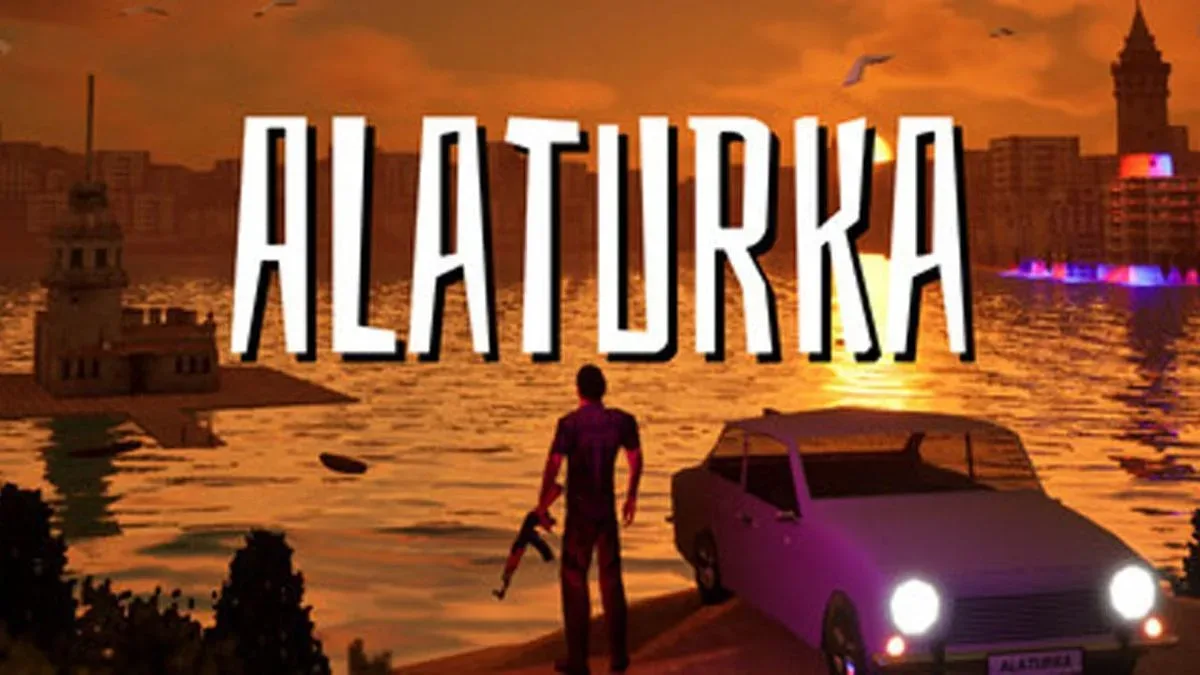
ALATURKA is shaping up to be one of the more distinctive retro-styled open-world projects on PC. Created by solo developer bufuakgames over roughly two years of spare-time work, the game combines an intentionally PlayStation 2-like visual direction with a 1970s-inspired version of Istanbul, driving-focused gameplay, and a job that is far less glamorous than the criminal empires often associated with city sandboxes: delivering döner kebabs.
The result has been described as an open-world "GTA Istanbul" concept, though ALATURKA's identity appears to lean strongly into its own setting, local character and knowingly scrappy premise. Players arrive in the city as an apprentice working for their uncle, with empty pockets and a straightforward objective: earn money. Naturally, the route to doing so involves a city split across two continents, uncooperative traffic, noisy seagulls, and the practical complications of getting food where it needs to go.
ALATURKA is currently listed on Steam, where it can be wishlisted. A release date has not been announced.
A deliberately PS2-inspired vision
Retro visual styles are common in modern indie games, but ALATURKA is pursuing a very specific kind of nostalgia. Rather than simply using pixel art or broadly low-polygon models, it aims for the look and feel associated with early-2000s console open-world games. Its low-detail environments, character models and overall presentation are designed to evoke the PlayStation 2 era, while the setting draws from 1970s Turkish culture and urban life.
For useful background on this topic, read Pokémon Dark Rising 2 Remake Announced, Bringing the Fan Sequel to a New Engine.
That combination matters. ALATURKA is not presenting its dated-looking technology as a temporary placeholder or something to be polished away later. The older visual language is central to the project's appeal, giving the city a stylized, game-like quality rather than trying to compete with contemporary photorealistic open worlds.
The developer has also pushed back against the suggestion that the project should be "modernised" with AI tools. That response fits the wider creative direction: the PS2-style appearance is intentional, and its rougher edges are part of the game's personality. For players who remember spending hours in compact, expressive console sandboxes, that commitment may be more appealing than a visual overhaul would be.
From kebab apprentice to city driver
The Steam description frames ALATURKA around a humble protagonist who comes to Bosforus to work as a döner kebab apprentice for an uncle. There is no indication that the player begins as a powerful underworld figure, wealthy entrepreneur or gifted action hero. Instead, the immediate concern is making enough money to get by.
That ordinary starting point gives the game room for comedy. The city itself is depicted as a source of constant friction: traffic barely moves, gulls never stop making noise, and a supposedly simple delivery job becomes the foundation for an open-world adventure. The premise recognizes that navigating a huge, crowded city can be entertaining even before traditional action-game escalation enters the picture.
Driving is expected to be a major element of the experience. The available footage and project description emphasize vehicles and moving through the city, while the delivery work gives that driving a clear purpose. Rather than traversing streets simply to reach the next mission marker, players will be working within the rhythms of an urban delivery job, likely balancing routes, congestion and the demands of a bustling setting.
There are also signs that ALATURKA will have more going on beneath its culinary premise. Community discussion around the game has already raised questions about the setting's lore, including the presence of weapons in the city and why kebabs play such an important role. Those details have helped generate curiosity around how far the game's open-world systems and story will extend beyond deliveries.
A city shaped by local flavor
Open-world games often borrow heavily from a familiar group of cities and crime-fiction archetypes. ALATURKA stands apart by focusing on an Istanbul-inspired location and putting regional details at the center of the pitch. The two-continent geography, relentless traffic and street-food culture are not background decorations; they are baked directly into the protagonist's situation and the game's tone.
The name "Bosforus" further signals a fictionalized take on the Bosphorus region rather than a literal simulation. That gives bufuakgames room to build a city with recognizable cultural touchstones while maintaining the flexibility of a fictional game world. It can celebrate the atmosphere of the location without being bound to exact real-world streets, businesses or layouts.
The 1970s influence is another important ingredient. While specific gameplay mechanics tied to the decade have not been detailed, the period framing gives ALATURKA a visual and tonal identity separate from modern urban driving games. It suggests a world of distinctive cars, fashion, signage and street life filtered through the limitations and charm of a PS2-inspired presentation.
For a genre often defined by sprawling maps and enormous production budgets, this more focused concept could be one of ALATURKA's biggest strengths. A solo-developed city does not need to be the largest fictional metropolis in gaming to feel memorable. If its roads, deliveries, characters and jokes all reinforce the same cultural and period-specific mood, the setting could be more memorable than a bigger but less cohesive sandbox.
Two years of solo development, built in public
The game's development story is almost as notable as its premise. Bufuakgames has spent the past two years working on ALATURKA during spare time, without a budget. That is a major undertaking for any game, particularly one attempting open-world driving, a city setting and numerous environmental details.
Development has also taken place publicly through more than 50 livestreams. Those streams were conducted in Turkish, offering Turkish-speaking viewers a chance to look back through the creation process and see how the project evolved. Building in public can make the long, iterative nature of game development more visible, especially for a solo creator handling the work without the support structure of a larger studio.
It also helps explain why the project has already attracted attention before launch. Viewers have been able to follow its progress over time rather than only encountering a finished announcement trailer. That kind of sustained development record can create an invested audience, with players watching elements of a concept take shape from early experiments into a Steam-listed game.
Solo development comes with obvious challenges, and ALATURKA has not yet provided a full breakdown of all its planned features, map size or mission structure. Still, the game's existing hook is clear enough to stand on its own. It has a specific place, a specific era, a deliberately old-school visual target and a central job that immediately communicates its sense of humor.
PC requirements and current availability
ALATURKA is planned for PC via Steam. It is not currently confirmed for PlayStation, Xbox, Nintendo Switch, mobile devices or any retro hardware. Despite its PlayStation 2-inspired appearance, this is not an announced PS2 release; the visual style is a creative choice for a modern PC game.
The currently listed recommended PC specifications are:
- Operating system: Windows 10 or Windows 11, 64-bit
- Processor: Intel Core i5-8400 or AMD Ryzen 5 2600
- Memory: 16 GB RAM
- Graphics: NVIDIA GeForce GTX 1050 Ti with 6 GB, or AMD Radeon RX 480
- DirectX: Version 11
- Storage: 4 GB available space
Those specifications indicate that the stylized visual design should not be mistaken for an absence of modern PC requirements. The listed hardware remains relatively accessible compared with many new large-scale releases, but players should still check the Steam page for updates as development continues.
Why ALATURKA is worth watching
ALATURKA does not need to imitate every part of the games that inspired its visual style. Its strongest feature may be that it understands the value of a focused, unusual premise. A retro-styled 1970s city game about earning a living through döner deliveries is immediately more specific than another generic open-world crime sandbox.
There is still plenty unknown, including when the game will launch and exactly how broad its activities will be. Yet the project has already established a confident identity through its setting, humor, driving emphasis and deliberately nostalgic look. For anyone interested in compact-feeling PS2-era aesthetics, unconventional city sandboxes, or games rooted in Turkish cultural flavor, ALATURKA is one to keep on the wishlist.
Community
Discussion
Start the conversation.
No comments have been posted yet.