

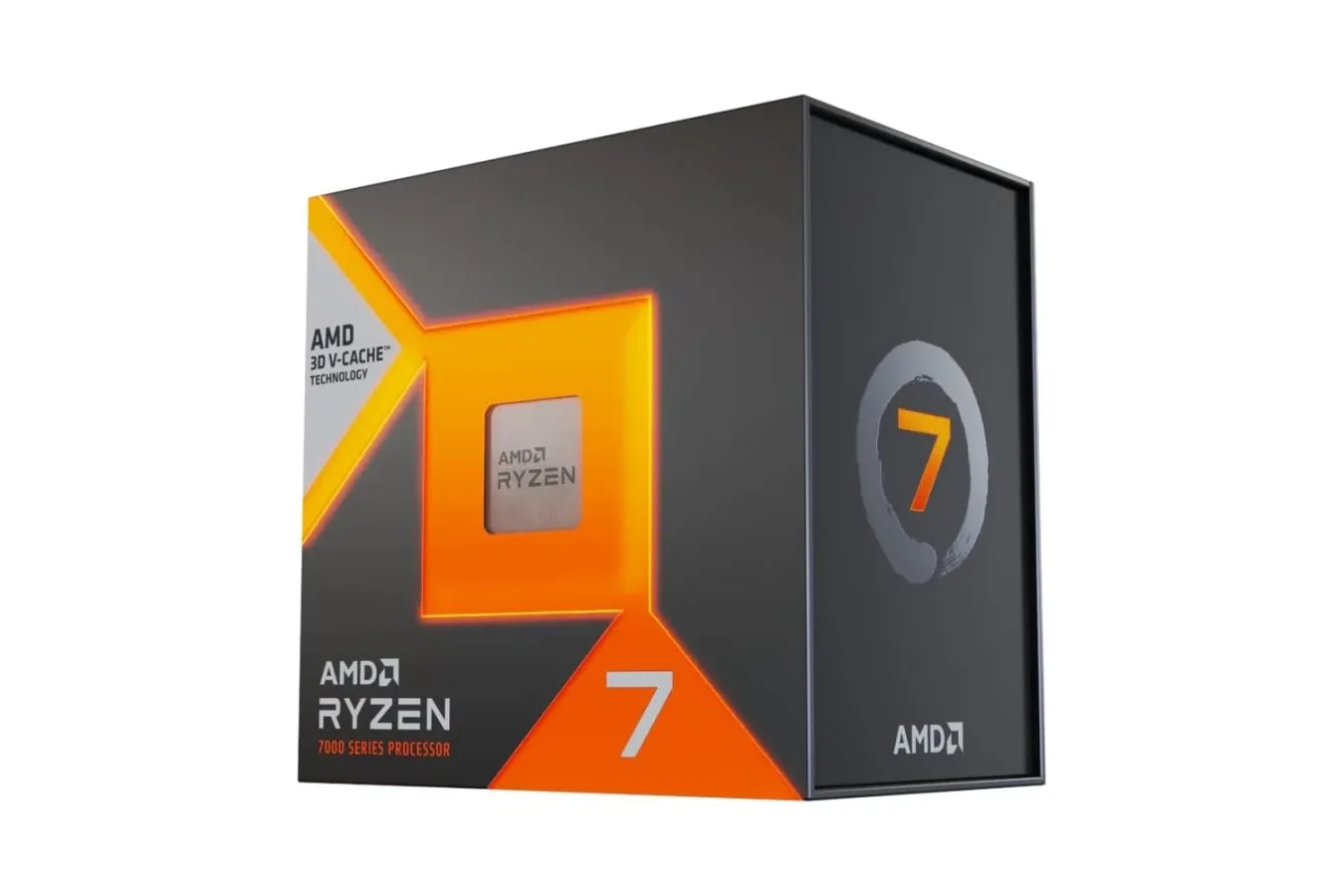
PC builders shopping for a high-end gaming processor have a notable new price to consider: AMD's Ryzen 7 7800X3D is listed at $348, down from a stated regular price of $449. That is a $101 reduction, or roughly 22% off, for one of AMD's best-known AM5 gaming CPUs.
The discount matters because the 7800X3D has built its reputation around a fairly specific goal: delivering consistently fast game performance, particularly in CPU-limited situations where a powerful graphics card is waiting on the processor. It is an eight-core, 16-thread chip based on AMD's Zen 4 architecture, but the defining feature is its added 3D V-Cache. AMD stacks additional L3 cache close to the CPU cores, giving the chip 96MB of L3 cache and 104MB of combined L2 and L3 cache.
For players, that cache design can be more important than headline clock speed alone. Many games repeatedly access similar data while rendering a scene, handling simulation work, tracking players, or managing a crowded open world. Keeping more of that frequently needed information near the processor can reduce the time spent waiting on system memory. The practical aim is smoother performance, stronger frame rates in the right games, and fewer disruptive dips when the CPU becomes the limiting component.
Why the 7800X3D remains a popular gaming-focused CPU
The Ryzen 7 7800X3D is not positioned as a do-everything workstation monster with an enormous core count. Instead, its eight Zen 4 cores and 16 threads are aimed squarely at the needs of a modern gaming PC, while still leaving room for everyday multitasking, streaming, voice chat, browser windows, recording software, and background applications.
For useful background on this topic, read Komorebi Prison codes for October 2026: Every Active Reroll Code.
Its base clock is 4.2GHz and it can boost up to 5.0GHz. Those figures are paired with the cache-heavy X3D design, which is why the processor has long been a frequent recommendation for builders whose priority is game performance rather than heavily threaded professional production workloads.
Competitive games are one area where a processor like this can be especially attractive. A system targeting a high-refresh-rate monitor needs more than a capable GPU; the CPU also has to feed frames quickly and consistently. In shooters and other esports-oriented games, higher averages are useful, but steady frame delivery and improved low-frame performance can be just as meaningful. A smoother experience can make rapid camera movement, aiming, and dense action feel more responsive.
That does not mean the CPU alone determines gaming results. Performance varies significantly by game engine, resolution, in-game settings, memory configuration, graphics card, drivers, and the rest of the system. At very high resolutions or maxed-out visual settings, the graphics card often becomes the primary bottleneck. Still, pairing the 7800X3D with a modern GPU gives a builder a strong foundation for both fast-paced multiplayer games and demanding single-player releases.
AM5, DDR5, and PCIe 5.0 support
The 7800X3D uses AMD's AM5 socket, which means it requires an AM5 motherboard and DDR5 memory. It is not a drop-in replacement for an older AM4 build using DDR4. Anyone upgrading should factor the motherboard and RAM requirements into the total cost, especially if they are moving from a much older platform.
For a completely new build, however, AM5 brings modern connectivity and a useful upgrade-oriented foundation. The platform supports DDR5 memory and PCIe Gen 5.0, allowing builders to select current storage and graphics options while leaving room to make later changes. AMD EXPO support also allows compatible DDR5 kits to run at their rated profiles through a simplified memory-overclocking setup process.
Compatible AM5 boards span several chipsets, including X670, B650, and X870 options, among others. That gives buyers a broad range of motherboard choices, from more affordable boards designed around the essentials to premium models with expanded connectivity, additional M.2 slots, stronger power delivery, and more USB ports.
It is worth remembering that a motherboard's chipset is only one part of the decision. Builders should check BIOS support for the exact CPU, the number and type of storage slots, networking features, rear I/O, case form factor, and whether a board offers the connections needed for their chosen cooler and front-panel ports. A less expensive B650 board can make perfect sense for a gaming-first build, while an enthusiast may prefer a board with more expansion and connectivity.
Integrated Radeon graphics provide a useful safety net
Like other Ryzen 7000-series desktop processors, the Ryzen 7 7800X3D includes built-in Radeon graphics. These integrated graphics are not a substitute for a dedicated gaming card in a high-performance rig, but they are a welcome convenience for building and maintaining a PC.
They can provide display output while a system is being assembled, help with diagnosing a graphics-card issue, or keep a computer usable if a discrete GPU is temporarily removed. For anyone who has had to troubleshoot a fresh build with no image on screen, that fallback can save time and reduce uncertainty.
The processor is rated at a 120W TDP. It does not include a stock CPU cooler, so prospective buyers should add cooling to their build checklist. Both quality air coolers and compatible liquid-cooling solutions can be viable choices, depending on the case, budget, preferred noise level, and desired appearance. Before buying, check cooler support for the AM5 mounting system and confirm that the case has sufficient clearance.
Who should consider this deal
At $348, the Ryzen 7 7800X3D is most appealing to a few distinct groups. First are builders assembling a new AM5 gaming machine around a midrange-to-high-end graphics card. The processor offers a gaming-centered platform with current memory and expansion standards, and it should have plenty of headroom for the usual mix of gaming, communications software, media playback, and background tasks.
Second are players with powerful GPUs who have identified their existing CPU as a likely limit, especially in games played at lower resolutions or settings chosen to maximize frame rates. Competitive players using 144Hz, 240Hz, or faster displays may find the proposition particularly interesting, though an upgrade is most worthwhile when the rest of the system is balanced around that target.
Third are users already committed to AM5 who are choosing components for a new build rather than replacing a processor in an existing machine. Since this CPU requires an AM5 motherboard and DDR5, it is easier to justify as part of a platform purchase than as a low-cost upgrade from AM4.
It may be less compelling for someone whose work is dominated by rendering, compiling, or other applications that scale aggressively with additional CPU cores. The 7800X3D can certainly handle general productivity, but shoppers whose priority is highly threaded professional work should compare it with processors built around larger core counts. Likewise, players with an older graphics card may see a more dramatic gaming improvement by directing more of their budget toward a GPU first.
What to check before placing an order
- Socket compatibility: The Ryzen 7 7800X3D needs an AM5 motherboard. AM4 boards are not compatible.
- Memory type: An AM5 build uses DDR5 memory, not DDR4.
- Cooler: No cooler is included in the box, so budget for an appropriate air or liquid unit.
- Motherboard BIOS: Verify that the selected motherboard supports the CPU, and check whether a BIOS update may be required.
- Graphics card balance: Match the processor with a GPU appropriate for the games, resolution, and refresh-rate target you have in mind.
- Deal timing: Retail pricing can change quickly, so confirm the current price and seller details before checking out.
The $348 listing puts a substantial dent in the cost of a processor that remains highly relevant for gaming-first PC builds. Its combination of eight Zen 4 cores, 16 threads, extensive 3D V-Cache, AM5 support, DDR5 compatibility, PCIe Gen 5.0 support, and basic integrated Radeon graphics makes it a well-rounded centerpiece for players who want high frame rates without giving up the flexibility of a current desktop platform.
For builders who have already accounted for an AM5 motherboard, DDR5 kit, cooling solution, and a capable graphics card, this discount could be the moment that turns a planned upgrade into a finished system. As always with hardware promotions, the best value depends on the full build rather than one component in isolation--but for a gaming CPU with the 7800X3D's track record, a $101 price cut is difficult to ignore.
Community
Discussion
Start the conversation.
No comments have been posted yet.