

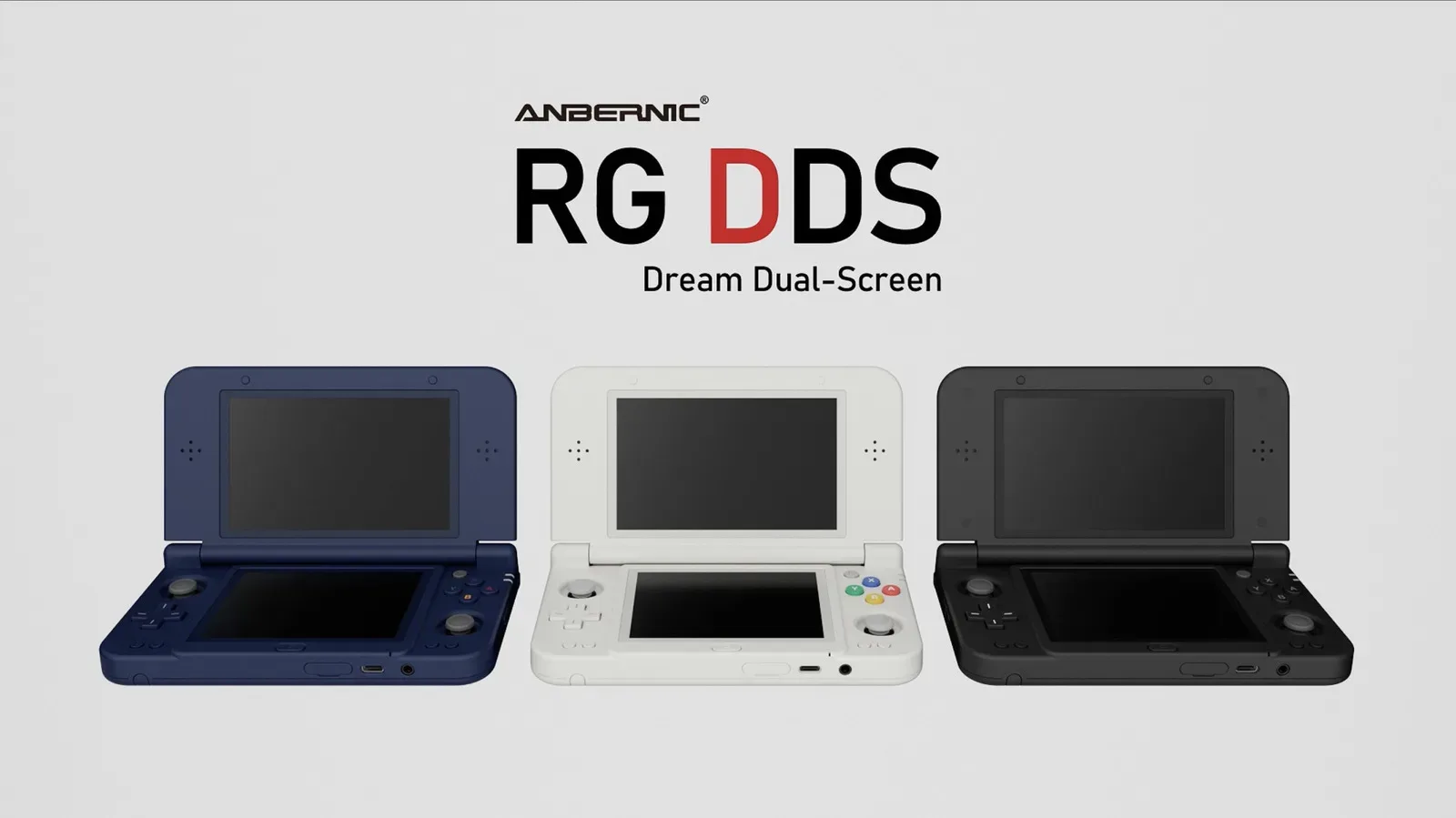
Anbernic has revealed the RG DDS, a new clamshell handheld designed around a familiar two-screen format and display proportions that should make it particularly interesting for fans of Nintendo 3DS-era games. The name stands for "Dream Dual-Screen," and the machine's overall layout makes its inspiration clear: it uses an upper screen, a lower screen, a stylus, and a control arrangement that closely resembles Nintendo's former portable family.
What makes the RG DDS more than a cosmetic throwback is its screen configuration. Anbernic has equipped the device with a 4.7-inch main display running at 1,200 x 720, producing a 5:3 aspect ratio. Beneath that is a 4-inch, 960 x 720 secondary display with a 4:3 ratio. Those shapes are important because they more closely reflect the differing display formats used by the Nintendo 3DS than the wide, same-sized panels commonly found on other dual-screen Android handhelds.
Anbernic has also confirmed Qualcomm's Snapdragon G2 Gen 2 chipset and a 6,000mAh battery, though many important technical details remain unannounced. There is no confirmed price, release date, memory configuration, storage capacity, operating-system version, or final rundown estimate. Still, the early specifications position the RG DDS as a substantially more ambitious product than a basic retro handheld.
A screen layout built around the software experience
The biggest appeal of the RG DDS is not simply that it has two displays. Dual-screen handhelds have become an increasingly visible niche, but screen dimensions and orientations can strongly affect how natural games feel. Nintendo's DS and 3DS libraries were designed around a top-and-bottom presentation, often using the lower panel for maps, inventory systems, touch controls, menus, note-taking, camera functions, or companion gameplay.
For useful background on this topic, read EU Action Targets Activision, Riot, Ubisoft and Others Over In-Game Currency Practices.
On a conventional single-screen device, players must frequently switch views, shrink both displays into a cramped layout, or make compromises with touchscreen placement. A two-panel clamshell can make that experience feel much closer to the original intent. The RG DDS goes further by using different aspect ratios on each screen rather than treating the second display as an identical extra panel.
The 5:3 upper screen should be especially notable for 3DS emulation. It is a better fit for the 3DS top display than a typical 16:9 panel, which can leave more unused space or require scaling choices that do not match the original presentation as neatly. The lower 4:3 display, meanwhile, suits the older touch-oriented format. It is a practical combination for software that treated the two screens as distinct tools rather than duplicated displays.
The company has not detailed panel technology, brightness, refresh rate, color performance, or whether the lower display supports touch input. However, the presence of an extendable capacitive stylus strongly indicates that touchscreen interaction is a central part of the intended experience. The stylus can be stored within the handheld when it is not being used, echoing a convenience feature that is essential for games built around quick touch commands.
For another perspective on this story, read Anbernic RG DDS Revealed With 3DS-Focused Dual-Screen Design.
More power than Anbernic's earlier dual-screen effort
The RG DDS follows the RG DS, Anbernic's earlier effort at a Nintendo DS-inspired handheld. For the newer model, the company has named a more capable processor: Qualcomm's Snapdragon G2 Gen 2. That chip choice suggests the RG DDS is aiming beyond lightweight 8-bit and 16-bit libraries, even if final performance will depend on the device's cooling, software tuning, available RAM, and emulator development.
Anbernic's own claims point toward the possibility of handling emulation workloads up to Nintendo Switch and PlayStation 2 games. That should be treated as a broad performance target rather than a guarantee that every title from either platform will run perfectly. Emulation results can differ dramatically from game to game, and demanding software often depends on the maturity of the emulator, the graphics backend, driver support, settings, and the specific demands of each title.
For the RG DDS, though, the more interesting question may be how that horsepower supports dual-screen software. A device can have enough processing headroom to run a game but still feel awkward if its display arrangement is poorly suited to the original hardware. The combination of a modern mobile gaming chip and a purpose-built two-screen shell could give the system a clearer identity than handhelds that focus only on raw benchmarks.
The 6,000mAh battery is another encouraging but incomplete specification. It is a sizable capacity for a compact portable, yet battery life cannot be calculated from capacity alone. Display brightness, resolution, processor load, wireless use, sleep behavior, and software optimization will all play a role. Running simple retro titles and pushing more demanding PlayStation 2 or Switch-era emulation are likely to produce very different results.
Controls closely follow the handheld blueprint
The physical control design also appears to follow the Nintendo handheld formula closely. The RG DDS uses a traditional directional control on the left, face buttons on the right, and the familiar arrangement of shoulder controls around the top of the clamshell. Anbernic has added a second analog stick on the right side, giving the system a control option that better suits games designed around twin-stick camera input or modern console-style layouts.
That extra stick is one of the clearest functional departures from the older design. Original 3DS models had an analog Circle Pad and, on later hardware, a small C-Stick nub, but a full second analog stick could provide a more comfortable option in software that benefits from two precise inputs. Whether its placement, travel, and size will be comfortable remains impossible to judge until the hardware is in players' hands.
The device also includes a dedicated AI button. Anbernic has not explained what the button does, what software services it may call upon, whether any functions require an internet connection, or whether users will be able to remap it. At this stage, it is simply an extra named control with no defined practical role. That makes it one of several details that will need clarification before the RG DDS can be fully evaluated.
A growing market for dual-screen retro hardware
The RG DDS arrives as companies continue to experiment with handheld designs that move beyond the standard horizontal gamepad shape. Clamshell systems have obvious portability benefits: folding the device protects the displays and can reduce the amount of exposed surface area in a bag or pocket. For a dual-screen machine, the format is also historically appropriate, recreating the vertical stack that a wide handheld cannot match as elegantly.
Competition is already taking shape in this category. Retroid recently released the Retroid Pocket Duo and its Lite version, with the Lite starting at $149. Anbernic has not announced a price for the RG DDS, but its prior RG DS model was priced at $99. The newer hardware, additional processing power, and more specialized displays make it reasonable to expect the RG DDS to cost more than that predecessor, although no official figure has been provided.
Affordability has long been a major part of Anbernic's appeal, so its final pricing will matter considerably. A low price can make a specialized device easier to recommend, especially for players who already own a more powerful single-screen handheld and want a second machine specifically for DS- and 3DS-style use. On the other hand, dual displays, a clamshell hinge, capacitive stylus support, and a higher-end Qualcomm chip all add potential cost and complexity.
Important questions remain before launch
The reveal establishes the RG DDS concept, but it leaves a long list of practical questions unanswered. Buyers will want to know the hinge's durability, the handheld's total weight and thickness, the quality of its buttons and sticks, whether the screens have matching color calibration, and how responsive the lower panel is for stylus-heavy games. Connectivity, expandable storage, video output, wireless standards, speaker quality, charging speed, and Linux or Android software support could all shape the final value proposition.
There is also the matter of setup. Dual-screen emulation is more convenient when the operating system and front end make it simple to manage screen layouts, touch controls, per-game settings, and library organization. Hardware alone cannot guarantee a smooth experience. The device's success may depend just as much on its software polish and community support as on the Snapdragon G2 Gen 2 inside.
As with any emulation-focused handheld, players should use software and game files they are legally entitled to use and should be mindful of applicable laws in their region. The RG DDS itself is being presented as hardware, while the eventual experience will be shaped by the software users choose to run on it.
For now, Anbernic's announcement is promising because it addresses a problem that many retro handhelds cannot solve with more power alone: the physical shape of the original experience. With a 5:3 upper display, a 4:3 lower display, an integrated stylus, and a clamshell body, the RG DDS looks purpose-built for a generation of games that depended on two different screens working together. Pricing, availability, and the rest of the specifications will determine how compelling the finished package becomes, but the design has already made it one of Anbernic's most distinctive upcoming handhelds.
Community
Discussion
Start the conversation.
No comments have been posted yet.