

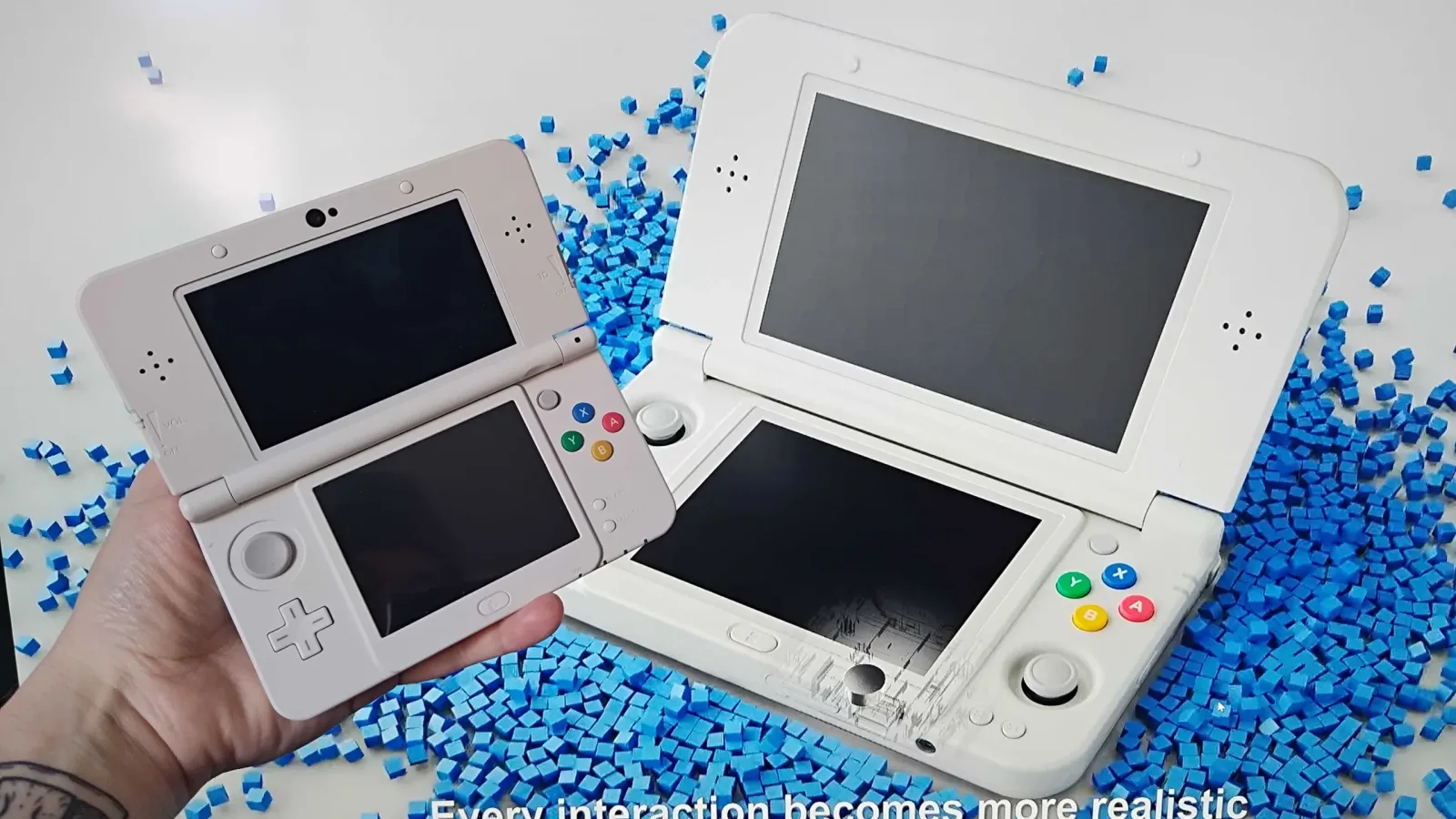
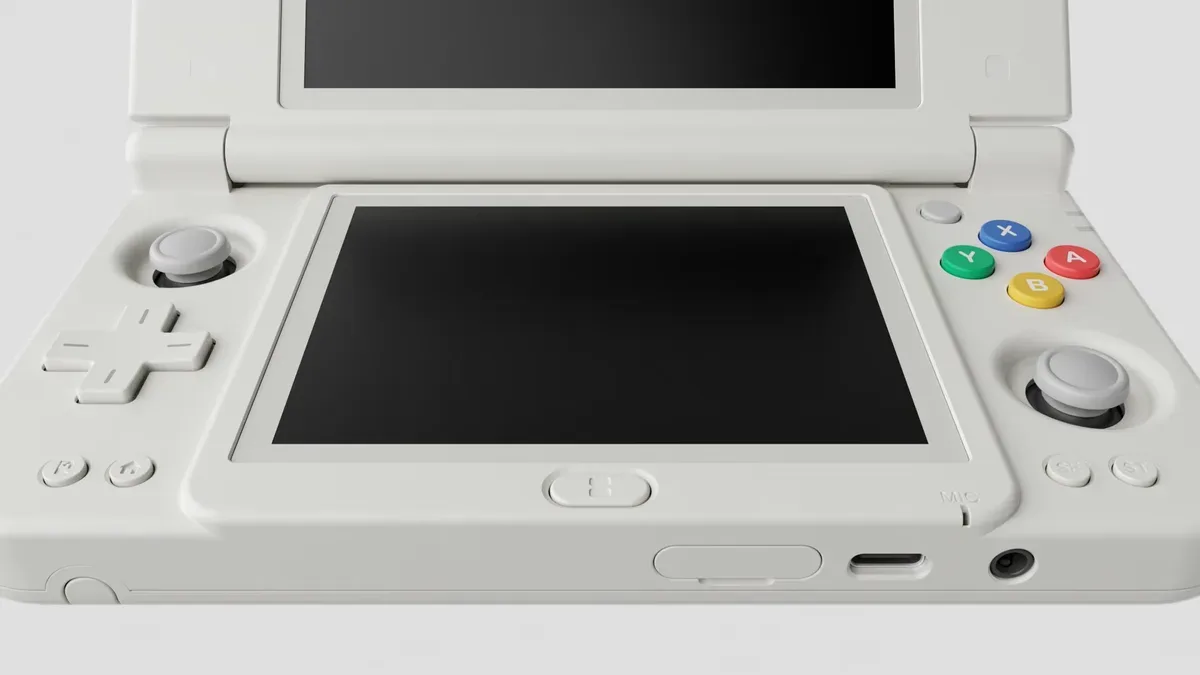
Anbernic appears to be preparing another dual-screen clamshell handheld, and this one is aimed squarely at people who want a more powerful way to revisit games designed for Nintendo's 3DS family. Called the Anbernic RG DDS, the newly teased device closely resembles the 2014 New Nintendo 3DS in both its overall shape and control layout, but it brings larger, higher-resolution displays and a more modern Qualcomm Snapdragon G2 Gen 2 chipset.
The company has not yet announced a price, complete specifications, or a launch date for the RG DDS. Still, the details visible in its teaser position it as a higher-end alternative in Anbernic's growing lineup of dual-screen emulation hardware. Its major promise is support for "true" 3x integer scaling for 3DS software, a claim that points to a handheld intended to handle more demanding dual-screen titles than entry-level DS-focused devices.
That makes the RG DDS an interesting prospect in a category that is becoming increasingly competitive. Dual-screen portable emulation has historically involved compromises: using a single widescreen display, relying on unusual layouts, or accepting performance limitations. A dedicated clamshell with two displays is a more natural fit for games built around touch controls, maps, inventories, camera views, and other second-screen features. The challenge, as always, will be whether the hardware, software, screen quality, controls, and final price can come together convincingly.
A Familiar Clamshell, With Bigger Screens
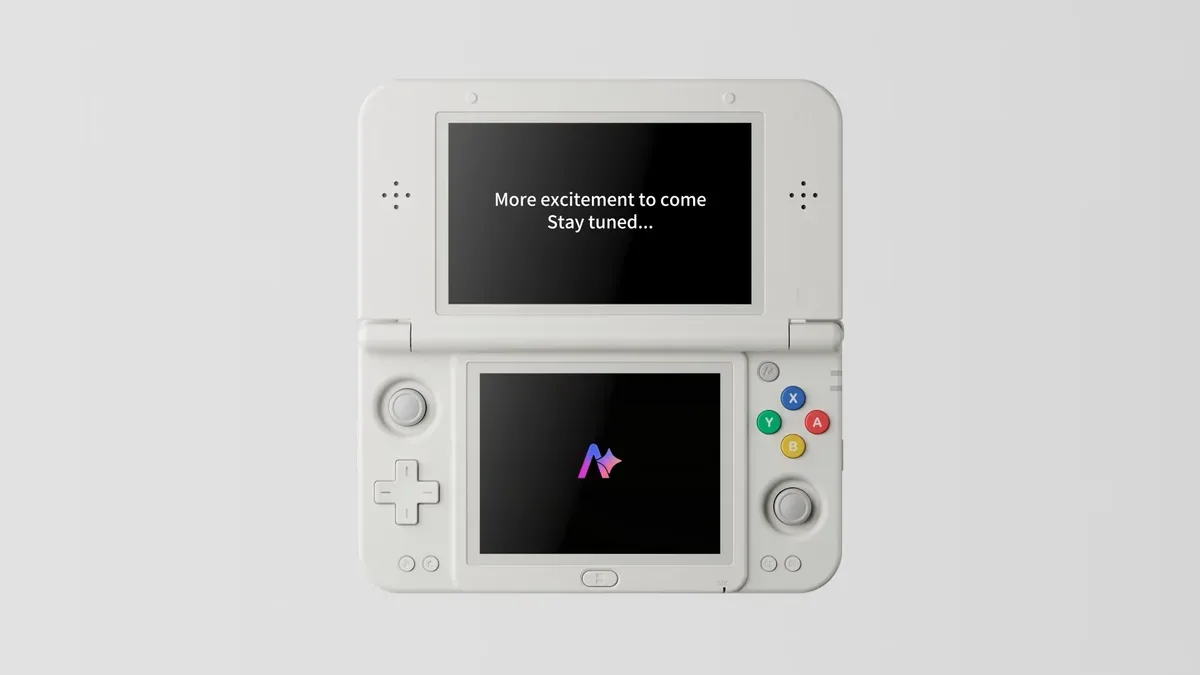
At first glance, the RG DDS looks remarkably close to Nintendo's New 3DS design. It uses the same compact folding format, with a display in the upper lid and a touchscreen panel beneath it. The resemblance is plainly intentional, continuing Anbernic's tendency to build hardware that evokes well-known portable systems.
The screens are where the dimensions start to differ. The upper panel is listed as a 4.7-inch 720 x 1200 display, while the lower screen measures 4 inches at 960 x 720. Both panels are therefore substantially different from the screens found on the original 3DS hardware, and the larger top display in particular should give games more room to breathe.
Those resolutions are central to the company's stated 3x scaling goal. Integer scaling is valued in retro and emulation-focused handhelds because it enlarges an image by whole-number multiples, helping preserve a cleaner pixel structure instead of producing an uneven or blurry result. Running 3DS games at three times their original presentation is considerably more demanding than simply recreating the native output, however, which is why the Snapdragon G2 Gen 2 processor is such an important part of the announcement.
There are still questions that need answering before the performance claim can be judged. Anbernic has not detailed the device's RAM configuration, storage options, thermal design, operating-system setup, or the specific emulator environment it will use. Those factors can make a substantial difference, especially for a library as varied as the 3DS catalog. Some games are light enough to run comfortably on modest hardware, while others can place much greater strain on CPU and graphics performance when resolution scaling is enabled.
No Glasses-Free 3D, but Modern Controls Are Included
Like other recent handhelds shaped by the 3DS concept, the RG DDS does not replicate Nintendo's headline feature: glasses-free stereoscopic 3D. The original 3DS and New 3DS used a specialized upper screen to create that depth effect without glasses. Reproducing it would add complexity and cost, and there has been no indication that Anbernic intends to do so.
For many prospective buyers, that omission may be expected rather than disappointing. The 3D slider was a distinctive part of the Nintendo experience, but plenty of players used their systems with the effect disabled. The bigger focus here is likely to be screen size, resolution, control comfort, and the ability to arrange the two displays in the physical configuration games were originally designed around.
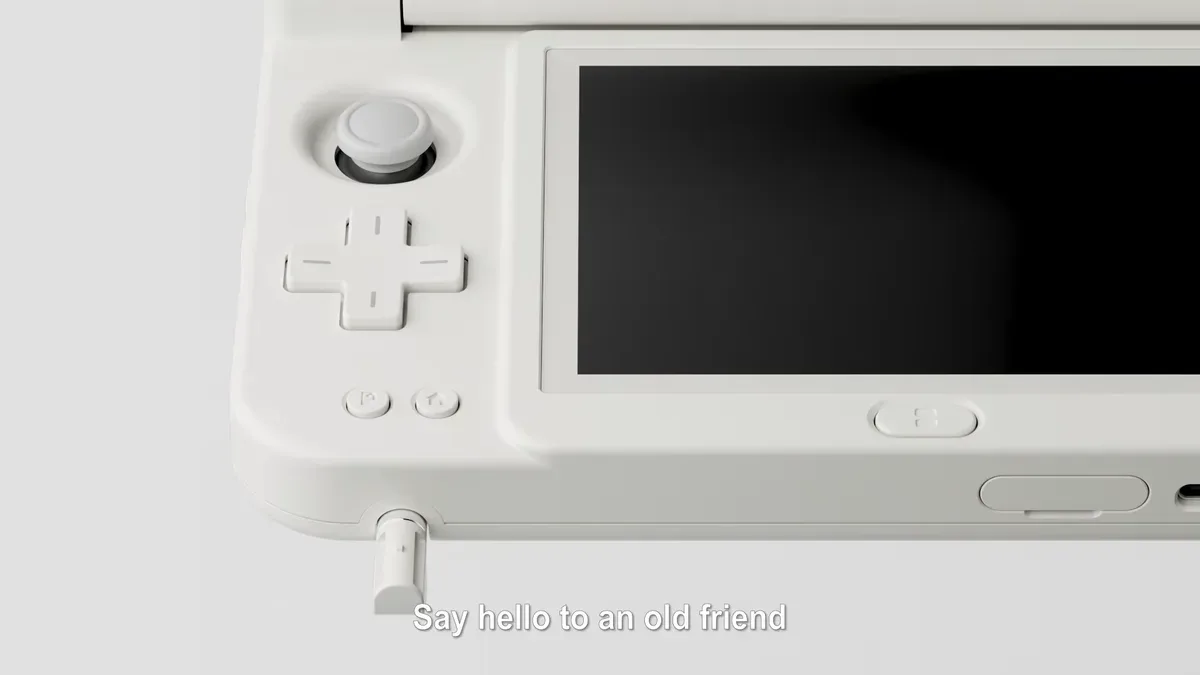
Anbernic has also made several noticeable changes to the control scheme. Rather than copying the New 3DS arrangement exactly, the RG DDS includes two full-size recessed analog thumbsticks. That is a meaningful choice for players who prefer conventional sticks over the original system's small C-Stick nub. It may also help with games that rely on analog camera movement or benefit from a more modern control feel.
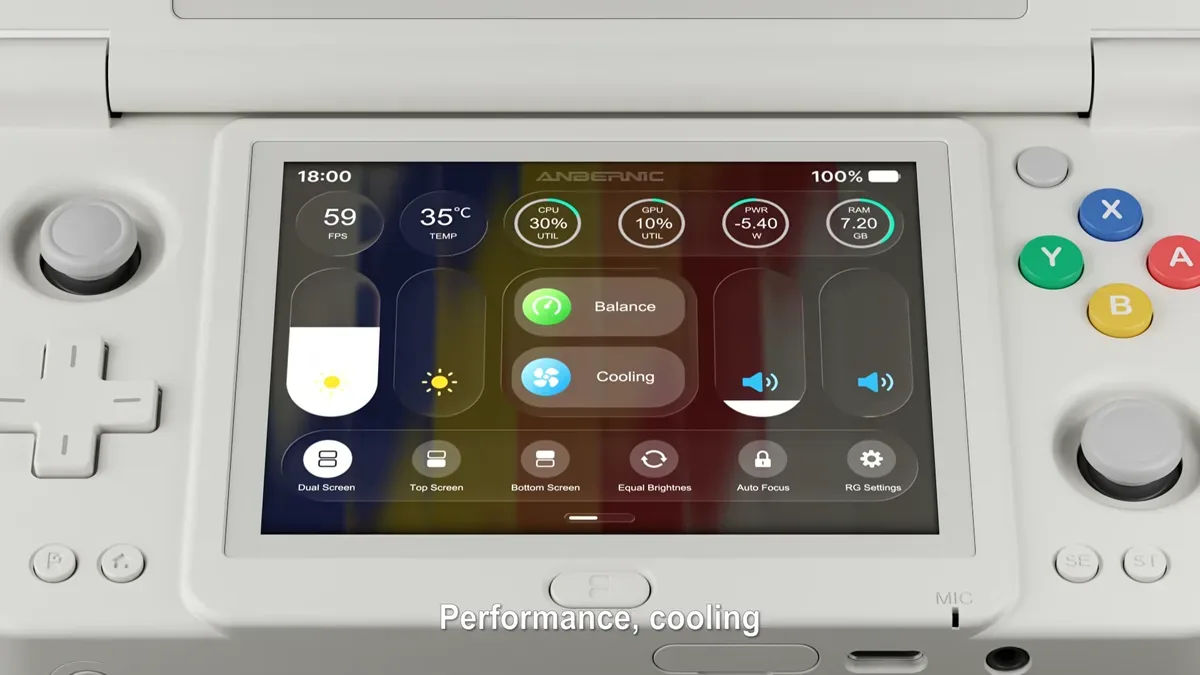
The lower half of the clamshell includes familiar face buttons, a directional pad, and additional controls for the device's operating system and emulation functions. These include Home, R, Start, and Select-style buttons. Anbernic has placed a dedicated AI button in the upper-right area where the New 3DS had its small camera-related hardware feature. The company has not explained what this button will do, so it remains unclear whether it will be tied to an assistant feature, system shortcuts, translation functionality, or something else entirely.
An integrated stylus is also part of the design. This is essential for a handheld inspired by DS and 3DS hardware, as so many games were built around direct touchscreen interaction. The stylus slot has been moved to the left side of the unit rather than sitting just right of center, as seen on the recently announced RG DS Plus.
Battery, Audio and Ports Point to a Premium Position
Beyond its screens and processor, the RG DDS is said to include front-firing speakers, a 6,000mAh battery, and a new z-axis linear vibration motor. Anbernic describes the motor as providing strong, nuanced feedback. Haptics are not the most important consideration for a retro handheld, but better vibration can add polish in compatible games and make the system feel less like a basic emulation box.
The listed battery capacity is notably generous for a compact clamshell, though capacity alone cannot determine real-world endurance. Two active displays, a high-performance processor, display brightness, wireless settings, and the workload created by 3x resolution scaling will all affect play time. Battery testing will be needed to establish how the RG DDS holds up during long sessions with more demanding software.
On the exterior, the device appears to place its headphone jack on the right side. The bottom edge houses the USB-C connection and a covered microSD card slot. There is no cartridge port, which is unsurprising for an emulation-focused handheld but worth noting for anyone hoping to use original physical game media. Storage expansion through microSD will instead be the relevant option for users maintaining their own legal game backups and software libraries.
Where the RG DDS Fits in Anbernic's Lineup
The RG DDS seems designed as the more capable sibling to Anbernic's other dual-screen products. The company already offers the RG DS at around $100, a less ambitious option geared toward DS-era games. That system should be sufficient for players mainly interested in 2000s DS releases and their original two-screen format.
For buyers who simply want an affordable folding handheld for DS-style play, the MagicX Zero 40 has also emerged as a lower-cost alternative at $75. The RG DDS is addressing a different audience: players who want additional processing power, a more premium build direction, larger displays, and stronger prospects for high-resolution 3DS emulation.
It also arrives as Anbernic prepares the RG DS Plus, another dual-screen model with an integrated stylus. Based on the hardware revealed so far, the RG DDS appears likely to sit above that system in the range. Its Snapdragon G2 Gen 2 platform, larger display specifications, and 6,000mAh battery all suggest that it is intended to be the enthusiast-facing option.
Price Will Be Crucial Against Dedicated Rivals
No MSRP has been confirmed, leaving one of the biggest questions unanswered. The RG DDS will likely be compared with the Retroid Pocket Duo and the Ayn Thor, both of which are targeting the growing demand for dual-screen handhelds capable of tackling 3DS-era software. Anbernic's opportunity may be to offer comparable functionality at a more aggressive price, but that will depend on the final component list and software execution.
A price around $200 has been suggested as a possibility, though this remains speculation until Anbernic makes an official announcement. If the RG DDS lands near that figure, it would need to demonstrate that its screens, ergonomics, performance, and firmware are competitive enough to justify its position above simpler DS devices.
For now, the RG DDS is a promising tease rather than a finished product with a complete feature sheet. Its design makes the intended audience immediately clear: players looking for a modern clamshell that preserves the practical two-screen structure of DS and 3DS games without attempting to recreate every original hardware feature. More details on memory, storage, software, price, and availability will determine whether Anbernic's newest foldable becomes a standout option or simply another contender in an increasingly crowded handheld field.
Community
Discussion
Start the conversation.
No comments have been posted yet.