


Sonic the Hedgehog has made an unexpected new stop on his decades-long tour of gaming hardware. Aonic, a fan-made playable demo by developer Reassembler, brings Sonic the Hedgehog's famous Green Hill Zone Act 1 to Commodore Amiga A1200 hardware. It is an ambitious technical project that aims to reproduce the original 1991 Mega Drive experience as closely as possible, from the course layout and enemy placement to Sonic's movement, pace, and physics.
The demo is particularly striking because Green Hill Zone is not merely an early level from a beloved platformer. It is one of the most instantly recognisable stages in video game history: a bright landscape of checkerboard cliffs, palm trees, rings, looping paths, and badniks that helped establish Sonic as Sega's defining character. Recreating that stage convincingly on an Amiga is therefore a high bar, and Aonic's first public showing appears to clear much of it.
Aonic is currently focused on Green Hill Zone Act 1 rather than offering a complete conversion of the original game. Even with that limited scope, though, the project presents a playable take on a level that has been carefully adapted from the Mega Drive code. The result is designed to preserve the fundamentals players associate with Sonic's debut: rapid acceleration, rolling momentum, slopes, springs, loops, enemies, and the constantly shifting routes that encourage repeat runs.
A Mega Drive classic reworked for Amiga hardware
Originally released in 1991, Sonic the Hedgehog became Sega's best-selling game and transformed its blue mascot into a global multimedia star. Its appeal was not solely built around speed, even if speed became Sonic's defining marketing hook. The game's stages mixed fast downhill stretches with platforming, traps, alternate paths, and momentum-based movement. Green Hill Zone demonstrated that formula immediately, using its inviting visual identity to introduce players to a character and a world built to contrast sharply with the era's other major platforming icons.
For useful background on this topic, read Ancient Magic: Bazoe! Mahou Sekai Returns on Switch in Japan This November.
That legacy makes Aonic's goal easy to understand. The demo is not just putting a fast blue character into a broadly similar tropical level. Reassembler's work is intended as a close technical and gameplay recreation. Side-by-side footage of the Mega Drive original and the Aonic build emphasizes how closely the Amiga version follows its inspiration in both presentation and play.
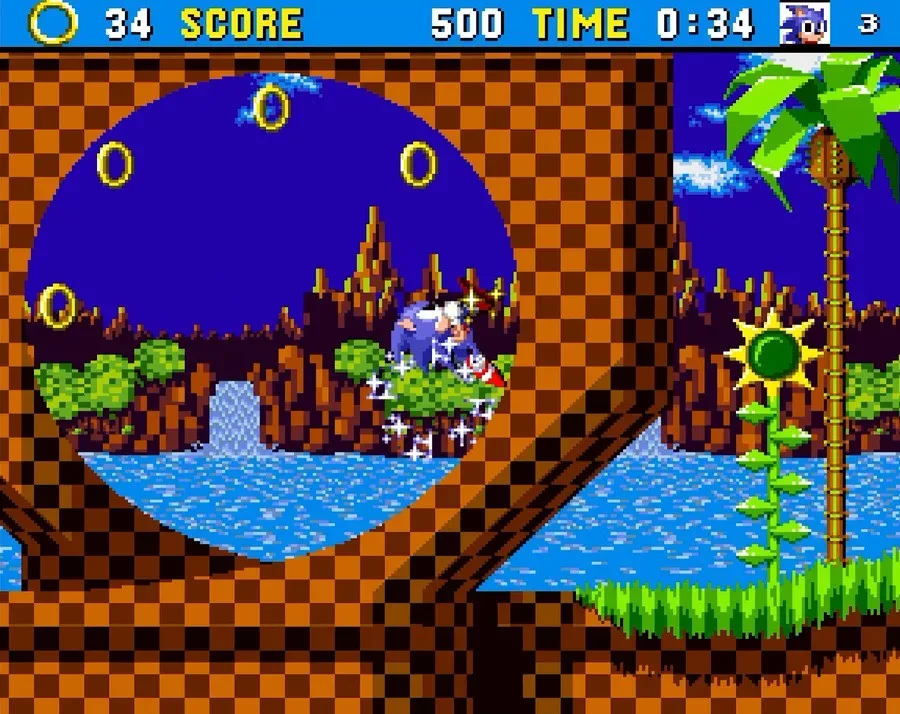
Visually, the demo comes very close to the Mega Drive game's look. Green Hill's familiar scenery, sprites, and colours have all been recreated with a level of care that makes the comparison especially compelling. There is one notable interface difference: the heads-up display cannot use the transparency seen in the original, so it sits outside the main gameplay area. That is a practical alteration, but it does little to diminish the overall effect of seeing Sonic race through this particular stage on the A1200.
The project is also a collaborative achievement. The Mega Drive-like colour palette used by Aonic is supported by work from another modder, RetroRic, whose own Amiga demo arrived in January 2026. RetroRic's colour work and Reassembler's code adaptation have combined to help create a version of Green Hill that looks substantially closer to Sega's original than a casual observer might expect from the platform shift.
For another perspective on this story, read Aonic Brings Sonic's Green Hill Zone to Amiga A1200 in a Remarkably Faithful Fan Demo.
Faithfulness extends beyond the scenery
Visual similarity can make an impressive first impression, but Sonic conversions live or die on motion. The original game's level design was built around its physics model. Sonic needed to build momentum, carry speed through slopes, react to terrain, and navigate routes that could either reward confidence or punish reckless movement. A recreation that only copied the art would not capture the point of Green Hill Zone.
Aonic's stated focus on the original stage design, enemies, speed, and physics is therefore central to why the demo is attracting attention. The build seeks to make the action feel recognisably like the Mega Drive release rather than simply resemble it in screenshots. Loops and curves are especially useful tests for such a project, since they reveal whether character movement, collision, scrolling, and level construction are working in concert.
For retro hardware enthusiasts, that makes Aonic interesting on two levels. It is a chance to revisit a landmark stage through a different machine, but it is also a demonstration of what can be achieved through detailed fan development on the Amiga. The Commodore Amiga remains a fertile platform for hobbyist projects, demos, new games, and technical experiments long after its original commercial era. Aonic fits neatly into that tradition while using one of gaming's most famous properties as its showcase.
There is a level editor, and even a familiar cheat
Although Aonic currently contains only Green Hill Zone Act 1, it includes more than the basic stage run. Reassembler has also added a level editor. It is presently unoptimised and runs sluggishly on Amiga technology, so it is clearly a work-in-progress feature rather than a finished creative suite. Still, its inclusion indicates that the project has ambitions beyond a simple proof of concept.
The demo also contains the classic Level Select cheat. The familiar input is Up, Down, Left, Right, A + Start. At this stage, the feature is naturally of limited practical use because the rest of Sonic's zones have not yet been implemented. Nevertheless, it is a fun sign of the attention being paid to the original game's details and quirks. It also leaves open the appealing possibility that additional stages could eventually give that menu a more substantial purpose.
Whether Aonic ultimately grows into a larger adaptation remains uncertain. The available demo establishes Green Hill Zone Act 1 as its current playable focus, and no completed version of the full 1991 game has been announced. For now, the value lies in what is already present: a technically impressive recreation of the first level, playable on the hardware for which it was created as well as through compatible emulators.
The big missing piece is sound
The most obvious absence in Aonic is audio. Green Hill Zone's upbeat theme is inseparable from the stage for many players, and the original game's sound effects are similarly iconic. The ring collection chime, jumps, springs, enemy destruction, and other feedback sounds are key parts of Sonic's rhythm. Their absence means the demo cannot yet be considered a complete sensory recreation of the Mega Drive experience.
Aonic does include the opening "Se-ga" jingle, but it does not currently feature Green Hill Zone's music or the main in-game sound effects. Reassembler has indicated that sound could be added at this point, but the preference is to wait until the classic audio can be recreated with the same degree of fidelity being pursued for the visual and gameplay components.
That approach makes sense for a project whose strongest quality is its close attention to the original. A rough or poorly matched soundtrack might fill silence, but it could also undermine the careful work already visible elsewhere. Waiting for a more faithful audio solution means Aonic remains unfinished in an important area, yet it also suggests that its development priorities are focused on matching the source material rather than checking off features quickly.
Aonic's Green Hill Zone recreation is already an impressive demonstration of Amiga A1200 development, even before its soundscape catches up with its visuals and movement.
Playable on original hardware and emulators
Aonic is compatible with original Amiga A1200 hardware as well as a range of emulators, making it accessible to both dedicated collectors and players who experience Amiga software through modern setups. The demo is available from Reassembler's itch.io page, which also includes further information about the modifications and adjustments used to make the Amiga version possible.
Its release is a reminder that retro gaming's most interesting projects are not always newly discovered commercial releases. Sometimes they are labours of technical curiosity: projects that ask how a game associated with one piece of hardware might look and feel on another. In this case, the question has produced a surprisingly convincing answer. Sonic's Green Hill Zone may have been built for Sega's Mega Drive, but Aonic demonstrates that the Amiga A1200 can deliver a very credible run through its loops, slopes, and checkerboard scenery.
For Sonic fans, Amiga enthusiasts, and anyone who enjoys seeing classic systems pushed in unexpected directions, Aonic is worth watching. It is not a full game, and its missing music and effects are impossible to overlook. Yet the quality of the existing stage, the attention to movement and visuals, the level editor, and the inclusion of familiar secrets all make this far more than a novelty. It is a focused fan project with an unusually strong first act.

Community
Discussion
Start the conversation.
No comments have been posted yet.