

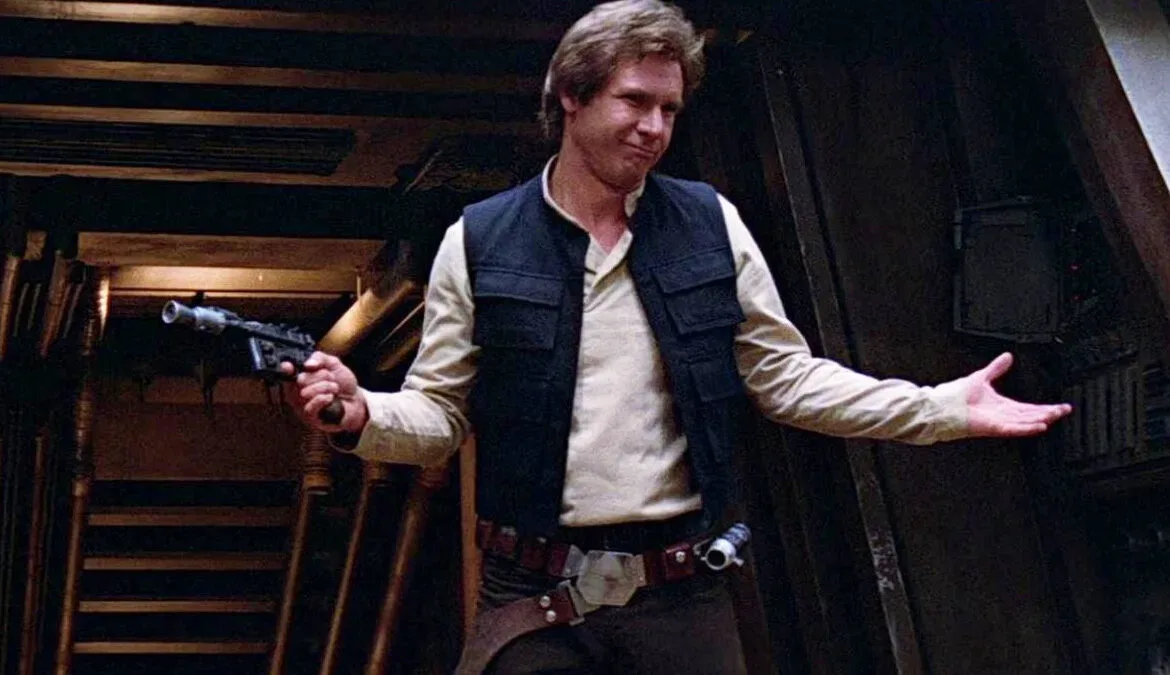
Footage said to be from Project Orca, EA's long-cancelled open-world Star Wars game, has apparently surfaced online. The clip runs for roughly three minutes and appears to show a very early build of the project, offering an unexpected glimpse at the combat ideas, environmental interaction, and wisecracking adventure-game tone that might have defined the finished release.
Because the video appears to be material from an unfinished and cancelled production, it should be treated with appropriate caution. It does not provide a full picture of what Project Orca would have become, nor does it establish how far along the game was when work ended. Still, the footage is notable because Project Orca has long been one of several high-profile single-player Star Wars projects that never reached players during EA's stewardship of the license.
What can be seen suggests an action-adventure with a roguish protagonist, a desert-world setting, and an emphasis on using the surroundings in a fight rather than simply firing at enemies from behind static cover. The result looks markedly different from the Star Wars games that ultimately did arrive, while also revealing why observers have drawn comparisons to a certain celebrated PlayStation adventure series.
What the apparent Project Orca clip shows
The footage centers on a fast-talking antihero in a black vest as he approaches wreckage on what appears to be a desert planet. A confrontation soon begins with large reptilian opponents. The character's banter and outwardly improvised style establish a scoundrel-like personality immediately, fitting comfortably within a galaxy that has always made room for smugglers, bounty hunters, and reluctant heroes.
For useful background on this topic, read ARZOPA 16.1-Inch 144Hz Portable Gaming Monitor Drops to $92.
The most interesting element is the apparent interactivity of the environment. Blaster fire seems able to tear apart pieces of metal and sections of cover. In one moment, the player fires at the ceiling, sending debris crashing down into the encounter space. The character also appears capable of grabbing loose shrapnel and positioning it as improvised protection.
These details point toward combat spaces intended to be more reactive than a conventional shooting gallery. Rather than treating cover as permanent scenery, Project Orca seemingly wanted players to damage it, bring material down on opponents, and adapt to the changing state of a fight. The protagonist can also throw sand into an enemy's face, an especially scrappy move that reinforces the game's rough-and-ready attitude.
None of those mechanics can confirm the depth of the final design, especially given the apparent early-development state of the material. A proof-of-concept sequence can contain systems that are later changed, reduced, or removed entirely. Even so, the footage gives Project Orca an identity beyond its codename: it appears to have been a Star Wars adventure built around opportunistic, physical, and somewhat unruly combat.
For another perspective on this story, read Apparent Project Orca leak shows EA's canceled Star Wars game.
Why the Uncharted comparison makes sense
Viewers have understandably noted echoes of Uncharted in the clip. The protagonist's constant quips, black-vested look, adventurous pacing, and willingness to use whatever happens to be nearby all create a familiar impression. That resemblance is not merely superficial when Project Orca's development history is considered.
Before Orca, EA had been developing another Star Wars action game internally under the codename Ragtag. That title was associated with Amy Hennig, the creator of Uncharted, and Visceral Games, the studio best known for Dead Space. Ragtag was planned as a single-player action experience, but EA closed Visceral in 2017, ending the project in the process.
Project Orca was subsequently handled by EA Vancouver and was said to have inherited a substantial amount of work from Ragtag. That lineage makes the overlap in tone far less surprising. The leaked-looking material does not mean Orca was simply Ragtag under another name; its open-world direction distinguished it from the earlier effort. But the shared DNA helps explain why the character work and action staging evoke Hennig's previous games.
It also puts the footage in a more melancholy light. What appears to be an isolated test or slice of gameplay may represent a later attempt to reshape ideas that had already survived one major cancellation. Rather than being a completely disconnected concept, Orca seems to have occupied a complicated place in EA's wider Star Wars development history.
A chain of cancelled Star Wars projects
Project Orca was cancelled in 2019. It sits in the middle of a painful sequence of shelved EA single-player Star Wars games: Ragtag came first, Orca followed, and a later EA Vancouver project known as Viking was also cancelled. Each project had its own circumstances and design goals, but together they illustrate how difficult it was for EA to carry several ambitious Star Wars concepts through to release.
Ragtag's cancellation followed the shutdown of Visceral Games. Orca's apparent move toward an open-world structure represented a different route for the publisher's Star Wars ambitions, but that project did not make it to market either. After EA Vancouver moved on from Orca to Viking, that effort was cancelled as well.
The sequence is important context for fans looking at the apparent footage and wondering why such a promising-looking concept disappeared. A short clip can make cancellation feel baffling, particularly when it demonstrates responsive destruction, character animation, combat ideas, and a clear tonal hook. Yet game development is shaped by far more than the quality of one encounter or prototype. Scope, production realities, shifting priorities, and the challenge of turning a concept into a complete game can all determine whether a project survives.
For that reason, the clip should not be read as definitive proof that EA abandoned a nearly finished blockbuster. It is instead a rare view into a project whose potential is easier to imagine now than it was possible to assess from its public record alone.
Not the same as Star Wars Outlaws or Star Wars 1313
The renewed attention around Orca has also prompted comparisons with Ubisoft's open-world Star Wars Outlaws. There are obvious broad similarities: both place a scoundrel-style character in a Star Wars setting and both are associated with open-world ambitions. But they are separate games developed by different teams, with different creative histories and production paths.
Project Orca is also distinct from Star Wars 1313, another famously unrealized Star Wars game. That project was developed at LucasArts before Disney's ownership of the company left it in prolonged uncertainty. Although fans often group cancelled Star Wars games together, 1313, Ragtag, Orca, and Viking belong to separate efforts with different studios and corporate circumstances behind them.
That distinction matters because each cancelled project represented a different possible direction for the franchise. 1313 was associated with the criminal underworld. Ragtag had Hennig and Visceral's cinematic-action pedigree. Orca appears to have pushed toward an open-world adventure with emergent-feeling environmental combat. Viking came afterward as yet another unrealized EA Vancouver undertaking.
Star Wars games have continued to move forward
Despite the losses represented by these cancelled projects, Star Wars game development has not stood still. This year brought two acclaimed releases in Star Wars: Zero Company and Star Wars: Galactic Racer. Neither is a single-player open-world adventure in the mould apparently pursued by Orca, but their reception shows that the franchise continues to support varied game concepts beyond one specific action format.
Meanwhile, Amy Hennig remains active in big-budget licensed game development. She is working on Marvel 1943, a crossover featuring Captain America and Black Panther. The game has not been cancelled.
For Project Orca, however, the apparent footage may be as close as players ever get to seeing its ideas in action. The clip preserves a fragment of a game that seems to have aimed for breakable surroundings, improvised tactics, and a charismatic outlaw at the center of a Star Wars adventure. It cannot tell the complete story of what EA Vancouver planned, but it gives the cancelled project more shape than a codename and a list of industry cancellations ever could.
That is why the video has attracted attention: not because it rewrites the outcome for Orca, but because it briefly shows the version of Star Wars players might have received if one more ambitious EA project had made it across the finish line.
Community
Discussion
Start the conversation.
No comments have been posted yet.