

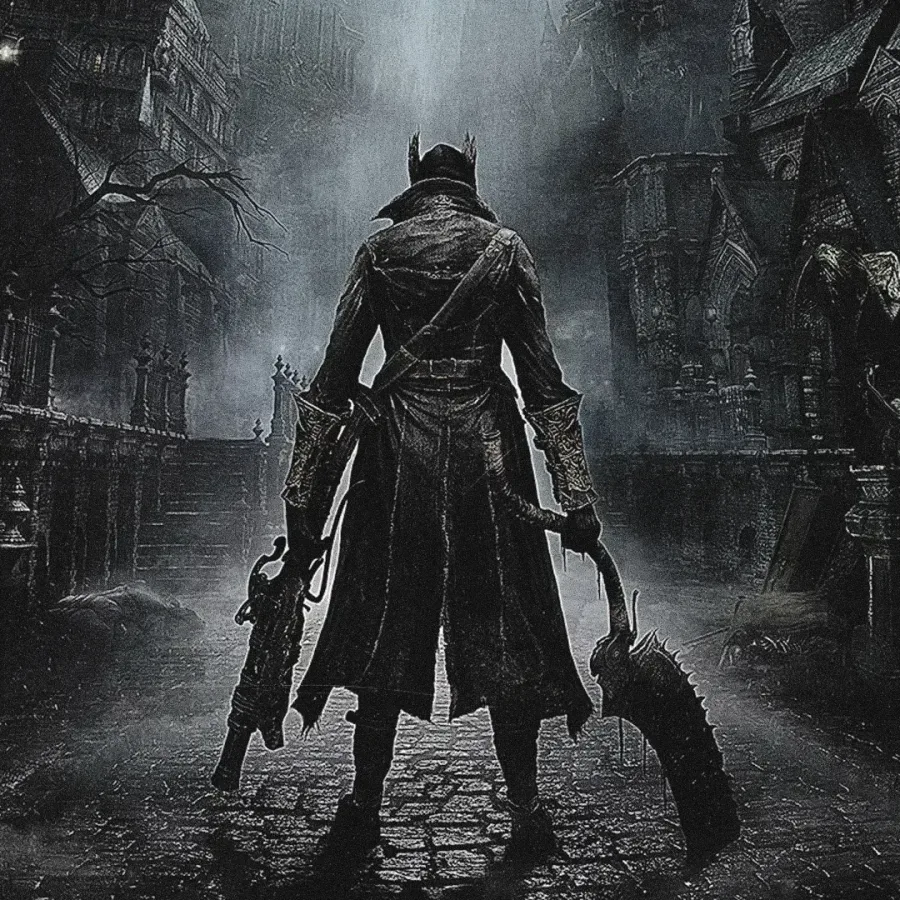
The animated Bloodborne movie has taken a substantial step forward behind the scenes. Producer Seán "Jacksepticeye" McLoughlin has confirmed that the project now has both a writer and a director attached, marking notable progress since the film's initial announcement more than six months ago.
Those names are still being kept private, and there is no release window or public creative-team reveal yet. However, McLoughlin's comments indicate that the film has moved beyond the earliest planning stage. The adaptation's story direction is being mapped out, key people are in position, and the production is aiming to share more concrete details when the team is ready.
For fans of FromSoftware's PlayStation gothic horror landmark, that is an encouraging update. Bloodborne has remained one of the most requested candidates for a wider multimedia revival ever since its 2015 debut, but its dense atmosphere, cryptic lore, grotesque transformations, and player-driven storytelling make it far from a straightforward property to adapt. The choice to make this project animated, rather than live action, appears central to the team's thinking about how it can preserve the game's strange and unsettling identity.
A Writer and Director Are Now Attached
McLoughlin described the film as being much further along than it was at announcement, even while stressing that he cannot yet disclose the full plan. He said there is now a clearer roadmap for the story and that personnel are in place to bring the movie forward.
For useful background on this topic, read Phantom Blade Zero day-one patch Targets Ray Tracing, Bugs and Nvidia Driver Stability.
That does not answer the biggest remaining questions for audiences. There is still no confirmation of the animation studio, cast, distributor, runtime, visual style, or whether the story will feature familiar game characters. But attaching a writer and director is an important threshold for any screen project. It suggests that the adaptation is beginning to settle on a specific creative perspective rather than existing solely as an announced concept.
McLoughlin also acknowledged the immense expectations surrounding the property. He characterized Bloodborne as a monumental IP and spoke about the pressure of trying to get its details right. He did not suggest that any adaptation could satisfy every individual expectation, but he made clear that precision and care are part of the production's approach.
That mindset matters especially for a game that has invited years of debate over its symbolism, hidden history, factions, cosmic mythology, and even the meanings players draw from its locations. A film cannot reproduce the exact act of discovery that comes from navigating Yharnam, reading item descriptions, losing to bosses, and comparing interpretations with other players. It can, however, offer another viewpoint on the setting--provided it has a reason to exist beyond retelling the same journey.
Why Animation May Fit Bloodborne Better Than Live Action
McLoughlin contrasted the Bloodborne project with Alex Garland's live-action Elden Ring film. In his view, the sheer scale required to fully realize a game such as Elden Ring in live action would be extraordinarily costly and complicated. He suggested that animation provides tools that can be especially effective for Bloodborne, whose world leans heavily into the surreal, the otherworldly, and the horrific.
That assessment is easy to understand from the game itself. Bloodborne begins with a city gripped by a plague-like hunt, but its setting grows steadily more uncanny. Its Victorian and gothic inspirations collide with eldritch imagery, nightmare spaces, impossible beings, blood rituals, and creatures that feel designed to challenge what the audience thinks they are seeing.
Live action can certainly portray elaborate fantasy horror, but animation offers a different level of flexibility. It can transform architecture, motion, scale, color, anatomy, and perspective without needing every uncanny image to pass through the practical restrictions of sets, makeup, compositing, green-screen work, or photorealistic visual effects. An animated Bloodborne feature could potentially make Yharnam feel painterly, feverish, expressionistic, or violently stylized in ways that are not trying to resemble ordinary reality.
McLoughlin's point was not simply that animation is cheaper. His comments instead frame it as a creative advantage: a medium capable of doing things that a live-action version might struggle to achieve convincingly. For a world filled with cosmic horror, animation may allow the movie to embrace heightened imagery rather than compromise it.
Of course, "animated" still leaves a vast range of possibilities. The film could ultimately use hand-drawn, 3D, hybrid, or another style entirely. No official visual material has been shown, so fans should not assume a particular look from the announcement alone. The most important detail for now is that the format is intended to help the adaptation express what makes the game distinctive.
The Goal Is Not to Replay the Game's Story
Perhaps the most revealing part of McLoughlin's update concerns the question of adaptation itself. He said he does not want to make an adaptation that merely tells the game's existing story again with the same characters. Instead, he wants a film to find a story that is worth telling specifically in the new medium.
This is a meaningful distinction. Games and films organize audience involvement very differently. A game is interactive: players determine pace, discover paths, fail and retry, and develop personal attachment through action. A film is passive by comparison, but it can control framing, rhythm, performance, editing, and emotional focus in more concentrated ways. A strong adaptation needs to understand those differences rather than act as if the only objective is to convert gameplay events into scenes.
McLoughlin said the key question is why an adaptation should be made at all. For him, the answer should involve using the new medium to pursue ideas that the original format cannot approach in the same way. That could mean centering a different figure in the world, examining a corner of Yharnam that the game only hints at, or telling a story that sits alongside the Hunter's path instead of replacing it.
He pointed to recent examples such as Fallout and Resident Evil as models for the broader principle of shifting the perspective within an established universe. Those kinds of projects can retain the setting, tone, rules, and recognizable details while letting viewers encounter an original narrative. The approach can give longtime fans something new while avoiding a beat-for-beat recreation they already know.
That philosophy seems particularly well suited to Bloodborne. The game's lore is intentionally incomplete and its world is full of unanswered questions. There is latitude to explore institutions, hunters, citizens, scholars, cults, or entirely new characters without needing to overturn the player's own interpretation of the game's protagonist. The movie has not revealed its exact premise, so this remains speculation, but McLoughlin's comments strongly suggest that the team is looking for expansion rather than duplication.
Elden Ring Will Be a Point of Comparison, Not a Blueprint
The upcoming Elden Ring movie will likely draw comparisons whenever more information about Bloodborne emerges. Both originate from FromSoftware worlds known for challenging combat, environmental storytelling, enormous lore communities, and fantastical settings that resist simple explanation. Yet McLoughlin emphasized that the two games are fundamentally different in their worlds and storytelling possibilities.
He said the Elden Ring film may offer lessons simply because it is expected to arrive first. Creative teams can look at another major game adaptation and consider what it attempted, what ideas overlap, and how audiences respond. But McLoughlin also expressed caution about taking too much influence from it. His aim is for Bloodborne to offer something unexpected rather than repeat another adaptation's choices.
That separation is sensible. Elden Ring operates across broad mythic landscapes of gods, ruins, and vast fantasy regions, while Bloodborne is more tightly associated with a diseased gothic city and its descent into cosmic nightmare. They share some structural DNA as FromSoftware works, but their tones, imagery, and emotional textures are very different. Treating their screen adaptations as interchangeable would risk flattening what makes each one memorable.
When Could More Be Revealed?
No timetable for the next announcement has been provided. McLoughlin said he hopes the production can share who is involved, where the film is headed, and small hints about the story sooner rather than later. Until that happens, fans should be careful about treating potential event appearances as confirmed.
The Game Awards in December is one possible venue for a reveal, though nothing has been announced. Other gaming or entertainment events next year could also make sense, particularly if the production is ready to introduce its writer, director, or visual direction. At this stage, those are opportunities rather than promises.
For now, the clearest takeaway is simple: the animated Bloodborne movie is progressing, it has a writer and director, and its producers are pursuing an original story within the game's universe instead of a direct replay of the existing narrative. There is still a long way to go before audiences can judge the final result, but the project's early creative priorities--animation, world expansion, and respect for the game's singular atmosphere--give fans meaningful reasons to watch its next steps closely.
Community
Discussion
Start the conversation.
No comments have been posted yet.