

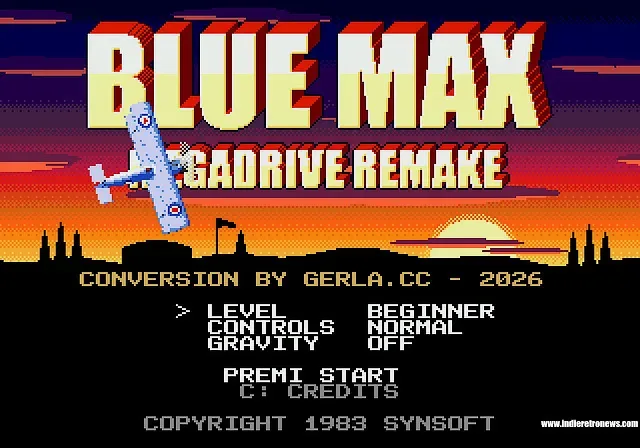
Blue Max: Megadrive Remake is taking a classic World War I arcade flight game back to the skies on Sega's Mega Drive hardware. Created by homebrew developer gerla.cc, the project revisits the aerial bombing-and-dogfighting formula associated with the 1983 original while rebuilding it specifically for the Mega Drive and Genesis. The result is not merely a conversion of an older release: it is a ground-up remake designed around the strengths of Sega's 16-bit machine.
The remake draws its direct inspiration from Peter Adams' Commodore 64 version of Blue Max, itself based on Bob Polin's 1983 game. That lineage matters because the Commodore 64 edition is remembered for its distinctive mix of low-altitude flying, target destruction, landings and score-driven rank progression. gerla.cc's project retains those foundations, but presents them with a changed visual approach, smoother performance and options intended to make the game more approachable for new players without abandoning the challenge that defines the original concept.
A biplane campaign built around bombing runs
At its core, Blue Max: Megadrive Remake puts players in control of a biplane flying over a World War I battlefield. Missions involve navigating a landscape of rivers, roads and bridges while seeking out enemy assets. Tanks, ships and buildings are all potential bombing targets, while hostile aircraft create a second danger in the form of dogfights. Success is not simply about staying airborne or shooting down every opponent; players need to manage their route, line up attacks, avoid crashes and choose when to return to safety.
That balance is a key part of what makes the original design enduring. Flying near the ground provides opportunities to hit targets, but it also sharply increases the risk of colliding with terrain and obstacles. Meanwhile, enemy fighters demand attention in the air. A player concentrating entirely on bombing can be exposed to attacks from above, yet chasing aircraft too aggressively may waste precious ammunition or carry the biplane away from the objective. It is an old-school action structure where quick reactions are important, but positioning and restraint are just as valuable.
For useful background on this topic, read BioWare's Legacy Continues Through a Wide Range of New Games and Stories.
Friendly airfields are essential stops between attacks on the enemy city. Landing at them lets pilots refuel, repair any damage suffered during combat and replenish their ammunition. This gives each flight a practical rhythm: head out, attack targets, survive incoming threats, then safely guide the aircraft down before its resources are exhausted. Missing a landing or pushing a damaged machine too hard can be as costly as losing a dogfight.
Climbing from trainee to Blue Max
Progression also remains central to the remake's structure. Pilots begin at the humble rank of Kamikaze Trainee and work toward earning the prestigious Blue Max rank. The goal gives the action a broader arc beyond a single successful sortie. Every target destroyed, landing completed and enemy encounter survived feeds into a campaign-like sense of advancement, even though the gameplay remains rooted in direct arcade-style flying.
The rank system fits the game's escalating demands. Early on, the basics are clear enough: take off, follow the terrain, bomb enemy positions and return to a friendly strip. As pressure builds, players must become more consistent at judging altitude, aligning bombing passes, navigating the map and preserving enough fuel and ammunition to complete the next task. The journey to Blue Max is therefore a test of mastery over the entire loop rather than just an exercise in firing weapons.
For players familiar with the 1983 game, keeping this progression is an important sign that the project aims to preserve its identity. The remake is updating presentation and adding choice, but it is still built around the same struggle to turn an initially vulnerable trainee pilot into an accomplished ace.
Rebuilt for Sega's 16-bit console
Rather than adapting old code, gerla.cc has rebuilt the game from the ground up for the Mega Drive and Genesis. The remake is designed to run at a smooth 60 frames per second, a substantial priority for a game based on fast movement close to the ground. Consistent fluidity should be particularly meaningful during sharp course corrections, bombing approaches and aerial duels, where delayed visual feedback can make an already demanding game feel harsher than intended.
The visual overhaul uses a fresh perspective and graphics rendered from 3D models. This separates the project from a straightforward pixel-for-pixel recreation. The original gameplay world--its roads, rivers, bridges, structures and combatants--remains the basis, but the presentation has been reworked for the Mega Drive version. That approach can give the remake its own character while still making its historical inspiration immediately recognizable.
There is an AI-related disclosure attached to the project's graphics. AI was used for the rotations of the 3D models. The stated use is specific to that rotational work, rather than a broad claim that all art was AI-generated. In an era when retro projects often prompt questions about how assets are made, that clarification provides useful context for anyone following the remake's visual development.
Difficulty and control options for different pilots
One of the most notable additions is a set of settings intended to suit varying levels of familiarity with this kind of flight action. Blue Max: Megadrive Remake includes three difficulty choices: Beginner, Advanced and Expert. The options should give first-time players a lower-pressure route into a game that can otherwise be intimidating, while veterans can select a tougher setting closer to the demanding spirit of the early-1980s design.
Flight behavior can also be tailored through a gravity toggle. Players may switch gravity on or off, creating a significant choice in how the biplane handles during low passes and recovery maneuvers. Keeping gravity enabled is likely to preserve a more traditional sense of aerial weight and risk. Turning it off offers a more forgiving alternative for players who want to focus on target runs and combat without battling the same degree of downward pull.
There are also two control modes, Normal and Pilot. The inclusion of both suggests that the remake is aiming to accommodate different expectations around steering a plane in a game environment. Some players will prefer controls that are easier to read immediately, while others may want a scheme that better matches their idea of piloting an aircraft. The important point is that neither newcomers nor long-time fans are limited to one handling model.
Those options do more than add a menu of preferences. They address one of the biggest hurdles facing revivals of classic games: preserving the underlying challenge while recognizing that modern players arrive with different habits, displays and expectations. A highly rigid remake can be satisfying for a narrow audience, but flexible difficulty and control settings let players decide how closely they want to engage with the old-school pressure.
A promising homebrew revival for Mega Drive fans
The Mega Drive homebrew scene continues to find interesting ways to revisit game history, and Blue Max: Megadrive Remake is a particularly fitting candidate for that treatment. Its combination of clear objectives, rapid runs, resource management and escalating skill requirements suits the immediate, controller-first character of Sega's 16-bit console. The move to 60fps and the new 3D-model-based visuals further give it an identity beyond nostalgia alone.
Most importantly, the project appears to understand what needs to survive the transition. Players are still a biplane pilot threading dangerous routes through a battlefield. They are still bombing tanks, ships and buildings, exchanging fire with enemy aircraft, and relying on airfields to keep the mission alive. They are still pursuing the Blue Max rank through repeated improvement. The difference is that this familiar framework has been reconstructed with the Mega Drive in mind.
For enthusiasts of World War I-themed action, Commodore 64 history, and new games developed for retro hardware, this remake is one to watch. gerla.cc's version is aiming to make an old aerial challenge feel active and responsive on Sega's classic system, without losing the risky landings, strategic attack runs and hard-earned victories that made Blue Max memorable in the first place.
Community
Discussion
Start the conversation.
No comments have been posted yet.