

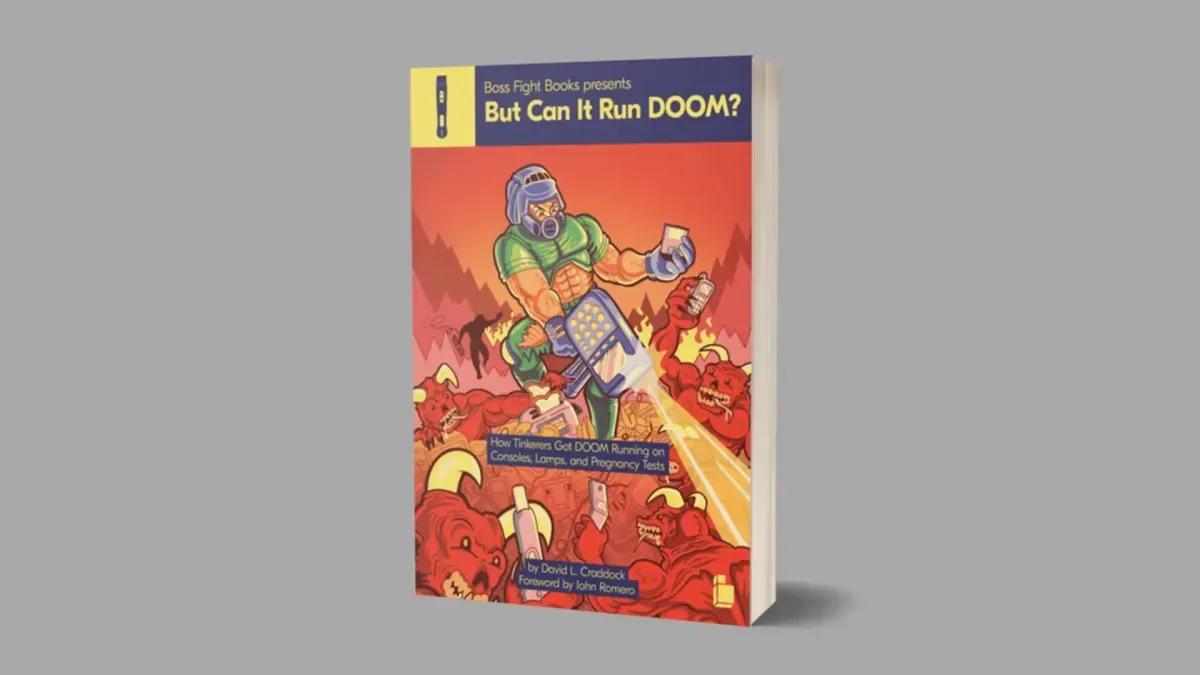
Few games have become as synonymous with technical experimentation as Doom. id Software's landmark shooter is still played in conventional ways on PCs and retro hardware, but it has also become the ultimate benchmark for a particular kind of engineering mischief: getting a playable version onto a device that was clearly never intended to run a first-person shooter.
That long-running challenge is now being turned into a physical book. But Can It Run Doom?, written by David L. Craddock and published by Boss Fight Books, is currently seeking backing through Kickstarter. The project is built around original interviews with the creators and tinkerers behind some of the strangest Doom ports ever attempted, from a pregnancy test and a pair of earrings to an Ikea lamp, a Twitter bot, and even a field of Minecraft sheep.
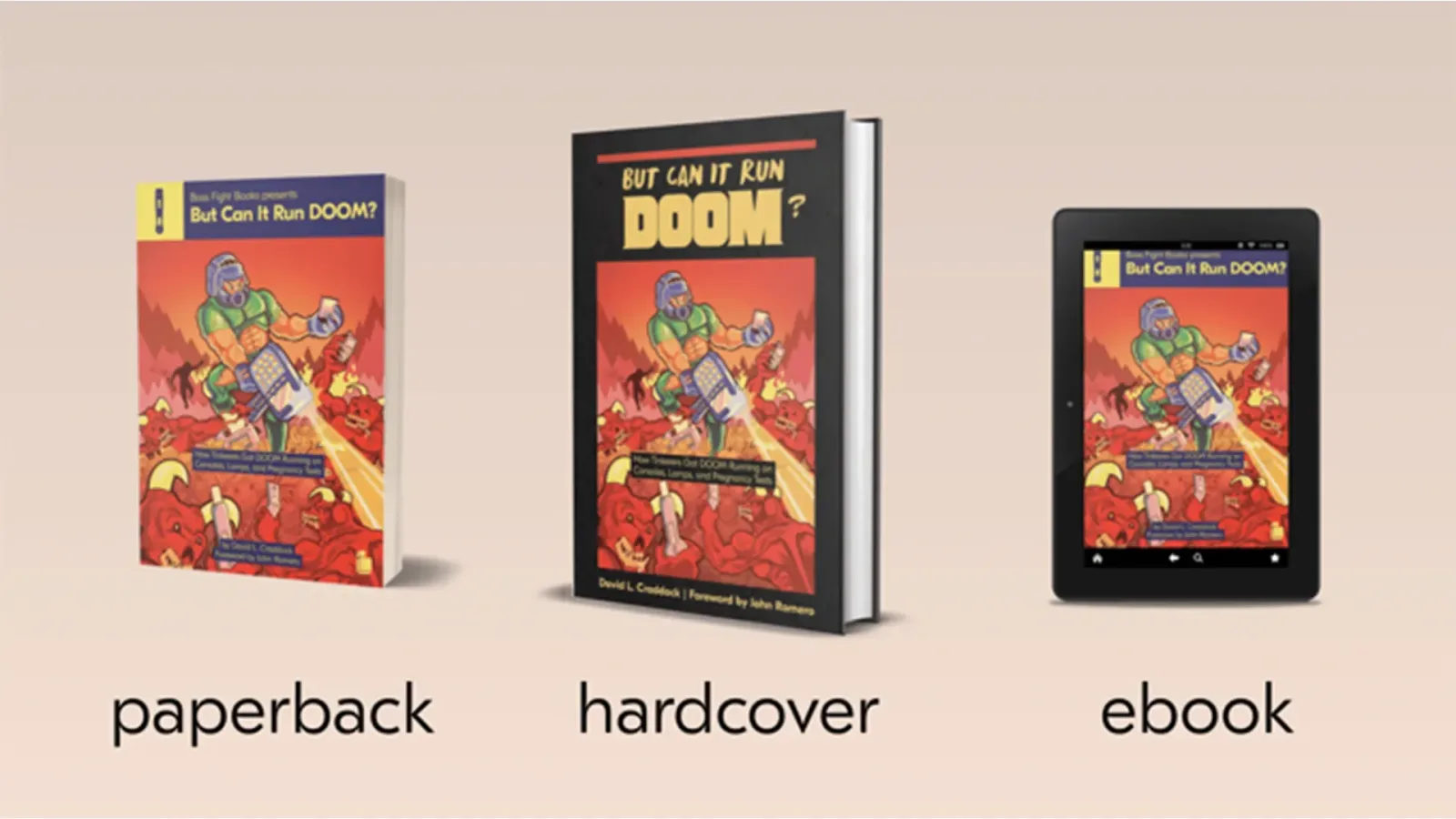
The crowdfunding campaign has already surpassed its £3,770 target. Backers can pledge £13/$16 for a copy, with shipping planned for later in March 2027. The book is set to arrive in paperback, hardcover, and ebook forms, with the standard release listed at 168 pages. The hardcover is positioned as a larger special edition with additional pages.
A history of the question every piece of hardware fears
"But can it run Doom?" has become more than a joke among retro-gaming fans and hardware enthusiasts. It is a compact way of asking how far a determined programmer can stretch limited technology, unusual displays, restricted interfaces, or an otherwise impractical piece of consumer electronics.
For useful background on this topic, read Blue Max Returns in a New Mega Drive Homebrew Remake.
Sometimes the answer means a relatively direct port to hardware with enough processing power to handle the game. Other times, the achievement lies in making a device display Doom's visuals in some form, adapting controls that were never made for movement and aiming, or using connected hardware to offload parts of the task. The methods can differ dramatically, but the appeal is consistent: turning a familiar game into proof that a device can do something unexpected.
Doom is particularly well suited to this culture of experimentation. Its gameplay and presentation are instantly recognizable, so even a tiny, low-resolution, awkward, or unconventional version is immediately legible. Seeing the game's corridors, enemies, and interface appear where they have no business appearing is the entire point. A successful port is both a technical feat and a punchline.
The examples covered by Craddock's book reflect how broad that creative space has become. The pregnancy-test port is among the most famous recent demonstrations of absurd hardware hacking. Other projects have put Doom onto items better known as tools, decorations, fashion accessories, household fixtures, or online services. A multimeter and a pressure cooker are among the unexpected devices that have joined the broader conversation around unlikely Doom machines.
More than a list of novelty ports
A simple catalogue of bizarre devices would already be entertaining, but But Can It Run Doom? is framed as a record of the people and communities behind the projects. Craddock's reporting draws on original interviews to explore how creators solved problems, shared discoveries, and encouraged one another to take on stranger challenges.
That emphasis matters because the most memorable Doom ports are rarely isolated stunts. They come from a culture in which makers compare notes, publish technical work, trade advice, and react to each new accomplishment by wondering what might be possible next. One person gets a game working on an unlikely screen; another decides to use an even less appropriate device. The escalating absurdity is part of the fun, but the exchange of knowledge is what makes the trend sustainable.
The book's central subject is therefore not only Doom itself. It is the inventive impulse that turns a familiar game into a shared project. For some participants, the challenge may be processor constraints. For others, it is display output, storage limitations, input design, or simply finding a pathway into a device not built to welcome custom software. In every case, the result makes an ordinary object feel newly strange.
That spirit has become one of the internet's more positive recurring technical traditions. Unlike a race focused purely on specifications, the question of whether something can run Doom rewards ingenuity, humor, persistence, and a willingness to make an impractical idea real. A port does not need to be the ideal way to play. In fact, the less sensible the platform is, the more satisfying the result can be.
From an Ikea lamp to Minecraft sheep
The range of projects named for the book makes clear that "platform" can mean almost anything when enough imagination is involved. A pair of earrings is a striking example because it pushes against expectations of both physical size and purpose. An Ikea lamp suggests another kind of appeal: a familiar household object transformed into an unlikely gaming display.
The Minecraft sheep project points in a different direction. Rather than placing Doom on one compact gadget, it turns a virtual environment into the canvas for a game within a game. A field of sheep is not a traditional monitor, and that is precisely why it belongs in this peculiar history. It demonstrates that Doom experimentation is not limited to squeezing software onto miniature electronics. It can also involve rethinking what counts as a display, a computer, or an interface.
Likewise, a Twitter bot represents a connection between the game and networked social technology rather than a normal local play experience. These projects are not all trying to solve the same engineering problem. Their common thread is the decision to start with an absurd premise and follow it seriously enough to produce a working result.
For retro fans, that mix of reverence and irreverence is an important part of Doom's legacy. The game remains historically significant, but it is not being placed behind glass. Instead, people continue to interact with it, modify it, reinterpret it, and use it as a testing ground for ideas that are equal parts software craft and performance art.
A fitting subject for Boss Fight Books
Boss Fight Books has previously produced physical books focused on games including 007 GoldenEye and Super Mario Galaxy. With But Can It Run Doom?, the publisher is taking on a subject that sits at an unusual intersection of gaming history, maker culture, and comedy.
The format also gives these fleeting online moments a more durable home. Many extraordinary Doom ports circulate as short clips, screenshots, technical posts, or jokes shared across social platforms. That is part of their charm, but it can make the stories behind them easy to lose as attention moves on to the next improbable device. A book built from interviews has the opportunity to preserve not just the spectacle, but also the context: why a creator chose a particular machine, what obstacles appeared, and how a seemingly ridiculous project became possible.
The hardcover edition's larger format and additional pages may especially appeal to collectors who want a substantial record of this corner of game culture. Meanwhile, paperback and ebook options make the project accessible to readers more interested in the stories than in a premium physical edition.
A celebration of playfulness in technical work
There is a serious amount of skill behind the joke of making Doom run on something bizarre. Yet the enduring appeal of the meme is its refusal to take that skill too solemnly. The question is not merely whether a system is powerful enough. It is why anyone would attempt it in the first place--and the answer is often simply that it would be funny, challenging, or memorable.
That combination is what gives But Can It Run Doom? its strongest hook. It promises a look at creators who see limits as invitations. Whether the final result appears on a medical device, wearable electronics, a household item, an online account, or a herd of blocky digital animals, each project begins with the same mischievous ambition: make the impossible-looking version happen.
With its Kickstarter goal already cleared and shipping currently planned for March 2027, Craddock's book is positioned as a tribute to that ambition. For anyone who has laughed at a headline about Doom appearing on a wildly inappropriate device, it may also be a reminder that the joke works because someone had the talent--and the determination--to make it real.
Community
Discussion
Start the conversation.
No comments have been posted yet.