

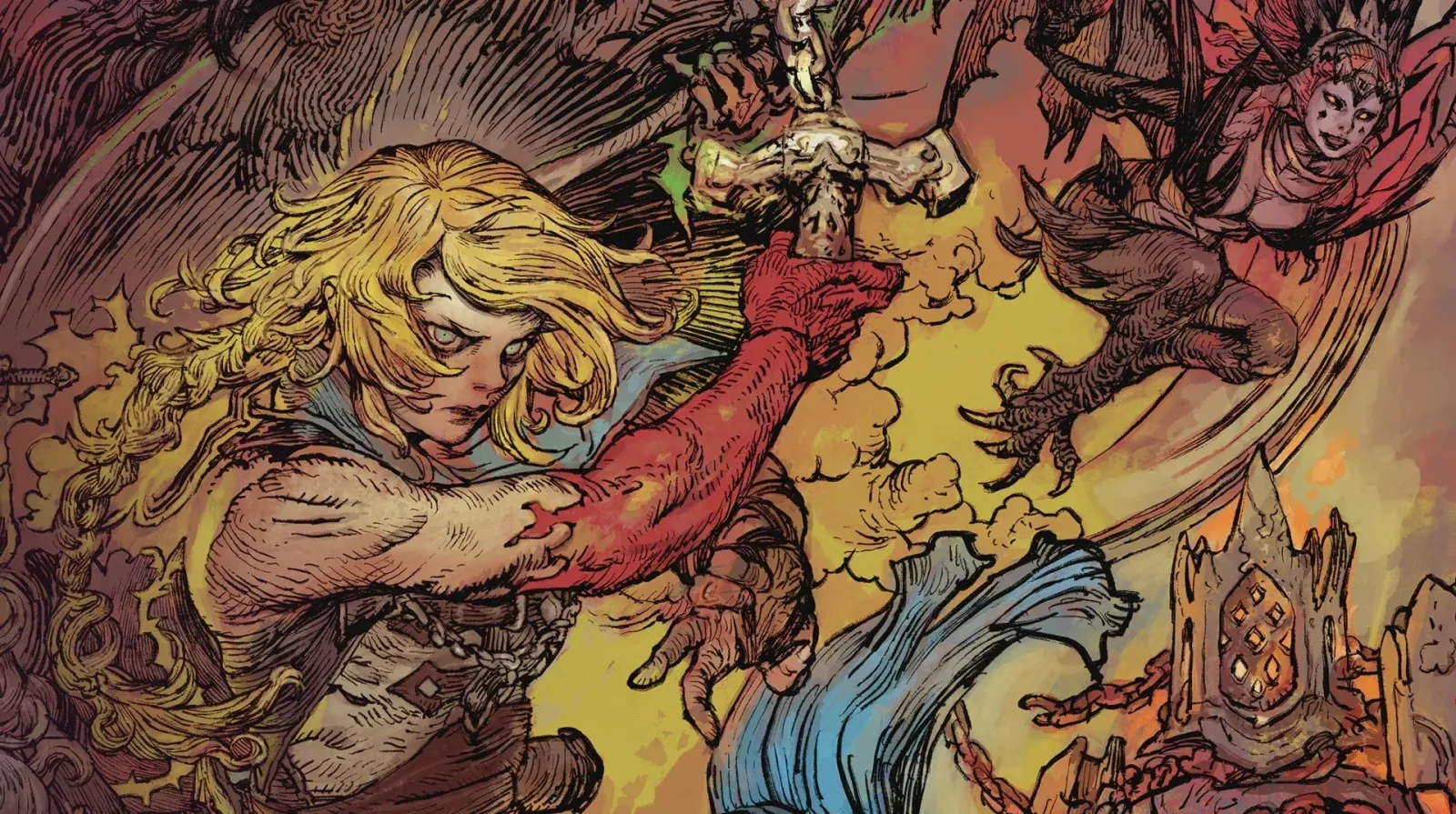
Castlevania: Belmont's Curse has found an interesting musical identity. Its soundtrack does not simply attempt to recreate the sound of every earlier entry in Konami's gothic action series, nor does it lean entirely on nostalgia for the most recognizable melodies. Instead, Evil Empire's music team has assembled an eclectic, largely downtempo collection that favors atmosphere, texture, and a modern lo-fi sensibility.
That approach is often a strong match for the game. Belmont's Curse stands apart mechanically and visually while still carrying the shadowy, monster-filled character that people associate with Castlevania. The music supports that difference without becoming a nonstop barrage of familiar riffs and dramatic flourishes. It can be moody and stylish without demanding attention every second.
But that restraint becomes a problem when the soundtrack reaches one of the most famous compositions in the entire franchise: "Bloody Tears." For a song so closely associated with Castlevania's momentum, danger, and triumph, the Belmont's Curse interpretation feels unusually muted. It recognizes the melody's legacy, teasing listeners with the familiar opening movement, but it does not deliver the cathartic force that the track's reputation seems to demand.
A Fresh Sound for a Familiar Horror World
Belmont's Curse benefits from not treating every room, stage, and encounter as an excuse to overwhelm the player with loud orchestration. There is a place for maximalism in Castlevania. The series has always had a flair for theatrical horror, elaborate castles, towering bosses, and music that can turn a simple corridor into a grand confrontation. Yet quieter music can make those big moments stand out more clearly.
For useful background on this topic, read Sony Patent Describes Controller-Aware Frame Generation for a Future PlayStation System.
The score's downtempo direction feels aligned with the contemporary popularity of lo-fi listening: music designed to establish a mood, hold a steady groove, and remain pleasant over long stretches. That is not traditionally the first musical mode associated with whip-cracking vampire hunters, but it gives Belmont's Curse a personality of its own.
It also makes the soundtrack more flexible outside of play. Rather than becoming exhausting through repetition, much of the music sounds suited to sitting in the background during work, reading, or another long session that calls for ambiance more than adrenaline. That is a real strength. Game music does not always need to seize control of the room to be memorable, and a score that can remain inviting over many hours is valuable in its own way.
Several tracks illustrate how well that balance can work. "Bone March," heard while exploring the Paris Catacombs, is a standout. The setting alone calls for something skeletal, subterranean, and faintly ominous, and the track's atmosphere helps sell the sense of descending into an old, hostile place. It can evoke menace without immediately becoming aggressive.
"Iron Clock," the Clock Tower theme, is another particularly effective piece. Castlevania's clock towers carry a powerful history within the series: they are places of machinery, elevation, precision platforming, and looming danger. Music for such a location has to suggest motion and tension, even when the arrangement is not racing toward a crescendo. The track's identity gives that familiar setting its own tonal space.
Then there is "Stone Tyrant," the theme attached to the Talos boss battle. The fight itself can be punishing enough to leave players frustrated, with sore hands after repeated attempts, but the music has a notably funky edge. That contrast is part of the score's appeal. It is not content to be gothic wallpaper. It finds unexpected grooves and colors while still fitting within a monster-hunting adventure.
Why "Bloody Tears" Carries Such Heavy Expectations
The difficulty comes from the special status of "Bloody Tears." This is not merely another returning Castlevania song. It is one of the franchise's defining musical statements, a theme so identifiable that its first recognizable notes can immediately call up the feeling of pushing deeper into Dracula's domain.
Its place in the series is comparable to a landmark theme such as Dr. Wily's Castle music from Mega Man 2: a composition that has escaped the boundaries of any one game and become shorthand for an entire legacy. The melody has been arranged repeatedly because it is both durable and demanding. Its structure invites reinterpretation, but it also brings a specific emotional expectation with it.
"Bloody Tears" should feel urgent. It should have forward momentum. Even when an arrangement is stylish, jazzy, orchestral, electronic, or otherwise unconventional, it needs to preserve the sense that something important is happening. This is music for facing impossible odds in a castle full of monsters. It should make a player want to press ahead, take a risk, and fight harder.
Previous versions have understood that essential quality. Even the arrangement made for the Castlevania crossover content in Dead Cells lands as a satisfying, energetic take on the classic. It works because it retains the song's punch and confidence. The details may differ from older interpretations, but the central promise of the melody remains intact: this is the moment when the adventure gets serious.
A Strong Opening Without the Necessary Payoff
Belmont's Curse does not mishandle "Bloody Tears" because it ignores what makes the song recognizable. In fact, the beginning seems to understand exactly what it is working with. The arrangement builds through the familiar sequence of notes, creating the anticipation that accompanies a beloved theme. For a brief moment, it feels as if the score is preparing to unleash a major set piece.
That buildup is why the eventual turn is so disappointing. When the song seems ready for the beat to arrive with real weight, the arrangement retreats. Rather than exploding into the fierce, propulsive energy expected from "Bloody Tears," it softens into something that barely commands the listener's attention.
The result is not necessarily bad music in isolation. As part of a low-key, orchestral, background-focused playlist, it may be perfectly listenable. But a "Bloody Tears" arrangement cannot be judged solely as a generic piece of atmospheric game music. The name, melody, and history impose a different standard. A version that blends into the environment may be appropriate for another composition, yet it feels like a missed opportunity here.
The orchestral texture appears to be part of the issue. Orchestration itself is not the problem; Castlevania has supported dramatic and sweeping arrangements for decades. The problem is the lack of edge. The song needs sharper attack, more prominent rhythmic drive, and a clearer sense of release after its buildup. Without those qualities, it feels as though the arrangement is deliberately pulling its strongest blow.
Atmosphere Cannot Replace Adrenaline Every Time
There is an understandable creative argument for a subdued "Bloody Tears." Belmont's Curse has its own musical language, and a soundtrack does not need to become a greatest-hits concert every time it references a famous tune. Reworking familiar material to match a new game's mood can be artistically rewarding. A quieter version might even work in a moment intended to feel mournful, reflective, or uneasy.
Still, context matters. "Bloody Tears" is not just a nod to the past. It is a track built around escalation. Its identity relies on the feeling that the listener is approaching a confrontation rather than drifting through a haunted atmosphere. When it is made too soft, it loses the combustible quality that has allowed the melody to endure through so many Castlevania incarnations.
This does not undo the broader achievements of Belmont's Curse's soundtrack. The score has a clear point of view, and the decision to embrace downtempo sounds helps distinguish the game from louder, busier interpretations of gothic action music. In a genre where soundtracks can sometimes become fatiguing through endless intensity, its relative calm is refreshing.
Yet the best tribute to "Bloody Tears" is not simple recognition. It is understanding the force that made the song iconic in the first place. The track should not merely remind players that Castlevania has a famous anthem. It should make them feel ready to march through Dracula's castle and earn the right to hear it.
Belmont's Curse largely succeeds at creating a soundtrack that is easy to live with, full of appealing atmosphere and unexpected character. "Bone March," "Iron Clock," and "Stone Tyrant" demonstrate how effectively it can shape a location or battle. But "Bloody Tears" is a rare case where the score's restraint becomes its greatest weakness. For one of gaming's most recognizable battle-ready themes, relaxing ambience is not enough. It needs blood, thunder, and a far harder crack of the whip.
Community
Discussion
Start the conversation.
No comments have been posted yet.