

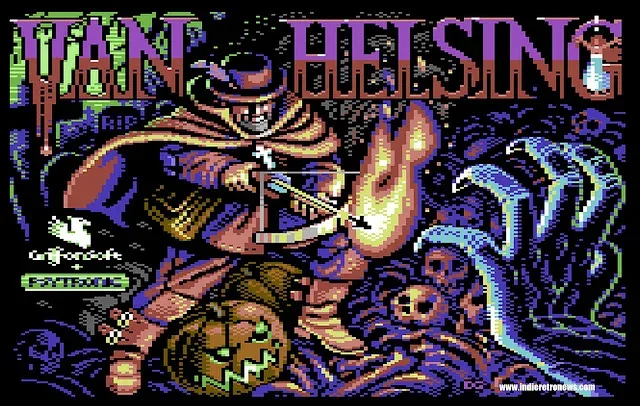
Van Helsing has arrived on the Commodore 64, bringing a new gothic action-platform adventure to one of retro gaming's most enduring machines. Developed by GriffonSoft and published by Psytronik Software, the game places players in the role of the famed monster hunter during an ominous 1893 tale that leads directly toward Dracula's territory.
The release is positioned as GriffonSoft's largest project so far, with eight scrolling stages, an array of collectible weapons, enemy-filled encounters, and support designed to suit both original C64 hardware and newer ways of playing Commodore classics. It also comes from a publisher with a recent history of supporting fresh C64 releases, including Sherwood and Musketeer.
For a platform still actively receiving new commercial games decades after its original debut, Van Helsing is another reminder that the Commodore 64 scene remains interested in delivering full-scale experiences rather than simple novelty releases. Its premise draws from familiar Dracula mythology, but its structure is geared toward arcade-style action and platforming as the hunter pushes through hostile territory in pursuit of a kidnapped Lucy Westenra.
A Horror Story Set in 1893
Van Helsing begins during the autumn of 1893 at the Harker residence. What should be a happy gathering, held to mark Jonathan Harker's return from Transylvania, is broken apart by a scream. A monstrous winged figure crashes through the balcony and seizes Lucy Westenra, disappearing into the darkness and leaving a bloody scene behind.
For useful background on this topic, read Roc'n Rope Is Climbing Back Onto Commodore 64 in a New Conversion.
That attack sets Van Helsing on the trail of the creature and into the dangerous lands controlled by Dracula. The setup gives the game a clear forward drive: this is a rescue mission and a monster hunt, with the player facing Dracula's forces while moving deeper into the vampire's domain.
The choice of setting is especially fitting for a C64 game built around atmosphere. Gothic horror has long been a natural match for the platforming genre, where ruined structures, shadowy passages, creatures, and threatening scenery can make every screen feel dangerous. Van Helsing's approach uses a scrolling level format, allowing the journey to extend beyond the more compact room-by-room designs associated with many older action games.
Its story also puts the focus on the hunter rather than Dracula himself. The vampire lord is the looming force behind the adventure, but the player's immediate task is to survive the horrors between the Harker residence and the heart of the enemy's territory. That leaves plenty of room for the kind of escalating enemy encounters expected from a side-scroller with a supernatural theme.
Eight Scrolling Levels and Collectible Weapons
The game features eight large, detailed scrolling levels. Rather than presenting Van Helsing as a brief single-screen challenge, GriffonSoft has built it around a longer progression through locations populated by enemies from Dracula's ranks. Players will need to fight their way through these threats while maintaining the precision needed for platforming.
Combat is supported by collectible weaponry. The release describes an arsenal that can be gathered during the adventure, giving Van Helsing tools to counter the creatures in his path. Specific weapon types have not been detailed, so the extent of the system is still something players will discover in play. Still, the inclusion of pickups suggests that the action will not remain completely static from the opening area to the final confrontation.
Responsive control is another major part of the game's design. Side-scrolling action games on 8-bit systems can rise or fall on how reliably a character moves, jumps, and attacks under pressure, particularly when enemies and hazards share the same tight spaces. Van Helsing is described as featuring highly responsive input and a smoothly animated main character, two elements intended to make its demanding traversal and combat feel more direct.
The title also includes native two-button joystick support. That setup separates firing and jumping, rather than requiring players to perform both actions through a single-button arrangement. For a game that combines platforming with combat, the distinction can make a meaningful difference. A dedicated jump input can help players react to hazards without unintentionally attacking, while a separate fire button makes it easier to engage enemies during movement.
That does not erase the appeal of traditional one-button C64 play for those who prefer it, but the two-button option shows an effort to accommodate modern controller expectations while remaining rooted in the machine's ecosystem. It is a practical feature for players using compatible hardware and contemporary C64 setups.
Built for PAL, NTSC, and Modern Commodore Setups
Van Helsing includes native compatibility with both PAL and NTSC systems. This matters in the Commodore 64 community because software created around one video standard can behave differently on the other, affecting speed, timing, or compatibility. Supporting both formats directly broadens the game's potential audience across regions and helps preserve its intended feel.
The game is also intended to run on the original Commodore 64 as well as modern platforms and devices associated with C64 play, including the C64 Mini, C64 Maxi, and Ultimate. These options have made it considerably easier for returning fans and newcomers to explore new Commodore releases without necessarily relying on an aging original system.
Compatibility alone is not the entire story for a contemporary retro release, however. Games made for vintage hardware must balance technical limitations with modern standards for presentation and accessibility. Van Helsing's combination of scrolling environments, character animation, music, sound effects, and controller support reflects that balancing act. It is designed around a classic computer's identity while recognizing the range of devices now used to enjoy C64 software.
For collectors, the release also offers a deluxe digital download bundle. Alongside the full game, the package includes the official soundtrack, promotional artwork, and printable disk labels and sleeves. The printable material offers a way for owners to create a physical-style presentation for a digital purchase, an appealing extra in a hobby where boxes, disks, cassette cases, manuals, and cover art remain a major part of the experience.
The bundle's soundtrack inclusion is notable as well. Music has always played an outsized role in the Commodore 64's legacy thanks to the character of its sound hardware, and a dedicated soundtrack gives listeners a way to enjoy the game's audio away from the action.
The Team Behind the Hunt
Ola Zandelin handled the code for Van Helsing, while Saul Cross created the music and sound effects. Dennis Gustafsson is credited with the game's graphics and inlay artwork, tying the visual presentation on screen to the artwork intended for the release materials.
Testing was supported by Daniel Zandelin, Mikael Linusson, Dan Saedén, Åke Forslund, and Ditlew. Richard Bayliss contributed the tape loading and cartridge intro music, as well as serving as tape master. Martin Piper is credited for the tape loader source, while Mike Robertson handled cartridge coding and the disk loader. Packaging was created by Jason "Kenz" Mackenzie.
Those credits underline how many specialized roles can be involved in a modern C64 release. Even when a project is built for a machine from the early 1980s, preparing versions for tape, disk, cartridge-oriented use, digital distribution, and collector-focused presentation can require a broad production effort.
A New Entry for the Active C64 Scene
Van Helsing arrives as a substantial new horror-themed adventure for Commodore 64 players, with an emphasis on a dramatic setup, extended scrolling stages, action-focused progression, and compatibility across old and new hardware. Its Dracula-inspired premise gives it an immediately recognizable foundation, while the eight-level campaign and two-button support aim to provide a more contemporary sense of control within an 8-bit framework.
For players seeking a newly made C64 game with a darker tone, the pursuit of Dracula's forces offers a strong reason to step back into the machine's world. Whether experienced on original hardware, a C64 Mini or Maxi, or an Ultimate setup, Van Helsing presents a fresh monster hunt built specifically for Commodore's classic platform.
Community
Discussion
Start the conversation.
No comments have been posted yet.