

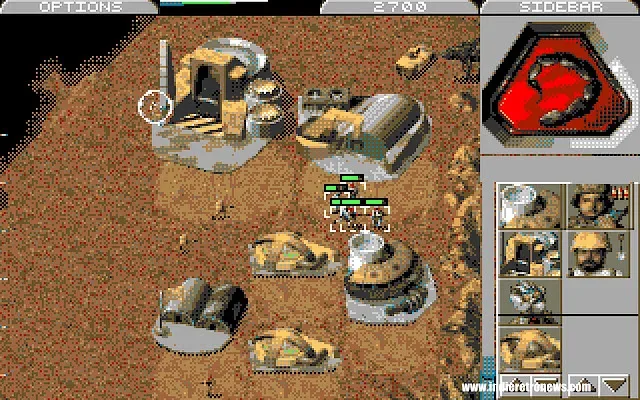
Command & Conquer, the landmark 1995 real-time strategy game from Westwood Studios, is being adapted for Atari ST-compatible computers in a technically ambitious fan project. Still under development, the conversion seeks to preserve the essential base-building, resource gathering and battlefield combat that made the original DOS release such an influential PC game, while translating it to hardware with dramatically different graphical and memory constraints.
The project is not simply a visual reinterpretation inspired by Command & Conquer. It is a port of the DOS version, meaning its creator, indyjo, is working to retain the familiar gameplay framework: construct a headquarters and production facilities, harvest Tiberium, expand a defensive perimeter, create an army and eliminate the opposing force. Both of the series' defining factions are planned to be present, with players able to take command of the United Nations-backed Global Defense Initiative, better known as GDI, or the Brotherhood of Nod.
That goal is especially notable because the Atari ST belongs to an earlier generation of home computers than the machine profile commonly associated with the original Command & Conquer. Westwood's game was built for DOS PCs with VGA graphics, where its maps, vehicles, infantry, structures and interface could use a 256-colour display. The Atari ST environment imposes a 16-colour presentation instead, creating a substantial challenge for a game whose visual language relies on quickly readable units and terrain during hectic real-time battles.
A 16-colour interpretation of a DOS strategy classic
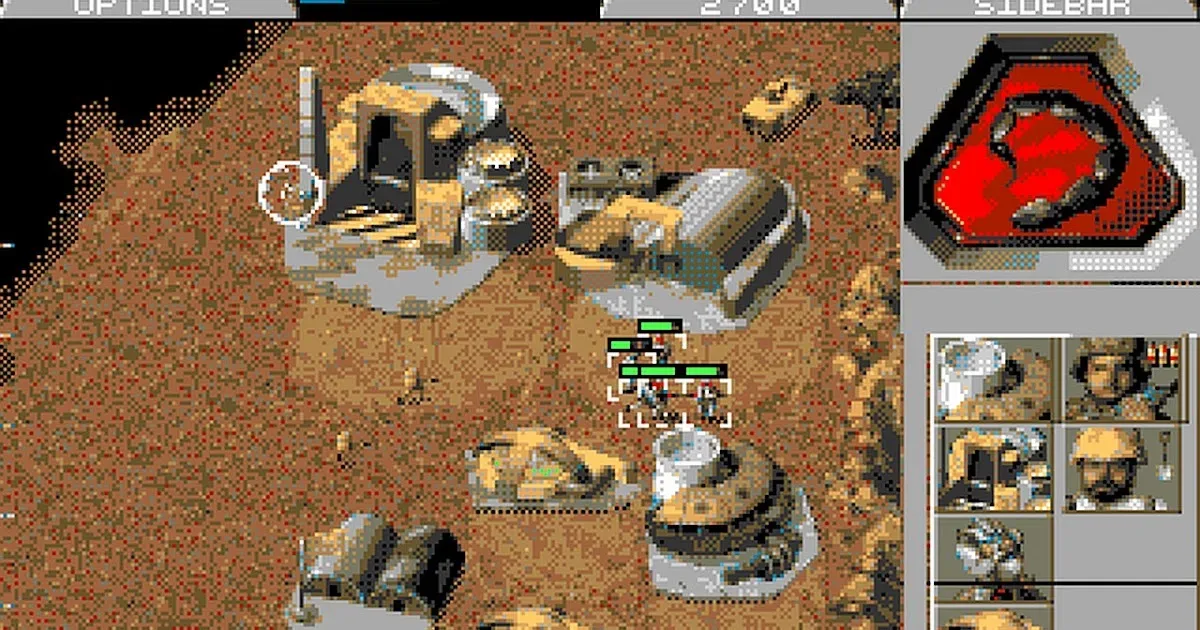
The port's most immediately visible compromise and creative opportunity is colour. Rather than attempting to reproduce the original VGA output directly, the project concentrates on careful colour reduction. Military hardware, terrain, buildings and other game elements have to be reworked into a much smaller palette while remaining understandable at a glance.
For useful background on this topic, read Call of Duty: Modern Warfare 4 Is Being Framed as an 'Epic Conclusion'.
For strategy games, that readability matters as much as raw detail. Command & Conquer regularly asks players to distinguish friendly units from enemy forces, judge where structures can be placed, locate Tiberium fields, identify chokepoints and react to an attack before production queues or harvesters are disrupted. A reduced palette can make those tasks harder if silhouettes, contrast and faction identity are lost. The Atari ST version's approach is therefore not just a matter of making screenshots look appealing; it is central to whether the game can continue to function as a responsive RTS.
The resulting look gives the conversion a distinctly 16-bit character. It cannot match the 256-colour VGA image of the original DOS game, but that limitation is also part of its appeal. Atari ST enthusiasts and players with a fondness for tightly controlled pixel art may find that the limited-colour presentation creates a different, era-appropriate way to experience the classic conflict between GDI and Nod.
Importantly, the project notes that artificial intelligence was not used to generate the artwork. AI was used in the software-porting process and to create tools that help manage the game's assets, but the visual art itself was not AI-generated. That distinction is relevant to a conversion that depends heavily on deliberate adaptation of complex original assets into a new palette and memory model.
For another perspective on this story, read Command & Conquer Is Being Ported to Atari ST, With 16 Colours and a Big Memory Challenge.
Memory is the major obstacle
Graphics are only one half of the engineering problem. The current build inherits hardware demands from its DOS origins that go beyond what a typical Atari STe from the early 1990s can comfortably provide. At present, running the port requires either comparatively uncommon enhanced hardware, such as an Atari STe fitted with an accelerator card, or an Atari Falcon. Emulation through Hatari is also an option for those who do not have the required physical configuration.
The present minimum specification is listed as any Atari ST-compatible computer with at least 4MB of RAM. The recommended configuration is more demanding: a 68020 or better processor running at 32MHz, 4MB or more of memory, DMA sound and a Blitter. Those recommendations underline how far the project reaches beyond the baseline Atari ST setup many players may picture when they hear the platform's name.
The eventual aim is to lower those barriers and make the game viable on a system such as an Atari Mega STe with 4MB of RAM. That target has not been reached, however, and reducing RAM use remains the toughest part of the ongoing work. For a real-time strategy game, memory has to cover far more than one screen of graphics. The program needs terrain information, unit and building data, interface elements, game logic, AI routines, audio-related resources and the state of an active battle. A port can look successful in still images yet fail to be practical if it cannot keep the necessary data available without causing disruptive loading or performance problems.
Several technical changes have already been introduced to improve the situation. A new iconset format called ST16 stores terrain tiles in the Atari ST's native 16-colour encoding. By preparing that terrain data in a format more suitable for the machine, the project can avoid some of the overhead involved in handling assets designed around the original 256-colour release.
Another new format, SHPX, changes how image data is handled. It separates an image's meta-information from its pixel data. The metadata remains in RAM, while the actual pixel data can be fetched from disk when needed. This arrangement frees almost 2MB of memory, a major saving on a machine where the stated minimum total memory is 4MB.
Other optimisations include removing a 256KB interpolation table and eliminating the terrain-tile cache, with the ST16 iconsets helping make the latter possible. The use of a new C library, libcmini, is also intended to reduce software overhead. None of these changes alone solves the memory challenge, but together they show the kind of targeted restructuring required to make a comparatively large DOS strategy game fit a far more constrained retro-computing environment.
Why Command & Conquer is a difficult game to move
Command & Conquer helped establish the template for accessible real-time strategy. Players are expected to make decisions continuously rather than waiting for turns: spend resources on structures or forces, select the right unit mix, scout an opponent's position, protect harvesters, counter enemy armour and choose when to commit to an assault. The game's campaign structure and two-sided GDI-versus-Nod conflict are important, but the constant interaction of its systems is what makes a faithful conversion challenging.
On less capable hardware, developers face a balancing act. A port needs enough processing speed to update movement, combat, pathfinding and enemy behaviour, enough memory to represent the battlefield and enough visual clarity for the player to issue informed commands. Sound and interface performance matter as well, particularly in an RTS where warning feedback and quick responses can change the outcome of a match.
The Atari ST conversion is notable because it is attempting to carry those core systems across instead of reducing the game to a simplified homage. The project description specifically points to base construction, Tiberium harvesting and tactical destruction of enemy strongholds as retained fundamentals. Including both GDI and Nod further signals an intention to keep the central identity of Command & Conquer intact rather than adapting only a small sample of its content.
That does not guarantee every feature or mode from the DOS game will arrive in the final version, and the port remains a work in progress. It also should not be assumed that the currently listed requirements are final. The developer is actively pursuing memory reductions, so compatibility and performance targets may change as the technology evolves.
A promising project for Atari and RTS fans
Fan conversions are often at their most interesting when they expose the differences between hardware generations. Command & Conquer on Atari ST is compelling not because it can be identical to the DOS original, but because it demonstrates how a defining PC strategy game can be reshaped for a platform limited to 16 colours and much tighter memory budgets.
The work completed so far suggests a port built around practical technical decisions: native-format terrain, on-demand pixel data, lower-overhead libraries and the removal of expensive data structures. At the same time, its current demands make clear that this is not yet a drop-in experience for every Atari owner. A standard 1990 Atari STe is not sufficient at this stage without additional acceleration, while Falcon hardware or Hatari emulation provide more realistic routes to playing the current version.
For retro players, the project is worth watching precisely because of that unfinished state. Each memory-saving revision could broaden the hardware that can run it, and each refinement to the 16-colour presentation could improve how naturally its maps and units read in motion. If the stated Mega STe-with-4MB goal is eventually achieved, it would make an already unusual conversion significantly more accessible within the Atari ecosystem.
There is no release date or final availability information confirmed for the port at this time. For now, Command & Conquer's Atari ST revival remains an ongoing technical undertaking--one that pairs a foundational RTS with a platform few would have expected to host it, and does so without hiding the considerable compromises and engineering work still ahead.
Community
Discussion
Start the conversation.
No comments have been posted yet.