

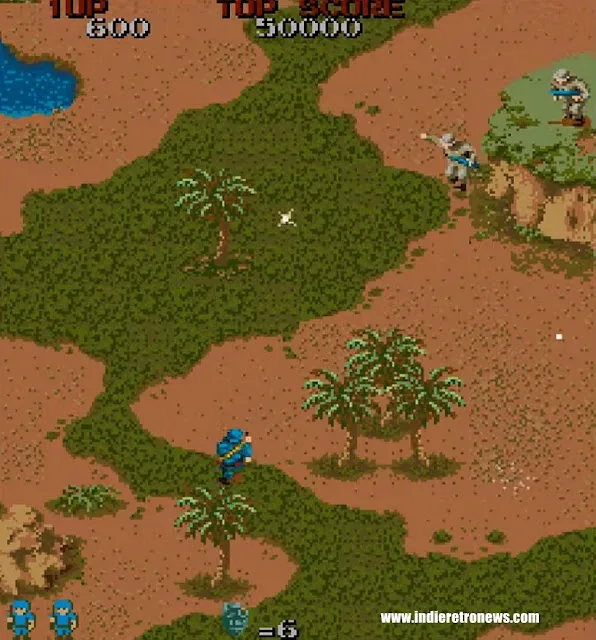
Capcom's Commando, one of the defining vertical military shooters of the arcade era, has been given a new life on Commodore Amiga hardware. A newly released enhanced AGA Arcade edition by prolific Amiga conversion specialist JOTD targets the Advanced Graphics Architecture found in the Amiga 1200 and Amiga 4000, with the stated goal of delivering a rendition that is substantially closer to the original coin-op game.
The project is especially notable because Commando was not absent from the Amiga in the first place. Elite Systems released an Amiga version in 1989 for the older OCS/ECS machines, and it remains well regarded as a conversion of its time. Rather than replacing or dismissing that edition, the new effort is built around the opportunity to use later Amiga hardware, more closely reproduce the arcade presentation, and test a specialized approach to translating arcade game code for the 68000-based platform.
JOTD is known in the Amiga scene for ambitious arcade-to-home conversions and enhancements, including work involving Double Dragon, Ghosts'n Goblins, and Xevious. For Commando, the developer has combined reverse engineering, code conversion, graphics work, and sound conversion in an attempt to retain the fast, direct identity of Capcom's original shooter while taking advantage of the AGA chipset.
A familiar mission, rebuilt for later Amiga hardware
Originally an arcade game from Capcom, Commando places a lone soldier in hostile territory and sends players upward through dense enemy lines. The basic controls are deceptively simple: move in eight directions, fire forward, and throw grenades into dangerous clusters of soldiers, gun emplacements, and other threats. That clarity helped make the game an enduring arcade favorite, but its nonstop scrolling action, large numbers of enemies, and constant audio activity also make fidelity a meaningful technical target for a home conversion.
For useful background on this topic, read Fliegeralarm Games Reveals AI-Assisted Amiga Projects Flieger Minigolf and Wintergames.
The Amiga AGA Arcade edition has been designed specifically around the capabilities of Amiga 1200 and Amiga 4000 systems. Those models use the Advanced Graphics Architecture, an evolution of the graphics hardware in the original Amiga range. In practical terms, AGA opened the door to richer color presentation and gives this new version a foundation that the earlier OCS/ECS release could not rely upon.
That distinction is central to the appeal. The 1989 Amiga port had to operate within the limits of the original chipset and represented a respected result for those constraints. The new edition is instead positioned as an arcade-faithful enhancement for machines that arrived later in the Amiga's life. It is not merely a graphics touch-up applied to the old version; it is a new conversion effort shaped by different technical goals and a different method of bringing the game's original logic to the system.
Why JOTD chose Commando
Although Commando has obvious nostalgic value, JOTD's reason for selecting it was as much technical as it was historical. The project served as a proving ground for custom tools built to convert Z80 assembly code into 68000 binary code. The arcade original uses a Z80-based design, while the classic Amiga runs on Motorola 68000-family processors. Bridging that gap requires more than moving assets between systems; it means understanding, reconstructing, and translating the behavior of the original program.
For another perspective on this story, read Commando Returns to Amiga in a New AGA Arcade Edition.
JOTD described the game as a suitable test case because it was comparatively straightforward while still being properly coded and worth preserving. Its structure offered a manageable route into refining the converter, particularly in comparison with titles whose original programming may be more difficult to work with. The developer also noted that the arcade hardware has similarities that made it feel relatively close to the hardware considerations involved with Ghosts'n Goblins, another major Capcom arcade game that has received attention from the Amiga conversion community.
The process began with a disassembly created by Scott Tunstall. That material was incomplete, so further work was needed before the code could be converted. Completing enough of the disassembly to support the conversion was part of what made the project possible. It also illustrates the preservation-minded labor that often sits behind new releases for legacy machines: the game may be decades old, but recreating its behavior on different hardware can demand detailed research, debugging, and tool development.
The new edition grew out of an effort to test and improve a Z80-to-68000 conversion workflow, with Commando chosen as a practical and achievable starting point.
That focus helps explain why this release matters beyond one arcade game. It represents a return to a specialized conversion technique for JOTD. If the tools and processes developed here continue to mature, they could potentially inform additional Amiga projects in the future. No further games have been confirmed as part of this specific effort, but the technical groundwork is an important part of the story.
Visuals aimed at the arcade original
In an arcade shooter such as Commando, visual accuracy is about more than sharper artwork. The player needs to instantly read bullets, enemy formations, scenery, obstacles, grenades, and explosive effects while the screen scrolls continuously. A version that better reflects the color, layout, and visual character of the original can make a real difference to how the game feels, particularly for players familiar with Capcom's cabinet release.
The AGA edition's purpose is to use the Amiga 1200 and 4000's expanded graphical capacity to push beyond what was possible in the earlier release. JOTD handled the project's graphics conversion along with the reverse engineering and 68000 transcode work. PascalDe73 is credited for icons, while Capcom remains credited as the creator of the original game.
It is worth emphasizing that "arcade-faithful" is an aspiration that can encompass many details: palette choices, sprite appearance, timing, scrolling, effects, stage presentation, and the overall density of action. The new Amiga release is framed around chasing that closer relationship to the arcade source, rather than simply offering an alternative set of visuals. Retro players who know the older Amiga edition may therefore be especially interested in comparing the two versions side by side, while owners of AGA systems have a fresh reason to revisit the game.
Sound conversion brings the arcade flavor into focus
Audio is another major component of the new edition. IM76 is credited with the music work, including packing the relevant chords and samples into three channels, or four channels where possible. The stated objective was to make the game sound much more like its arcade counterpart on Amiga hardware.
This matters because Commando is remembered not only for its relentless combat but also for its urgent musical identity and unmistakable battlefield effects. Sound on classic home platforms is always a balancing act, particularly when music and effects must coexist under hardware limitations. Careful channel use can help preserve the force of the music without losing the feedback players expect from shots, explosions, and grenades.
The collaboration gives the project a broader scope than a pure code exercise. JOTD's technical conversion and asset work are joined by IM76's audio contribution and PascalDe73's icon work, producing a package intended to feel complete for Amiga users rather than a bare demonstration of a new translation tool.
A welcome addition to the Amiga preservation scene
New games and conversions for vintage hardware often thrive because they allow old systems to be experienced in ways that were unavailable during their original commercial lifetimes. The Amiga AGA Arcade edition of Commando fits that tradition neatly. It revisits a landmark arcade title, recognizes the value of an earlier Amiga release, and explores what a later branch of the same hardware family can accomplish with modern community knowledge.
For players, the immediate attraction is simple: a chance to play Capcom's upward-scrolling shooter in a version designed around Amiga AGA machines and built to echo the arcade game more closely. For enthusiasts interested in development, the release is also an example of reverse engineering being used constructively to study old code, adapt it across processor families, and preserve a game's original design on an alternative platform.
Commando's enhanced Amiga AGA Arcade edition is now available as a community release. Players should ensure they have compatible Amiga 1200 or Amiga 4000 hardware, or an appropriate setup capable of supporting AGA software, before attempting to run it. With its renewed graphics, arcade-minded sound work, and an underlying Z80-to-68000 conversion experiment, the project offers both a playable retro release and an intriguing look at the craft behind keeping classic arcade games active on beloved home computers.
Community
Discussion
Start the conversation.
No comments have been posted yet.