

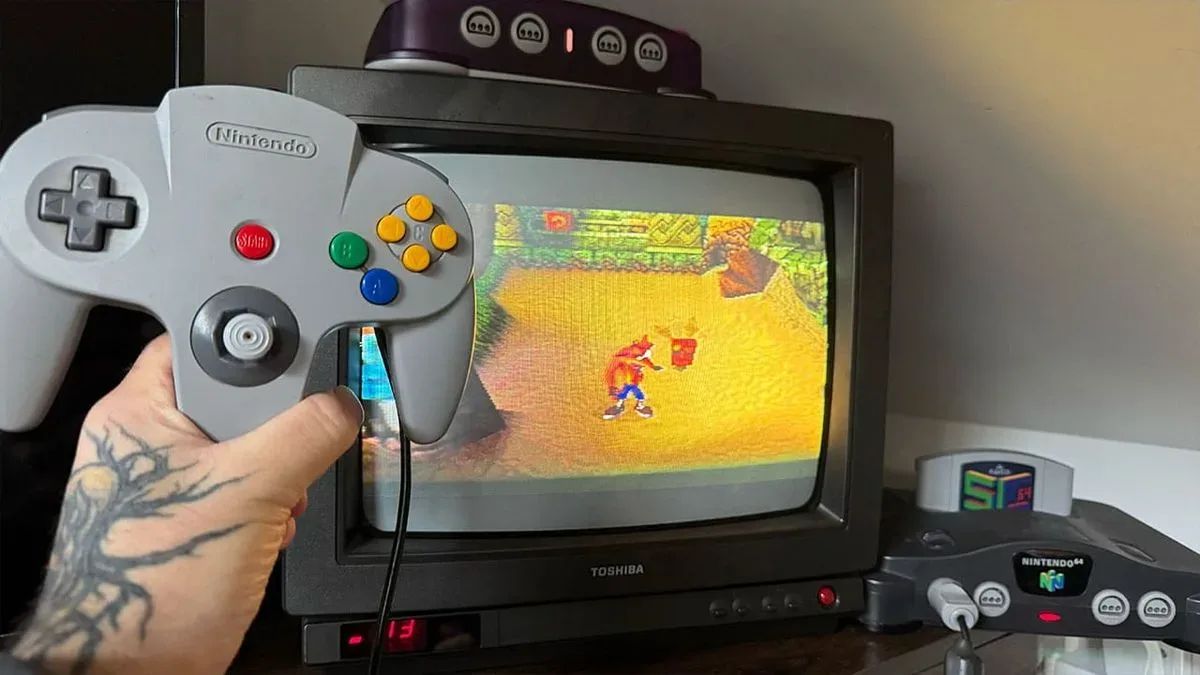
Crash Bandicoot, one of the defining PlayStation platforming stars of the 1990s, has appeared in a place it never officially reached during its original era: the Nintendo 64. A fan-made work-in-progress port is now playable on N64 hardware, offering an early but notable look at Naughty Dog's original PlayStation adventure running on Nintendo's cartridge-based console.
The project is not yet a complete conversion of the 1996 game. At present, the build includes a single playable level, with no sound effects or music implemented. Even so, it is a substantial technical curiosity and an exciting preservation-minded experiment for retro enthusiasts. Crash's rivalry with the Nintendo 64 was central to the character's identity in the mid-1990s, making the sight of the orange marsupial navigating an N64 game environment feel particularly unusual.
The port was created by a developer known as old pirate and was showcased through Recollect64. A demo is available as a free download via Itch.io, allowing interested players to test the current build for themselves. It remains an unfinished fan project, rather than an official release or a confirmation that the complete game will eventually be converted.
A PlayStation Icon on Its Former Rival's Hardware
The original Crash Bandicoot launched for the first PlayStation and quickly became closely associated with Sony's console. Its linear 3D platforming, jungle settings, crate-smashing challenges, and memorable mask companion Aku Aku helped it stand apart in an era filled with new mascot-driven platform games.
For useful background on this topic, read The Duskbloods Delayed to 2027 as FromSoftware Refines Multiplayer Balance.
Crash was also famously positioned in direct contrast to Nintendo's hardware during the PlayStation's marketing battles. In that context, a Nintendo 64 version of the original game would have been difficult to imagine at the time, both commercially and technically. The game was designed around the PlayStation architecture, while the Nintendo 64 had its own very different strengths, constraints, storage format, and rendering approach.
That history gives this project a novelty beyond the usual retro port. It is not simply another old game appearing on another machine. It is a former console exclusive, strongly linked to one side of a defining industry rivalry, now operating on the hardware of its contemporary competitor.
The available level demonstrates that the concept can work. Crash can be controlled through the stage, and the level can be completed through both available routes. The experience has reportedly worked successfully over multiple playthroughs, though performance can become somewhat laggy at points. For an early demonstration, that means the project already goes beyond a static technical showcase: there is a real playable slice of Crash Bandicoot on Nintendo 64.
What the Current Demo Includes--and What It Does Not
Players should set expectations appropriately before trying the demo. This is not a feature-complete N64 edition of Crash Bandicoot, and it does not currently represent the full game. The build is limited to one level, leaving the wider campaign, its varied environments, bosses, bonus areas, and progression outside the scope of the current release.
Audio is another major missing element. There is no music or sound effects in the demo, so Crash's jumps, spins, crate breaks, enemy encounters, and Aku Aku interactions play out silently. That omission is immediately noticeable because the original game's soundtrack and effects are such a large part of its character. Crash Bandicoot without its familiar musical cues is a markedly different experience, even when the visual and gameplay framework is recognizable.
The project also has moments of slowdown. That is not unexpected for an unfinished port attempting to translate a PlayStation game to different hardware, but it is important for anyone expecting a polished retail-style experience. The demo should be viewed as an evolving technical effort, one that shows the possibilities of the concept while also making its incomplete state clear.
- One level is currently playable.
- The stage can be completed using both of its routes.
- Performance may become laggy at times.
- Music and sound effects are not included in the present build.
- The project is a fan-made work in progress, not an official Nintendo 64 release.
Playable on Original Nintendo 64 Hardware
One of the most appealing parts of the project is that it can run on genuine Nintendo 64 equipment. The build has been tested using an SC64 flash cartridge on an original N64 connected to a CRT display. That is especially meaningful for collectors and retro hardware players, since it means the port is not restricted to emulation or modern PC-based experimentation.
Flash cartridges have become an important part of the retro scene, allowing users to load compatible game files and homebrew projects onto original consoles. In this case, that hardware makes it possible to play the Crash demo in a setting close to how a hypothetical N64 release might have been experienced decades ago: with an original controller, original console, and period-appropriate display technology.
The build is also expected to work through the same flash-cartridge setup on systems such as the M64 and Analogue 3D. That broadens its interest beyond owners of launch-era Nintendo 64 consoles. Still, compatibility and performance can depend on individual setups, especially with an early homebrew project, so players should be conscious that this is a developing build rather than a standardized commercial cartridge.
Why Porting Between PlayStation and N64 Is So Interesting
Seeing a PlayStation game on N64 hardware is more than a novelty exercise. The two consoles were built around different design philosophies. Sony's machine used CDs, providing considerably more storage space for music, videos, voice samples, and other data. The Nintendo 64 used cartridges, which offered fast access times but typically imposed much tighter storage limits. That contrast alone helps explain why the current Crash demo lacks audio: a conversion of a game is not just about making its visuals and mechanics function, but also about managing every element within the target platform's available resources.
Rendering and graphics techniques present their own challenges. Games are often tailored to the quirks of the platform for which they were made, including how that platform handles geometry, textures, effects, memory, and display output. A successful port therefore involves adapting an experience to an entirely different technical environment, potentially making compromises along the way.
For fans, those compromises can be part of the appeal. They invite a fascinating alternate-history question: what might Crash Bandicoot have looked and felt like if it had been developed for Nintendo 64 from the beginning? An unofficial project cannot fully answer that question, especially while it remains in an early state, but a playable stage can offer a compelling glimpse.
Could the Project Grow Into a Full Game?
There is understandable enthusiasm for old pirate's work to continue. Adding sound effects and music would be a major next step, while additional levels would turn the project from a striking demo into a more substantial adaptation. Completing the entire original Crash Bandicoot campaign would be an ambitious undertaking, and there is no indication that a finished full-game release is guaranteed.
That uncertainty matters. Fan projects can change direction, slow down, or conclude long before their most ambitious goals are reached. The available demo should therefore be appreciated for what it presently is: evidence that Crash can run in playable form on Nintendo 64, rather than a promise that every level will eventually arrive.
Still, the retro community has repeatedly shown an appetite for projects that revisit games through unfamiliar hardware. Whether the goal is technical education, preservation, curiosity, or simply the thrill of seeing an old favorite somewhere unexpected, these efforts can create new ways to engage with classic games.
The timing also makes the idea of a Nintendo 64 Crash feel less far-fetched than it once did. Croc is set to come to N64 officially, rather than through a fan-made conversion. That separate development does not make a commercial Crash release any more certain, but it does underline how long-dormant platforming history can still find unexpected routes back to original hardware.
A Small Demo With Big Retro Appeal
The current Nintendo 64 Crash Bandicoot port is rough, silent, and limited to a single level. Yet those limitations do not diminish the core achievement. It is a functional playable build of a landmark PlayStation platformer operating on the console that once stood opposite it in one of gaming's most memorable rivalries.
For players with an N64 flash cartridge and an interest in homebrew, it is an opportunity to try a strange and appealing piece of gaming what-if history firsthand. For everyone else, it is a reminder that classic hardware still inspires inventive work decades after its commercial lifespan ended.
Whether old pirate expands the demo with audio, performance improvements, or more of Crash's adventure remains to be seen. For now, the project offers a brief but genuinely remarkable detour: Crash Bandicoot, once synonymous with PlayStation, finally taking his first playable steps on Nintendo 64.
Community
Discussion
Start the conversation.
No comments have been posted yet.