

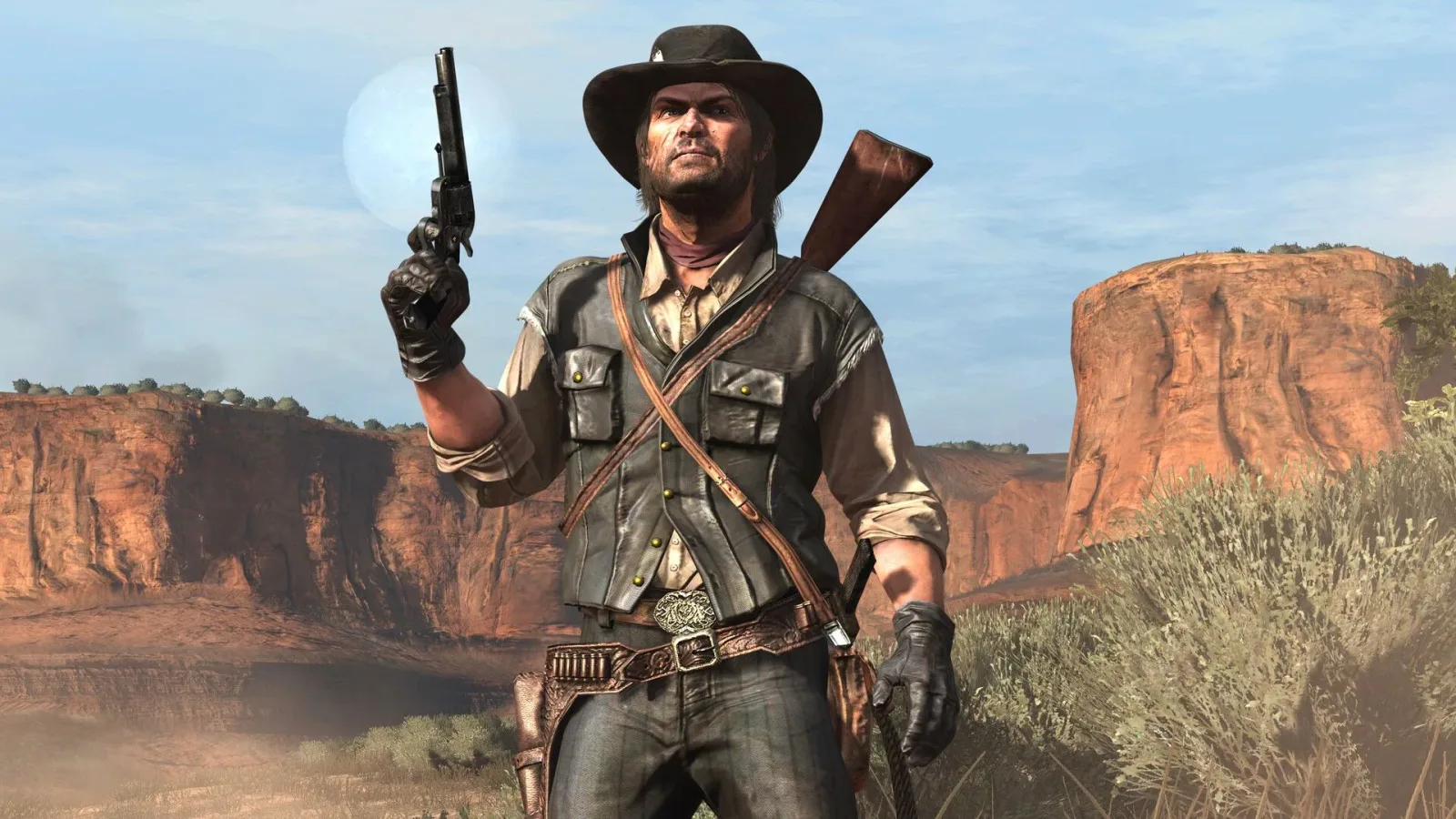
Red Dead Redemption and Bully are now widely regarded as two of Rockstar Games' defining projects beyond Grand Theft Auto, but former Rockstar co-founder and lead writer Dan Houser has said both games came perilously close to not being completed at all.
In an interview with IGN, Houser reflected on the uncertain path faced by ambitious original games, particularly at the AAA level. While sequels can benefit from established technology, a known audience, and a clearer idea of what a finished product should be, a new project often has to prove its value while it is still struggling to find its identity. That uncertainty, Houser suggested, can leave even eventually beloved games vulnerable during development.
Houser said there were numerous points at which Red Dead nearly failed to make it through, and that Bully experienced similar moments. He also pointed to the broader reality of game development: many projects that never reach players may have had the potential to become something special if circumstances had turned out differently.
"I think there were lots of moments where Red Dead nearly didn't happen. I think there were lots of moments when Bully nearly didn't happen, and lots of other moments when games that didn't happen could have," Houser said.
For useful background on this topic, read Reported Halo Battle Royale and Extraction Shooter Was Shelved During Campaign Evolved Development.
For players who know Red Dead Redemption as a sweeping open-world western and remember Bully for its distinctive school-set social satire, the idea that either project might have disappeared before release is a reminder of just how unpredictable game production can be. A finished classic can seem inevitable in retrospect. During development, however, teams are dealing with incomplete systems, unresolved design questions, technical setbacks, shifting priorities, and the ongoing pressure to demonstrate that an expensive project is worth continuing.
Original games have a harder road than sequels
Houser's comments draw a clear distinction between new properties and follow-ups to established hits. A sequel is not automatically easy to make, especially at the scale associated with Rockstar, but it begins with a foundation. Developers can build upon proven ideas, returning audiences already understand the premise, and the team has a better sense of which features matter most.
Original games do not have that benefit. Before a studio can refine an idea, it first has to discover what that idea really is. The central appeal may not be clear in early builds. Features that sound compelling in planning can fail to work in motion. A setting that appears strong on paper may need an entirely different structure once players are allowed to explore it.
Houser described how a game that is struggling can sometimes be rescued by circumstances that are difficult to plan for: a particularly promising build, an important breakthrough, or a moment where the project suddenly starts to cohere. Those turning points do not erase previous problems, but they can give a team and its decision-makers the confidence that there is something worth finishing.
That is why Houser views the completion of fresh AAA ideas as especially impressive. Games that do not survive production can be disappointing, but he argued that it may be more remarkable when an unproven concept successfully reaches the market at all. The process is not simply a matter of executing a fixed plan. It involves identifying the game's strongest possibilities while also solving problems that may only become visible after years of work.
Finding the shape of an open-world western
Red Dead Redemption launched in 2010, but Houser recalled that the project passed through "a lot of difficult periods" on its way there. The game's ultimate strengths may appear apparent today: a vast western setting, dramatic storytelling, open-world exploration, and a tone distinct from Rockstar's crime-focused Grand Theft Auto series. During the actual work of making it, though, the team had to work out why those elements belonged together and how they could support one another.
Houser described the development process as one of gradually uncovering the problems involved in an open-world cowboy game, then attempting to solve them one by one. In hindsight, the appeal of Red Dead can look obvious. At the time, the team was faced with gaps in the design and had to fill them slowly.
That observation speaks to the unusual difficulty of making an open-world game in a setting that is not built around dense modern cities. A western frontier calls for a different rhythm. Travel, landscape, settlements, character encounters, and action all need to contribute to the fantasy of inhabiting that world. The project needed more than a period setting or horseback riding; it needed a convincing answer to what players would find interesting about living in that environment over the course of a major game.
Houser credited the core members of the Red Dead Redemption team with helping the project endure its most challenging stretches. He said those developers remained focused on what they were trying to achieve and worked through the issues in front of them. In his telling, the game was not saved by a single effortless revelation. It was the product of sustained attention from people who could identify weaknesses and keep pursuing solutions.
Bully's survival makes its singular legacy even clearer
Bully occupies a very different place in Rockstar's catalog, yet Houser's comments indicate it faced a similarly uncertain path. Rather than following Grand Theft Auto's urban criminal framework or Red Dead's frontier drama, Bully centered on a school environment and its own hierarchy of cliques, rivalries, pranks, and social pressures. It remains one of the studio's most unusual games precisely because it did not simply repeat the formula of its better-known series.
That distinctiveness also helps explain why the game's existence matters to players. Bully demonstrated that Rockstar could apply its interest in open-ended systems, character-driven storytelling, and satire to a setting far removed from the streets of Liberty City or the American frontier. It was a risky premise, and projects with a less immediately familiar premise can face more questions as they move through development.
Unlike Red Dead Redemption, Bully did not go on to receive a sequel. Houser's reflection does not offer a new explanation for that absence or indicate that a follow-up is in development. Instead, it adds context to the original game's place in Rockstar history. Even getting the first Bully across the finish line was, by his account, far from guaranteed.
For longtime fans, that may make the continued interest in the game easier to understand. Its reputation has endured not because it became a routinely expanded annualized series, but because it remains a singular project with a perspective few other major games have attempted. The lack of a sequel has kept questions around its future alive, but Houser's comments are primarily a look backward at the uncertainty involved in creating it in the first place.
A reminder that successful games are not inevitable
Red Dead Redemption's eventual success makes its difficult development period especially striking. The series later continued with Red Dead Redemption 2, which became one of the best-selling games of all time. That outcome can make the franchise feel like an obvious pillar of Rockstar's lineup, but Houser's recollection challenges the idea that it was always destined to occupy that position.
Games are often discussed after launch as polished, fixed objects: franchises, brands, classics, disappointments, or commercial successes. The more chaotic reality of their creation is usually less visible. Before a game has a final title screen, a confident marketing campaign, or a player community, it may be a collection of promising but unfinished work. Whether it develops into a hit can depend on leadership, iteration, timing, technical progress, and the willingness of a team to continue through periods when the destination is unclear.
Houser's comments also underline the human side of that process. His recollection of Red Dead Redemption emphasizes the people who kept their focus and solved problems, rather than presenting the game's arrival as the inevitable outcome of a corporate plan. In an industry where canceled concepts are often never publicly shown, that is an important perspective. The games players remember can represent only a fraction of the ideas that were once being explored.
Rockstar is currently focused on Grand Theft Auto 6, while the future of both Bully and Red Dead beyond their existing releases remains unconfirmed. There is no new project announcement in Houser's remarks. What his reflection offers instead is a rare acknowledgement of the precarious stage that existed before these games became landmarks: a time when Red Dead Redemption and Bully were not guaranteed successes, and not even guaranteed to happen.
For developers and players alike, it is a useful reminder that the most memorable games are frequently built out of uncertainty. Sometimes a concept finds its form. Sometimes a build proves the potential was there. And sometimes a committed team manages to turn a set of difficult, incomplete ideas into a game that lasts for years after release.
Community
Discussion
Start the conversation.
No comments have been posted yet.