

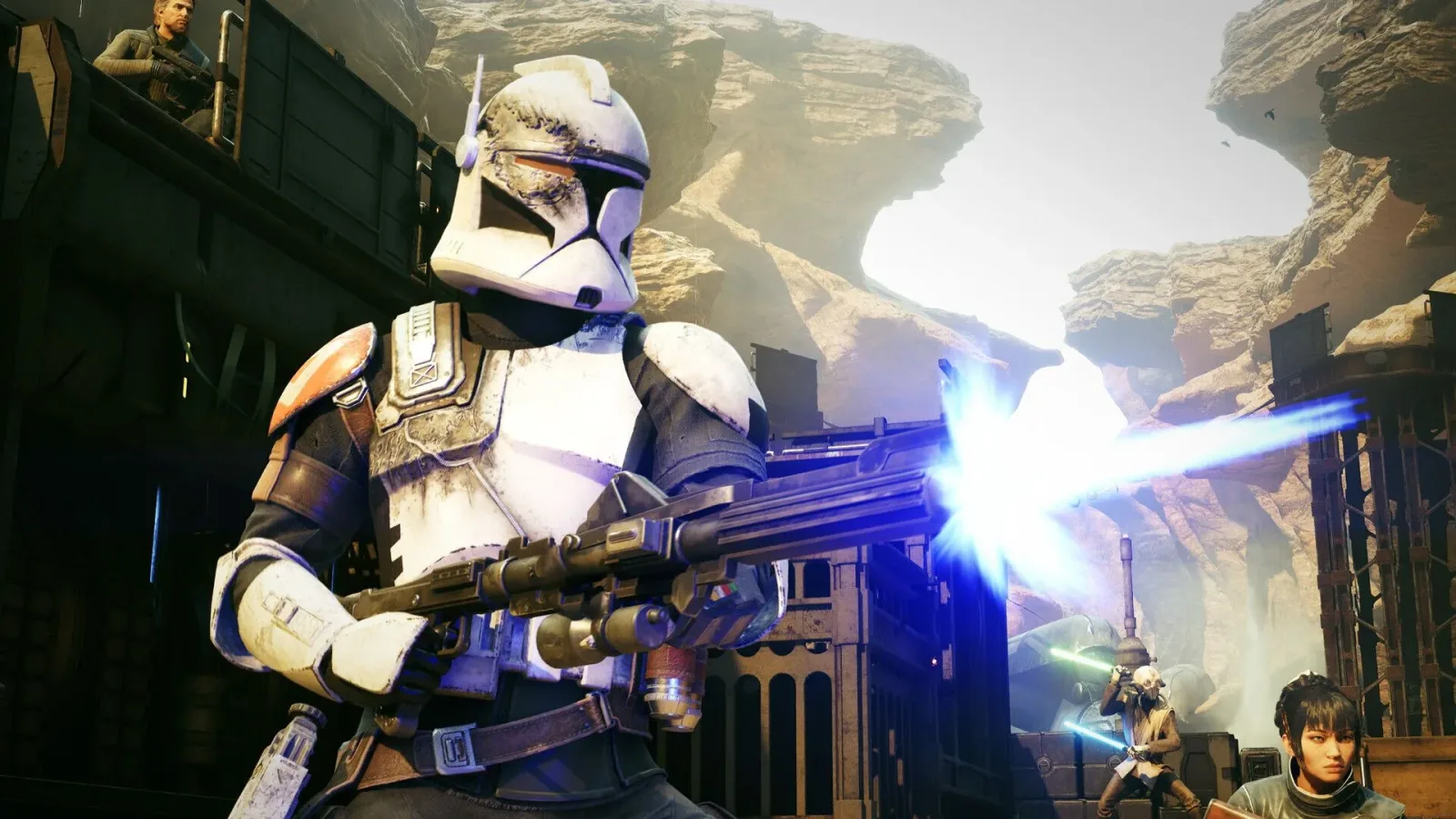
Star Wars video games may be entering a notably broader creative era. After a year that brought the turn-based tactics title Star Wars: Zero Company and arcade racer Star Wars: Galactic Racer, Lucasfilm Games executive Douglas Reilly has indicated that the company is becoming more open to pitches and partnerships from across the industry.
That does not mean the standards around one of entertainment's largest franchises have been lowered. Reilly stressed that Lucasfilm Games still expects projects to meet a high quality threshold and generally seeks teams with a proven history of making strong games. But the company's view of where a compelling Star Wars idea can originate appears to have expanded, potentially making room for studios and publishers outside the biggest names in the business.
For fans, that is an encouraging signal. Star Wars has always been a setting capable of supporting dramatically different kinds of games: dogfighting simulators, role-playing adventures, lightsaber action games, strategy titles, racers, shooters, and experiences focused on the less explored corners of the galaxy. A partnership strategy that welcomes more types of proposals could help the brand continue moving beyond a narrow range of familiar formats.
A shift away from the old exclusive model
The context for this apparent flexibility is important. Disney previously had a 10-year arrangement with Electronic Arts that gave EA exclusive rights to develop Star Wars video games. That agreement ended in 2023, opening the door for Lucasfilm Games to work with a wider set of companies.
For useful background on this topic, read Street Fighter Director Explains the Film's Hand-Drawn Anime Flashbacks.
Exclusivity can provide consistency, resources, and a clearer long-term relationship between a rights holder and a publisher. At the same time, it can limit the number of creative perspectives shaping a franchise. Since the end of the EA agreement, the Star Wars game slate has increasingly reflected a multi-partner approach, with different developers pursuing different genres and eras.
Reilly described Lucasfilm Games as being more flexible about who it accepts pitches from, emphasizing that good ideas can emerge from many places. He also made the case that a publisher does not need to rank among the industry's very largest companies to create an excellent Star Wars game.
"You don't have to necessarily be a top five publisher to make a great Star Wars game," Reilly said.
That distinction matters because it suggests Lucasfilm Games is not exclusively looking for the biggest possible production partner. Experience remains important, but scale alone is not the only qualification. A specialist studio with a clear command of a genre could be a natural fit if it has an idea that respects the property and can deliver at a high level.
Zero Company and Galactic Racer demonstrate the possibilities
The recent releases cited in the discussion provide a useful picture of what a wider partnership strategy can produce. Star Wars: Zero Company takes the franchise into turn-based tactics, adapting a style associated with games such as XCOM for Star Wars' science-fiction setting. That is a meaningful departure from the action-heavy design many players may first associate with the license.
Meanwhile, Star Wars: Galactic Racer approaches the universe through arcade racing, with developers involved in the project having worked on Burnout. Its existence alone underscores the value of matching an experienced team to a concept that suits its particular strengths. Rather than requiring every Star Wars game to look and play alike, the franchise can draw on established talent in different areas of game design.
Both games earned strong reviews, giving Lucasfilm Games evidence that audiences are willing to embrace less expected takes on the galaxy far, far away when the core concept is executed well. The lesson is not simply that every genre needs a Star Wars version. Instead, it is that the setting can provide a powerful foundation for games that have a distinct identity of their own.
A tactics game should be built by people who understand encounter design, squad management, and strategic decision-making. An arcade racer benefits from developers who know how to make speed, collisions, handling, and competition satisfying. In either case, Star Wars is not a substitute for expertise. It is the world that gives a well-made game additional atmosphere, stakes, characters, and visual imagination.
Quality remains central to Lucasfilm Games' approach
Reilly's comments also make clear that a more open door does not mean an indiscriminate one. Lucasfilm Games still has what he characterized as a high quality bar. The company wants its releases to be excellent experiences, and that normally leads it toward teams with meaningful development experience rather than brand-new groups without a record of successful work.
That is a practical position for a franchise of this size. Star Wars carries major expectations from players, and each new game becomes part of a history that includes beloved classics as well as modern hits. An unconventional genre choice can attract attention, but the novelty will only last if the game is polished and satisfying on its own terms.
The balancing act for Lucasfilm Games will be finding partners that can offer fresh ideas without sacrificing the confidence that comes from proven craft. Smaller or mid-sized publishers may be able to bring focused concepts and a clearer genre identity, while experienced studios can provide the production discipline needed to turn those concepts into completed games.
It also means that future surprises may not always take the form of enormous blockbuster productions. A Star Wars project could be notable because of its genre, its development partner, its place in the franchise timeline, or the particular part of the universe it chooses to explore. A game does not need to be designed around the most recognizable characters to be worthwhile if it delivers a convincing Star Wars fantasy.
More unexpected collaborations could be on the way
Reilly said Lucasfilm Games is exploring a range of possibilities with both large and small partners. His description suggests that future announcements may prompt the kind of reaction that comes when fans see a studio associated with one type of game taking on Star Wars in an unexpected way.
Reilly said the company is looking at projects with partners of different sizes that could continue to surprise people who see a collaboration and become curious about how it will turn out.
There is no indication yet of which studios those future collaborators may be, what genres they may tackle, or when their projects could be revealed. The comments should therefore be read as a direction of travel rather than a list of imminent announcements. Still, the broader message is that Lucasfilm Games appears interested in maintaining a pipeline with room for experimentation.
That could be especially valuable for a universe as expansive as Star Wars. The franchise contains military conflicts, criminal underworld stories, podracing and other sports, political intrigue, exploration, bounty hunting, droid-focused adventures, and local stories far from the Jedi-versus-Sith conflict. Each of those areas could support very different game structures.
A healthy Star Wars lineup does not require every project to appeal to every player. A racing fan may be drawn to Galactic Racer while a strategy player finds their ideal entry point in Zero Company. Meanwhile, an action-focused audience can look toward the continuing Star Wars Jedi series. Greater variety may ultimately make the overall catalog stronger by giving more people a reason to engage with it.
Known projects keep the Star Wars slate active
Even as Lucasfilm Games discusses future opportunities, several major Star Wars projects remain in development. EA's Respawn is working on a third game in the Star Wars Jedi franchise, continuing one of the most prominent modern series set in the universe.
Quantic Dream's Star Wars Eclipse also remains in development. The project encountered a significant complication earlier in the summer when developers planned to strike, leaving open questions about its path and eventual arrival. No new release timing is established in the information currently available.
Those titles represent a different side of the current strategy: larger, established teams working on ambitious projects with recognizable creative identities. Together with the reception for Zero Company and Galactic Racer, they show a portfolio that is no longer defined by a single publisher or a single formula.
What the new approach could mean for players
The most meaningful outcome of a more flexible licensing model may be an increased willingness to take calculated creative risks. Star Wars has the scale to support prestige action adventures, but it also has room for games built around systems, speed, competition, simulation, investigation, or other ideas that have not been central to the license in recent years.
Reilly's comments do not promise that every prospective collaboration will materialize, nor do they guarantee that every unusual concept will succeed. What they do indicate is that Lucasfilm Games sees value in looking beyond a small circle of expected partners. With a firm quality requirement still in place, that openness could help create a more varied and surprising future for Star Wars games.
For now, the practical takeaway is simple: the recent genre variety appears to be part of a larger philosophy, not a one-off experiment. As Lucasfilm Games continues conversations with partners large and small, fans may want to expect the unexpected from the next wave of announcements.
Community
Discussion
Start the conversation.
No comments have been posted yet.