

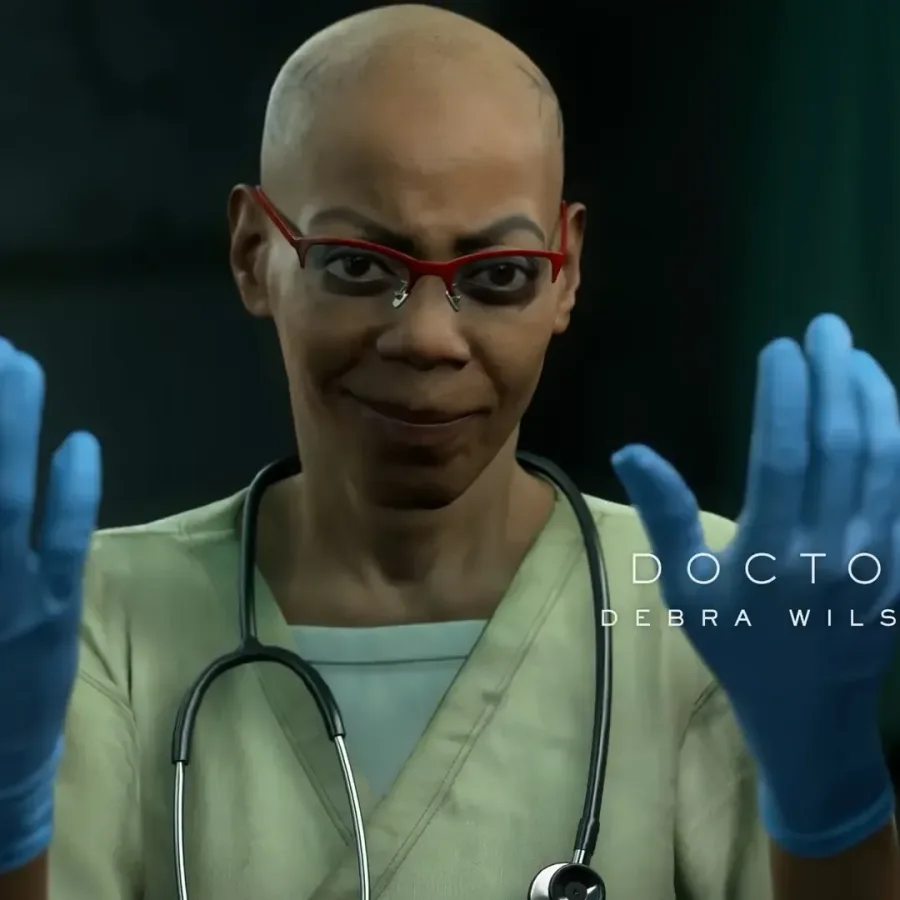
Debra Wilson has become one of the most recognizable performers working in video games, but that familiarity has created an unusual problem for the actor: she is increasingly tired of seeing her own face reflected back at players.
In a recent interview, Wilson discussed the growing use of her likeness in game roles and explained that the decision does not generally come from her. While she appreciates the work video games have brought her, she would often prefer to portray characters who do not look like Debra Wilson. For her, a performance can encompass far more than a faithful digital reproduction of an actor's appearance.
That distinction matters especially in games, where players may spend dozens of hours looking at a character. Wilson said the repeated use of her facial likeness can make it harder for audiences to stay immersed in the fictional world. She also recognizes that some players have become familiar enough with her appearances that they notice her immediately, rather than seeing only the role she is playing.
It is a candid observation from an actor whose work has reached fans through major releases including Star Wars Jedi: Fallen Order, Wolfenstein: The New Colossus, and God of War Ragnarok. Wilson's performances have covered a wide range of characters, but facial scanning can blur the line between performer and role in a way voice acting or more heavily transformed digital performances may not.
For useful background on this topic, read Sony's Last 4K Blu-ray Player Reportedly Ends Sales in Japan, Leaving PS5 as Its Remaining New UHD Option.
A line drawn over tattoos
Wilson's comments became particularly pointed when she described her work as Callisto in Marvel's Wolverine. She said the development team wanted to scan her original tattoos for use in the game. That was where she decided the likeness process had gone too far.
Rather than objecting to the role itself, Wilson's response appears to be about the degree of real-world detail being carried into the fictional character. A face scan already makes the performer highly visible within a game. Reproducing personal tattoos, which can be distinctive markers of someone's individual identity, would have taken that resemblance another step further.
Wilson noted that Callisto resembles her, adding the role to a list of game characters whose visual design has been closely tied to her own appearance. She previously appeared as Amanda Waller in Suicide Squad and Grace Walker in Wolfenstein: The New Colossus. For players who know her screen and game work, that repetition can become noticeable even when the characters themselves occupy very different settings and genres.
The actor does not fault players for reacting to that pattern. In fact, she said she understands the feeling. When a recognizable performer seems to appear repeatedly with the same face, it can pull attention away from the world, the writing, or the character's place in the story. Some players may enjoy recognizing a familiar actor, while others want the illusion to remain intact.
Performance capture's creative tension
Wilson's perspective highlights a broader tension in contemporary game production. Performance capture and facial scanning can preserve subtle expressions and bring actors' physical mannerisms into digital spaces. That can be a powerful storytelling tool, particularly in cinematic games built around detailed character animation. At the same time, the technology can encourage games to present performers as themselves, even when the part might call for a more transformative approach.
For an actor, being scanned may also change how the audience reads the work. A role that is performed through voice, movement, and animation can give viewers room to accept a new person entirely. A highly accurate face scan invites direct comparisons with the actor's previous roles. That is especially true when the same performer appears across several prominent franchises.
Wilson's career makes the issue especially interesting because she has played far more than ordinary human characters. She pointed to her experience portraying demons, dragons, and other non-human beings as evidence of the range that can be lost when a production continually returns to a familiar physical template. The actor's ability to create a character does not necessarily depend on making that character visually identical to her.
Her preference is therefore not a rejection of game performance or of the people building the characters. It is an argument for allowing performers to disappear into roles more often. In an industry increasingly able to reproduce an actor in remarkable detail, Wilson's comments are a reminder that accuracy is not always the same thing as transformation.
Not a demand for a blanket ban
Importantly, Wilson said she would not want to impose a requirement in her contracts that prevents developers from using her likeness. She does not want to limit artists from telling stories in the way they believe works best. That nuance separates her personal preference from a demand that every studio abandon facial scans or stop creating characters around an actor's appearance.
Instead, Wilson sees the choice as dependent on the individual project. Some games are designed around recognizable people, and in those cases a detailed likeness can be part of the intended effect. Her example was Death Stranding 2, where her likeness was used alongside those of many other actors. In that setting, she said she was not bothered by the decision because the cast broadly appeared as themselves.
Wilson also praised Hideo Kojima's creative vision, describing him as more than a director and emphasizing his artistic intent. That distinction is central to her position. She is not arguing that every likeness scan is inherently wrong. She is arguing that context matters, and that the approach should serve the work rather than becoming an automatic default for every performance.
When an entire project embraces well-known performers as recognizable presences, players may enter with different expectations. Their familiarity can become part of the experience. But when only one character repeatedly resembles an actor seen in numerous other games, the resemblance may produce the very distraction Wilson described.
Why Callisto's design has attracted attention
For Marvel's Wolverine, the conversation around Callisto arrives at a time when fans are paying close attention to every detail connected with the game. Wilson confirmed that she plays Callisto, but her comments are not a full description of the character or a wider explanation of Insomniac Games' plans. They do, however, offer a rare performer's-eye view of how much personal identity can be incorporated into a game character before it begins to feel uncomfortable.
The proposed tattoo scan is especially revealing because tattoos are not merely a technical asset. They are personal details with their own history and meaning. Wilson's refusal shows that performers can draw boundaries even when they are willing to participate in facial scanning and performance capture more generally.
That boundary also raises questions the industry will continue to face as digital doubles become more common. How much of an actor's real appearance should be imported into a fictional role? What details should require more explicit discussion? And when does a game benefit from a star's recognizability, rather than asking the audience to look past it?
Those questions do not have one answer. Wilson herself makes that clear by welcoming some uses of her likeness while wishing others had taken a different direction. The key issue is creative fit, consent, and the room for an actor to demonstrate range beyond their face.
A busy slate for Wilson
Wilson's remarks come during another active period in her game work. In addition to Callisto in Marvel's Wolverine, she recently starred as Jessica Pike in Ace Combat 8: Wings of Theve and contributed background voices to Modern Warfare 4.
Her continued presence across high-profile games makes her concern easy to understand. The more often players encounter the same recognizable likeness, the more likely they are to associate every new role with the performer rather than the character. Wilson is not dismissing the value of that visibility, but she is asking for more variation in how games use her talents.
For players, the discussion may offer a new way to think about the increasingly lifelike faces seen in modern games. A scan can be impressive, but it is only one possible tool in a performer's toolkit. Wilson's preferred alternative is simple: let the character be someone new, even when the voice and performance come from someone audiences already know.
Community
Discussion
Start the conversation.
No comments have been posted yet.