

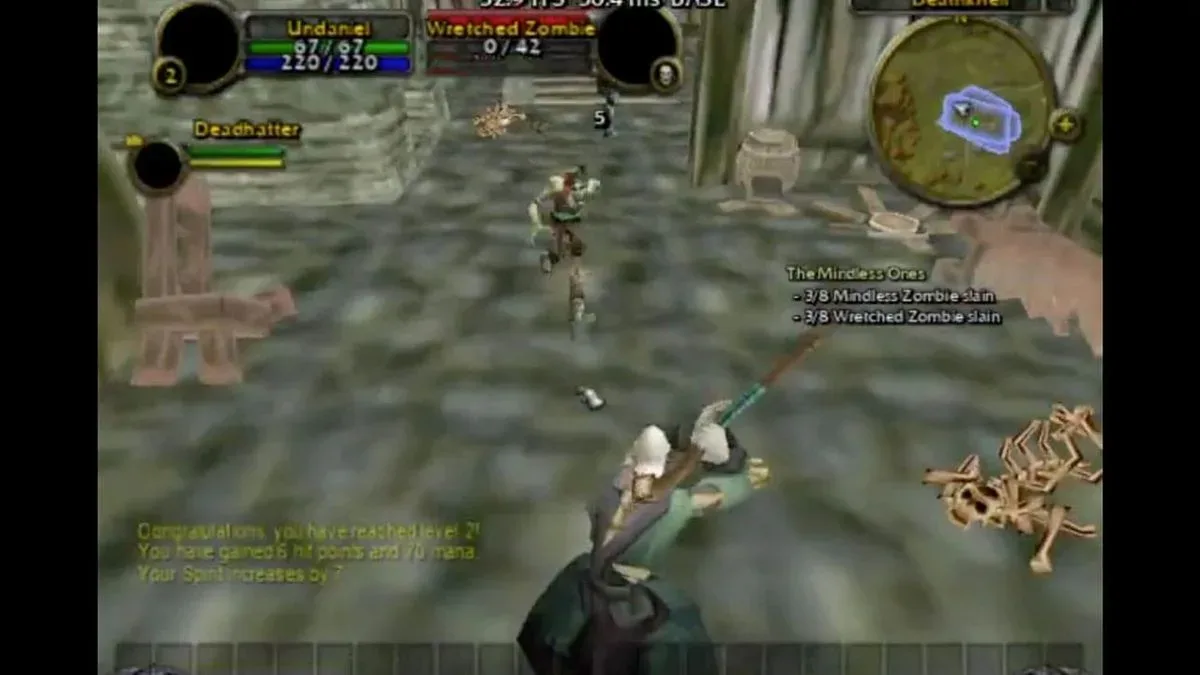
World of Warcraft has been shown running on Sega Dreamcast in a striking community-made port demonstration, giving one of PC gaming's defining online role-playing games a home on hardware that left the market years before Blizzard's MMO first launched. Footage shared by Dreamcast developer and enthusiast Falco Girgis shows playable sessions on the console, including online activity and journeys through multiple areas.
The project is an especially attention-grabbing example of what remains possible within the active Dreamcast homebrew and modification scene. World of Warcraft was built around the expectations of early-2000s PCs, persistent online worlds, keyboard-heavy communication, and a game that would steadily expand in scope for decades. Seeing it operate through Sega's final console naturally raises questions about the technical compromises, the online setup, and how the familiar MMO has been tailored for a machine with a very different controller and hardware profile.
The available demonstration presents the port as more than a menu or login-screen experiment. Gameplay footage shows characters moving through the world and participating in online play, with segments featuring cypress577422 and another player. Girgis has stated that the full game engine has been accommodated on two discs, while the playable build supports every class and its abilities.
Embedded X/Twitter post
A two-disc MMO build for Sega's final console
Dreamcast games were commonly distributed on GD-ROM, Sega's proprietary disc format, and physical media limits are an immediate consideration for a game as vast as World of Warcraft. The claim that the engine has been fit across two discs is therefore central to the project's appeal. It suggests that the port is not simply streaming a PC game from another device or using the Dreamcast as a thin client; instead, it is designed to operate on the console itself with a purpose-built content package.
For useful background on this topic, read Diablo Gets an Unofficial Game Boy Advance Port With Four-Player Co-Op.
That does not mean the entire historical catalog of World of Warcraft content is present. Girgis noted that GM Island and other accessible material are not included in the two-disc build. Such omissions are unsurprising given the scale of an MMO whose original world, patches, expansions, audio, textures, models, interface assets, and data accumulated enormously over time.
For players, the more important point may be what the project does retain. The stated goal is a playable World of Warcraft experience with functioning character classes and abilities, rather than a limited technical sample restricted to a single zone or combat encounter. The clips of online gameplay reinforce that ambition, even if the final scope, server population, installation process, and broader availability have not been detailed.
It is also worth separating the project's demonstration from any suggestion of official support. This is a community effort built around a legacy console, not a newly announced Blizzard or Sega release. The showcased online experience depends on the project's own configuration and compatible server environment, rather than the official modern World of Warcraft service.
Online play takes advantage of Dreamcast hardware
One reason the Dreamcast remains such a fascinating target for network-focused homebrew is that Sega's machine was designed with online connectivity in mind. Its original modem was a notable part of the console's identity, while a broadband adapter offered a much more suitable route for experiences that need a stable connection. This World of Warcraft build supports the broadband adapter, enabling players to connect online and play with others.
That support is thematically fitting. The Dreamcast was ambitious about connected gaming at a time when online console play was still far from routine. World of Warcraft, meanwhile, became one of the landmark games of the always-online PC era. The two belong to adjacent, overlapping moments in gaming history: Sega's hardware represented a forward-looking console strategy, while Blizzard's MMO helped define how social, long-running online games would work on PCs.
The practical experience still differs from playing on a computer. The standard Dreamcast controller has a single analog stick, a digital pad, face buttons, triggers, and a VMU-equipped controller slot. It does not have the twin-stick layout that later became standard across console controllers. An MMO with movement, camera control, targeting, hotbars, menus, and social systems has to work around those limits.
The footage and feature list indicate that the port has found a usable way to handle core play, but controller adaptation is one of the most intriguing parts of the project. A game can technically run on a platform without automatically feeling comfortable there. Making World of Warcraft's moment-to-moment combat and navigation playable through Dreamcast inputs is arguably as meaningful as getting the engine and online connection operational in the first place.
Custom quests, mounts, pets, and progression changes
This version is not described as a completely untouched reconstruction of vanilla World of Warcraft. Girgis has highlighted Dreamcast-specific additions, including new pets, mounts, special quests, and recipes. Those changes position the port as a custom experience built for its unusual platform rather than a strict archival conversion.
The server rules also include arena play up to 3v3, drawing on systems associated with later World of Warcraft expansions while operating alongside vanilla-style PvP systems. That is a notable mixture for players familiar with the game's history. The original version of World of Warcraft had a different competitive structure from the arena system that later became a major part of PvP progression. Combining these elements makes the Dreamcast build feel deliberately curated rather than tied to a single historical patch identity.
Progression has been adjusted as well. Characters receive double experience for level gains through level 20, after which experience returns to its normal rate. This could help new players move past the earliest stages more quickly, a sensible consideration for a community server and for a version that may attract curious users who want to experience the technical novelty without committing immediately to a long leveling climb.
These modifications also underscore a broader truth about retro MMO projects: preservation, adaptation, and fan design often overlap. Recreating an old online game exactly is difficult because the original experience was never only a client on a disc. It involved servers, rulesets, patches, social communities, and ongoing maintenance. A Dreamcast-oriented World of Warcraft build necessarily has to make choices about all of those elements.
Another high-profile experiment for Dreamcast modders
The World of Warcraft showcase arrives amid a period of energetic Dreamcast experimentation. Community developers have continued pushing the machine with ports and adaptations that can appear improbable at first glance. Recent examples discussed within the scene include work bringing Grand Theft Auto III and Star Fox 64 to the console.
There has also been substantial interest in seeing Nintendo 64-era games run on Dreamcast hardware. Mario Kart 64, Diddy Kong Racing, and DOOM 64 have all been among the games associated with that broader wave of Dreamcast porting interest. Each project comes with its own legal, technical, and compatibility questions, but together they illustrate why the console remains a lively homebrew target.
The Dreamcast's architecture, devoted fan base, and long-running independent development tools have helped sustain that enthusiasm. It is a platform remembered for commercial shortcomings and a brief lifespan, yet it continues to receive software experiments that would have seemed impossible during its original retail years. In that sense, the World of Warcraft project is part of a larger afterlife for the machine: one where its limitations are not ignored, but treated as creative design problems.
What still remains unclear
The demonstration establishes that World of Warcraft can run and connect online on Dreamcast hardware, but several practical details remain uncertain. There is no confirmed public release date, no stated price, and no full explanation of how players will obtain or install the build. Details such as supported Dreamcast hardware revisions, network configuration requirements, server access, character persistence, keyboard compatibility, and the final content selection have also not been fully outlined.
Those unanswered questions matter because a technical proof and a widely usable community release are different milestones. A project may run impressively in a controlled setup while still needing work before it is straightforward for other Dreamcast owners to use. Conversely, the public footage already represents a considerable achievement, particularly given the complexity of adapting an online PC MMO for a console from Sega's final hardware generation.
For now, the key takeaway is simple: a community-built Dreamcast version of World of Warcraft has been publicly demonstrated with online gameplay, working classes and abilities, broadband adapter support, and an array of custom systems. Whether it develops into a broadly available package or remains a more specialized project, it is another reminder that the Dreamcast's story did not end when Sega stopped making consoles. Its modern community is still finding unexpected new worlds for it to explore.
Community
Discussion
Start the conversation.
No comments have been posted yet.