

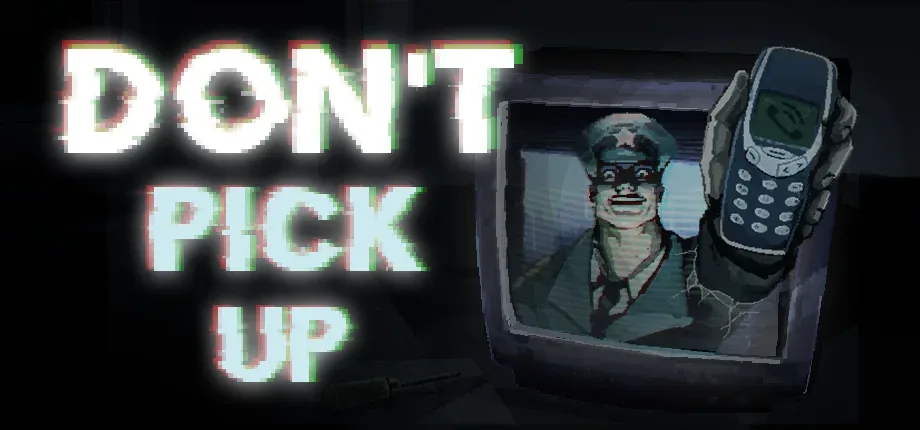
Don't Pick Up, the narrative-focused psychological horror game from developer Quarter Games and publisher Clover Bite, has received a free demo on Steam. The playable preview introduces a premise built around pressure rather than combat spectacle: players work as a technician in a government-certified repair shop, where phones and other communication devices arrive carrying far more than routine technical faults.
Set in an alternate version of the early 2000s, Don't Pick Up places that shop inside a deteriorating authoritarian state. Government rules are not a static backdrop. Directives change from day to day, affecting which devices can legally be serviced, which replacement parts are permitted, and even which customers are acceptable to deal with. The result is a job in which following procedure can be as unsettling as ignoring it.
That combination gives the game's horror a deliberately mundane starting point. Repairing a device is ordinarily an act of problem-solving: identify the damaged component, find a compatible part, return an item to its owner. In Don't Pick Up, each of those ordinary steps may become loaded with risk. A customer may be connected to an unseen faction, a device may contain sensitive evidence, and a simple repair can put the technician on the wrong side of a shifting rulebook.
A repair bench at the center of a political crisis
The Steam demo casts players as an employee in a communications repair business that has government certification. That detail immediately establishes an uneasy relationship between the workplace and the regime outside it. The technician is trusted enough to handle private tools of communication, but that trust comes with surveillance, restrictions, and the expectation that official policy will be enforced at the counter.
For useful background on this topic, read WonderPaws Brings a Stress-Free Animal City Life Sim to PC and Mobile in 2027.
As customers bring in their devices, players inspect and repair them from a first-person perspective. The work also exposes information about the lives around them. Personal messages, hidden details, and signs of larger activity can point toward individuals, conspiracies, and rival groups caught up in the country's broader decline. What begins as a technical task gradually becomes an act of interpretation.
That is the central tension behind Don't Pick Up. The player is not simply asked whether they can fix an object. They must decide what the information inside that object means, whether it should be reported, and whether keeping it secret is worth the danger. The game frames access to private communications as both an advantage and a burden, turning the repair shop into a narrow but consequential viewpoint on a society moving toward collapse.
The setting's alternate early-2000s identity is especially suited to that idea. Communications hardware from the period can feel tactile, private, and personal in ways that encourage close examination. Phones and related devices are not just abstract data containers; they are physical items that pass through the player's hands and workshop. The era also helps reinforce the sense that the technician occupies a small, enclosed space while a much larger crisis develops beyond the door.
For another perspective on this story, read Don't Pick Up Brings Dystopian Phone Repair Horror to a Free Steam Demo.
Daily directives make routine work unstable
Rather than presenting authoritarian control only through story scenes, Don't Pick Up makes regulation part of its gameplay structure. New policies and restrictions can alter the boundaries of legitimate work each day. A repair that was permissible yesterday may become forbidden today. Components that seemed ordinary may be restricted. A customer who appears to need help may represent an unacceptable risk under the latest order.
This system should make each working day feel less predictable than the last. Players need to pay attention not only to the physical condition of a device, but also to the legal and political context around it. The official rules are an immediate survival concern, yet obeying them is not necessarily presented as an uncomplicated moral choice. Regulations can force players to choose between protecting themselves, complying with authority, helping another person, or preserving information that could matter later.
Those choices form the narrative backbone of the game. Decisions about who receives service, what is disclosed, and what is withheld influence the story's direction. Don't Pick Up features multiple endings, meaning the technician's conduct is not treated as a sequence of isolated interactions. The consequences of earlier calls can accumulate as the external political situation grows more severe.
That structure gives a potentially familiar horror setting a different kind of agency. The threat is not defined solely by a creature, a weapon, or an escape route. It comes from uncertainty, complicity, and the fear of making a decision without knowing who will be hurt by it. Even a choice that seems compassionate can have implications the player cannot fully see from behind the counter.
Psychological horror built around information
Don't Pick Up is described as a first-person psychological horror experience, and its premise suggests that unease will come from discovery and implication as much as from immediate danger. The act of examining a customer's property creates an intimate perspective on strangers' lives. Every detail can invite questions: Is this person telling the truth? Is a hidden piece of information evidence of wrongdoing, an appeal for help, or a trap? Is the government's version of legality something the player should enforce?
The shop itself is positioned as a pressure chamber for those questions. Customers enter with their own needs and secrets, while orders from above establish the penalties for doing the wrong thing. Meanwhile, the player can glimpse evidence of a crisis taking shape outside the business. The design turns a small workplace into a place where private lives and public control collide.
There is also an inherent anxiety in the game's title. "Don't Pick Up" can evoke an incoming call, a found object, or a warning not to involve oneself in something dangerous. Within the game's repair-shop scenario, it fits the idea that contact itself carries risk. To accept a device for service is to accept a connection to the person who owns it and whatever may be stored within it.
Players looking for horror rooted in bureaucracy, distrust, and difficult decisions may find the demo an opportunity to see how Quarter Games approaches that concept in practice. The preview's focus on device examination, changing rules, and branching outcomes indicates that close attention will matter. The tension is likely to come not only from what players uncover, but from deciding what responsibility comes with uncovering it.
What the Steam demo includes
The free Steam demo offers a first look at Don't Pick Up's core setup: working inside the certified repair shop, handling communication devices, navigating daily government restrictions, and confronting the consequences of sensitive information. It also establishes the dystopian setting in which a political crisis escalates around the player's routine work.
- First-person psychological horror: Experience the repair shop and its growing atmosphere of unease from the technician's perspective.
- Device inspection and repair: Examine customer communications hardware and carry out service work under restrictive conditions.
- Changing government rules: Adapt to daily directives that determine what repairs, parts, and customers are allowed.
- Information-driven choices: Decide what to report, what to conceal, and who to help.
- Branching narrative outcomes: Player decisions shape the story and can lead to different endings.
- A widening external crisis: Learn about factions, conspiracies, and individuals connected to a larger political collapse.
The demo is available now through Steam. No release date for the full game was included with the demo announcement, so the preview currently stands as the available way to enter its unsettling workplace dystopia. For a game about the costs of access, silence, and obedience, a repair counter may prove to be a particularly effective place to start asking uncomfortable questions.
Community
Discussion
Start the conversation.
No comments have been posted yet.