

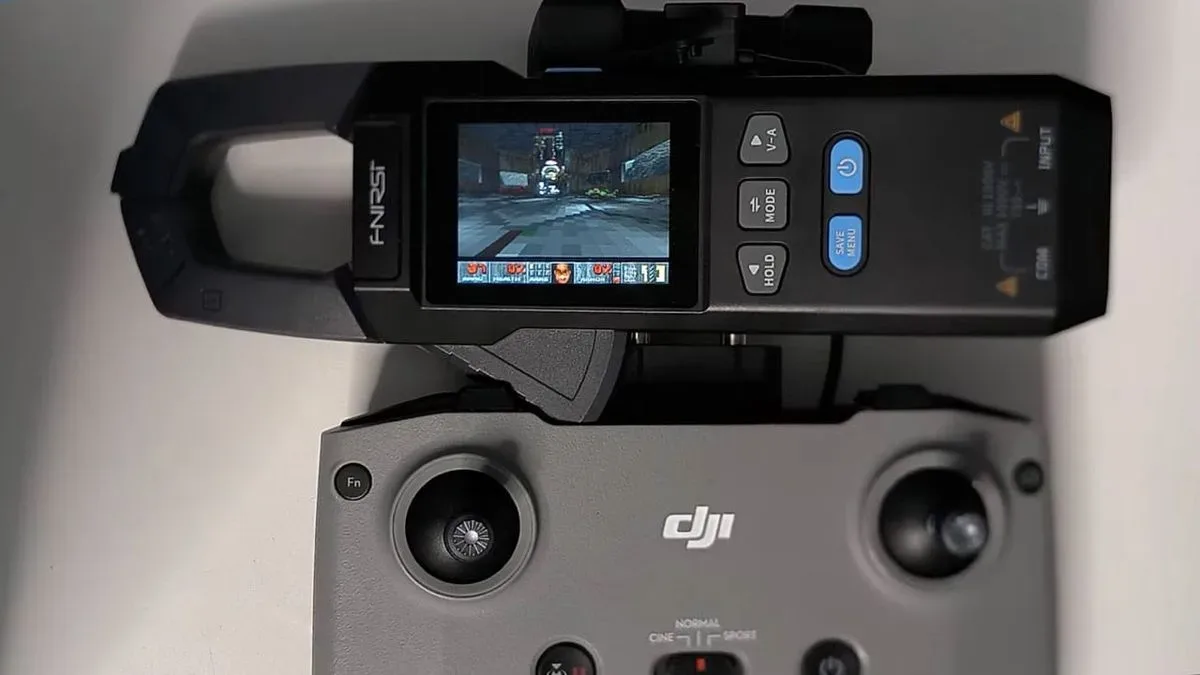
There are few traditions in gaming quite as enduring--or as wonderfully impractical--as getting DOOM to run on hardware that was never meant to play games. The 1993 shooter has appeared on devices ranging from food-order displays and lawn equipment to a pregnancy test, each project serving as both a technical challenge and a celebration of the game's remarkable adaptability.
The newest addition to that long-running list is especially fitting for anyone who enjoys measuring the impossible: DOOM can now run on a roughly $30 FNIRSI DMC-100 multimeter. Rather than merely displaying a static image or a stripped-down proof of concept, the project boots into a playable version of Freedoom: Phase 1, offers a full set of opening-episode maps, supports saving progress, and even works with a controller designed for a DJI drone.
It is an absurd destination for a first-person shooter about battling demons, but it is also a serious embedded-systems achievement. A clamp meter is designed to inspect electrical measurements, not render colorful corridors, process player input, or preserve campaign progress. Yet developer Artur Bieniek has made all of those things happen on the compact tool.
A meter built for circuits becomes a tiny DOOM machine
The FNIRSI DMC-100 is a digital multimeter, also commonly called a clamp meter depending on region and usage. Its normal job is to measure electrical characteristics in a circuit, with its clamp-style design helping users inspect current. Gaming is obviously far outside that intended role, but the device includes the ingredients that make modern hardware experimentation possible: a programmable processor, onboard firmware, storage access, a screen, and USB connectivity.
For useful background on this topic, read Blip Brings a Purpose-Built Dual-Screen Frontend to Android Gaming Handhelds.
At the center of the port is the multimeter's Artery AT32F415 chip. Bieniek used the doomgeneric engine as the foundation for the project, adapting it to work on the hardware inside the DMC-100. Doomgeneric is designed to make DOOM easier to bring to unusual platforms by isolating the game's platform-dependent functions, such as drawing frames, reading controls, and handling timing.
That flexibility is precisely why DOOM remains such a frequent candidate for eccentric ports. The original game's demands are extremely modest by modern standards, while its codebase and the wider community's tooling have given technically minded fans countless avenues for experimentation. A multimeter might sound less capable than a conventional handheld or computer, but embedded devices can be surprisingly powerful when somebody is willing to understand their constraints and build around them.
Freedoom supplies a playable Episode 1
This version does not use the commercial DOOM game data. Instead, it runs Freedoom: Phase 1, a free and open-content game package built to work with engines compatible with the original DOOM. The implementation includes the game's first episode, covering the familiar E1M1 through E1M9 map progression.
That matters because the project goes substantially beyond loading one level as a visual demonstration. Players can navigate from the title screen, play through the available episode, see intermission material, and reach the finale. It also includes four save slots, a particularly impressive inclusion for a device whose standard software is concerned with voltage, resistance, current, and related readings rather than campaign-state management.
The game is displayed in color as well. Color output may sound like a small detail in an age of high-resolution portable displays, but it gives the multimeter port far more of the feel of an actual game than a monochrome novelty demo. On a device with a small screen and an unusual form factor, simply making the game readable and functional requires careful consideration of the display pipeline and controls.
It is worth keeping expectations grounded. This is not a newly released gaming handheld and not a recommendation that anyone replace a normal way of playing DOOM with test equipment. The charm lies in the mismatch between purpose and result. The DMC-100 still looks like a practical electrical tool, but its internal hardware can now be repurposed for a compact trip through Freedoom's demon-filled halls.
Drone controls add another surreal twist
As if running a first-person shooter on a meter were not unusual enough, Bieniek demonstrated control through a DJI RC-N1 controller. The RC-N1 is associated with DJI drone operation, making it an unexpected input device for navigating DOOM-style levels on a multimeter.
The optional controller support is a good example of the project's playful spirit. A drone controller is more recognizable as a joystick-equipped device than a multimeter's ordinary controls, so it can offer a more workable route to movement and aiming. But the pairing also emphasizes the experimental nature of the whole setup: hardware meant to fly a camera drone is used to battle digital monsters on a tool meant to test electrical systems.
For people who want to reproduce the installation, the controller is not mandatory. The project documentation lists it as optional and points prospective users toward the relevant controller materials. The essential starting point is the FNIRSI DMC-100 itself, a USB-C connection to a computer, and the willingness to work through a software build and device-install process.
Reproducing the project requires a real development environment
This is a DIY port, but it is not presented as a one-click consumer mod. Bieniek's setup was developed on Linux, although the basic requirement for transferring files is a system that can copy files to a USB drive. Building the firmware requires a collection of command-line development tools, including GNU Make, Clang, LLVM utilities, Python 3, Git, and related testing dependencies.
Toolchain versions are especially important. The documentation notes that Clang 19 or older will not fit the firmware into the available space, producing an error in which the image runs into the settings page. The listed successful environment used Clang and LLD 23 along with Python 3.14, while the Ubuntu 24.04 example installation uses the LLVM 20 package set.
There are further requirements for those who intend to build and validate everything rather than only perform the most basic installation. Tests need Clang's sanitizer runtime, plus tools such as mtools and dosfstools. Renode and Pillow are needed for the Renode-based tests, while certain installation, restoration, and optional USB test scripts use udisks2. The project also specifies that the local checkout path must not contain spaces.
Those details underline the difference between a clever video clip and a reproducible engineering project. Publishing the dependency notes, build conditions, and restoration tools gives experienced hobbyists a route to investigate the port for themselves. It also helps clarify that the DMC-100's newfound game capability is not accidental. It is the result of working within strict memory and firmware limits while accounting for the hardware's particular behavior.
Why DOOM ports still matter
It is easy to dismiss unusual DOOM ports as a meme, especially after decades of increasingly strange hardware targets. But the humor only exists because the technical work is real. Every successful port asks developers to study an unfamiliar platform, locate usable processing and display resources, solve input problems, fit a program into finite storage, and find a dependable way to install or restore software.
The multimeter project captures all of that in miniature. It runs an open-content DOOM-compatible campaign, preserves saves, presents the game in color, and accepts an optional external controller. More importantly, it turns an everyday device into a conversation piece without hiding the engineering effort behind the joke.
DOOM has become a kind of informal benchmark for hardware curiosity. Getting it working does not mean a device is suddenly a practical gaming platform, but it does demonstrate that its processor and surrounding software environment can be pushed in unexpected ways. In the case of the FNIRSI DMC-100, the result is a clamp meter that can check a circuit one moment and host a journey through Freedoom the next.
For enthusiasts with the right model, the necessary development experience, and a tolerance for firmware tinkering, Bieniek's work offers a chance to follow the same path. For everybody else, it is another delightful reminder that almost any screen with a capable-enough chip may eventually face the same question: can it run DOOM?
Community
Discussion
Start the conversation.
No comments have been posted yet.