

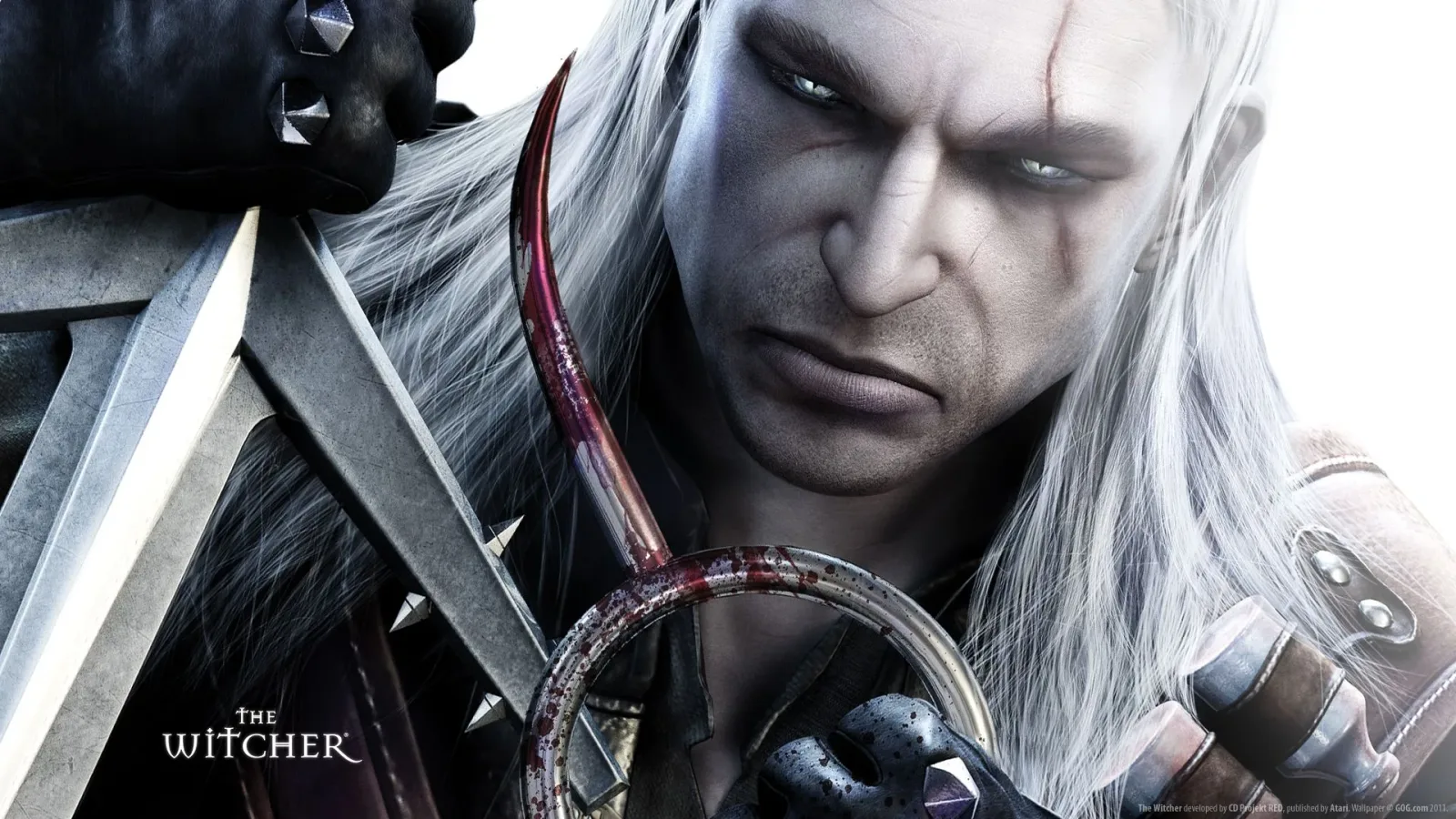
Geralt of Rivia's voice is one of the most immediately recognizable sounds in modern role-playing games: measured, rough around the edges, and capable of making a short response feel like it carries years of exhaustion and hard-earned experience. For many players, that voice is inseparable from The Witcher series. Yet Doug Cockle's original performance as Geralt was created under a remarkably compressed schedule. The actor has recalled that he recorded the protagonist's complete dialogue for the first game in roughly eight days.
That workload becomes even more striking considering the kind of game The Witcher was. Role-playing games ask a great deal of their lead performers, with conversations that range from major plot scenes and branching choices to incidental dialogue, combat barks, reactions, narration, and repeated lines that must remain consistent across many hours of play. Cockle said the work included a run of five consecutive recording days, with sessions lasting approximately six or seven hours each day.
Maintaining Geralt's distinctly deep register for that length of time took a physical toll. Cockle described the voice as being very low in his range, and said it was severely worn out by the end of a day in the booth. His recovery routine was simple but necessary: returning to his hotel room and drinking peppermint tea, or lemon and ginger tea, through the evening before starting again the next day.
A Character Built Without an English Novel for Reference
The demanding schedule was not the only unusual part of Cockle's introduction to Geralt. When he first auditioned for the role, Andrzej Sapkowski's The Witcher novels had not yet been translated into English. That meant Cockle could not turn to the books as preparation or use them to study Geralt's history, personality, or the wider world in which the character lived.
For useful background on this topic, read Elden Ring Movie Reportedly Nears $200 Million Budget as A24 Prepares Its Biggest Gamble Yet.
Instead, his initial understanding of the witcher came directly from a developer at CD Projekt Red, who explained the character during the audition process. Cockle has said that he simply attended an audition and met with a member of the development team who outlined who Geralt was. From there, the actor had to establish a version of the character that served the game while working without the English-language source material that would later introduce many more readers to Sapkowski's fantasy setting.
That situation gives the first game's English performance a particularly interesting place in the franchise's history. Cockle was not adapting a character he had encountered on the page in his own language. He was helping define how a new audience would first hear and understand Geralt through the game itself. The eventual success of that portrayal makes the limited preparation time feel less like a setback and more like a foundational part of the role's creation.
Cockle was nevertheless enthusiastic about the opportunity from the outset. He has spoken warmly about discovering an unfamiliar fantasy universe and explained that he had long been drawn to the genre. His interests included landmark fantasy works such as The Lord of the Rings, The Hobbit, and The Dragonriders of Pern, as well as Conan the Barbarian. For an actor already invested in fantastical worlds, the chance to explore a new setting clearly held immediate appeal.
The Challenge of Finding Geralt's Sound
Geralt's voice may sound effortless in the finished game, but the performance relies on careful control. It is not merely a low voice. Cockle's Geralt combines restraint with dry humor, skepticism with empathy, and professional detachment with flashes of anger or tenderness. The character often says relatively little, so changes in pace, texture, and emphasis can matter as much as the dialogue itself.
In that context, spending hours each day at the bottom of one's vocal register was a demanding technical choice. A low, raspy delivery can provide a memorable quality, but sustaining it for prolonged sessions can be punishing. Cockle's account of drinking tea between recording days illustrates the less visible side of voice work: the performance players remember is the result of vocal stamina, recovery, and the ability to repeatedly return to the same character sound under pressure.
The quick turnaround also underscores how much confidence the production placed in Cockle's interpretation. Recording every line for a game's central character in about eight days leaves little room for a lengthy process of gradual discovery. The voice needed to be established early, carried through extensive material, and preserved across long workdays. By Cockle's recollection, the game arrived and audiences embraced it, beginning a relationship between actor, character, and players that would last far beyond the original release.
Why the First Performance Still Matters
The original The Witcher introduced players to a version of Geralt who was already shaped by Sapkowski's writing but still needed to be translated into an interactive role-playing lead. In games, players do not only observe a protagonist; they direct conversations, make decisions, and spend long stretches hearing that character respond to the world. A lead performance therefore has to withstand repetition while remaining expressive enough to sell dramatic scenes.
Cockle's work gave Geralt a strong identity in English. The reserved tone suited a monster hunter accustomed to suspicion, political conflict, and difficult moral choices. At the same time, the delivery left room for the wit that became a defining ingredient of the character. It is easy to see why the voice became a constant point of recognition as the series expanded.
The games that followed had larger ambitions, broader audiences, and increasingly elaborate cinematic presentation, but the core vocal identity remained intact. That consistency helped establish Geralt as more than a player avatar. Even as players guided him through choices and relationships, he retained a specific presence: weary but alert, blunt but not without feeling, and never entirely comfortable with the labels other people placed on him.
For longtime fans, learning how quickly the first performance was recorded adds another layer to that legacy. The voice that would become so closely associated with Geralt was not the product of an open-ended production schedule or years of familiarity with translated novels. It came from an audition, a developer's explanation of the character, an actor's affection for fantasy, and a concentrated burst of difficult studio work.
Geralt's Place in The Witcher 4
Cockle is confirmed to return as Geralt in The Witcher 4, though the character will not be the central focus in the same way he was in the original trilogy. CD Projekt Red has said that Geralt will always remain important to the series, even when he is not positioned in the spotlight. That framing suggests a meaningful continuing presence without promising that the next game will repeat the previous structure.
The planned return carries obvious weight because of the actor's history with the role. A new chapter can explore different leads and directions while still benefiting from the familiarity of Geralt's voice when the story calls for it. For players who began with the first game, Cockle's involvement also creates a connective thread between the franchise's early PC roots and its next major era.
The Witcher 4 is currently associated with a tentative 2028 release window. With that timing still some distance away, details about Geralt's exact role remain limited. What is clear is that Cockle's original work remains central to the series' identity. The circumstances behind it are now part of the character's history: eight days of recording, long sessions, a voice pushed to its limit, and a performance that endured.
A Lasting Result From an Intense Beginning
There is something fitting about Geralt's voice emerging from a tough production process. The character has always been defined by endurance, whether he is tracking monsters, navigating dangerous politics, or carrying the consequences of choices with no clean outcome. Cockle's account reveals an actor meeting a different kind of endurance test, one involving sustained low-register work and careful recovery after exhausting sessions.
The result has outlasted the circumstances of its recording. What began as a rapid production assignment for the first The Witcher became one of gaming's most familiar vocal performances. With Cockle set to reprise the part in the future, Geralt's voice will continue to be a bridge between the series' beginnings and whatever comes next.
Community
Discussion
Start the conversation.
No comments have been posted yet.