

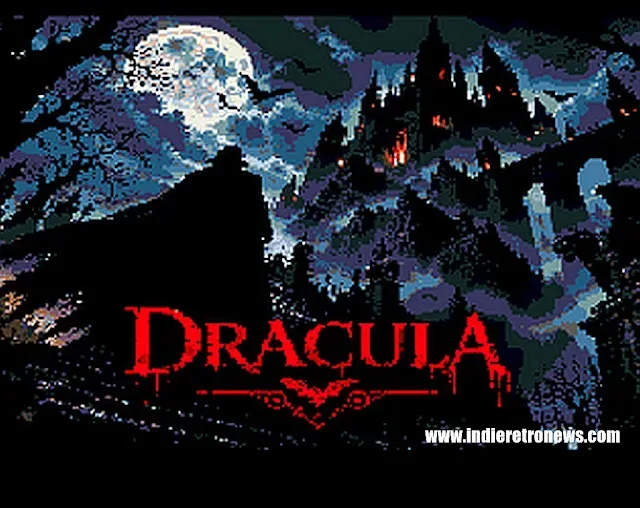
DJSOFT has released Dracula, a gothic interactive adventure built specifically for the Commodore Amiga and ZX Spectrum. Inspired by Bram Stoker's landmark horror novel, the game combines illustrated scenes with the hands-on language of a traditional text parser. Its central promise is simple but potent: players are not choosing from a fixed list of actions. They must decide what they want to do, type that command, and deal with the consequences as they explore an increasingly unsettling world.
That approach makes Dracula a notably old-school horror proposition, but not merely because it is arriving on vintage hardware. Parser adventures have always depended on participation in a way that menu-driven games often do not. A player is asked to observe a location, infer what may be important, try an action, rethink the wording of that action if necessary, and gradually build an understanding of the game's rules. In a horror setting, that process can turn even ordinary decisions into sources of tension.
DJSOFT's game is designed around that feeling. Dark locations, objects that invite close examination, characters who may need to be questioned, and puzzles rooted in the environment form the backbone of its adventure. Adding another layer of pressure, Dracula uses a real-time mechanic: events and situations can change while the in-game clock continues to move. The player is therefore not simply solving a static chain of problems at leisure. Timing can matter, and hesitation may reshape the circumstances surrounding a puzzle or encounter.
A horror story told through typed commands
Text parsers are one of gaming's most direct ways of putting imagination to work. Rather than displaying a handful of highlighted verbs or dialogue choices, they invite instructions such as examining an object, moving through a location, speaking to someone, or attempting a more unusual action. The system's appeal lies in its apparent openness. The player is encouraged to think beyond the most obvious solution and to engage with the setting through language.
For useful background on this topic, read Space Trolls of Mahlsdorf Brings a New Shoot 'Em Up to ZX Spectrum Hardware.
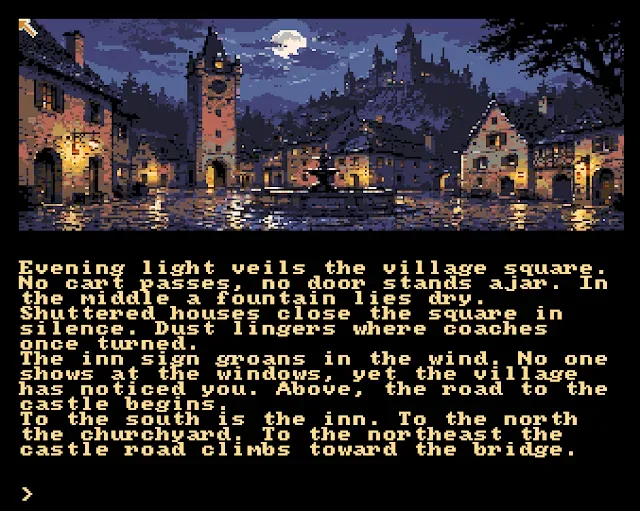
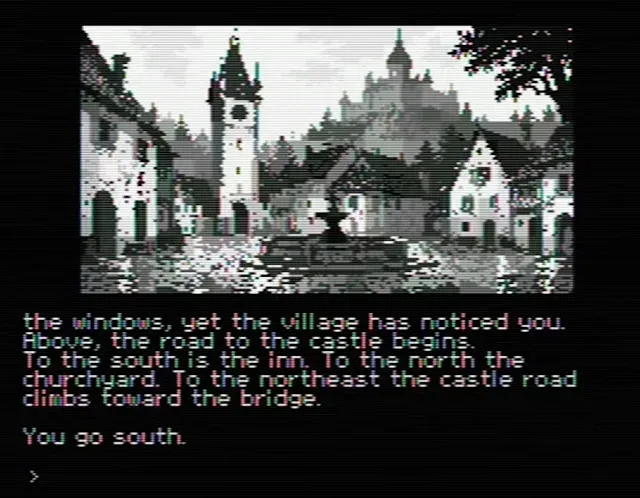
For Dracula, that means the journey is built around active exploration. Players will type commands to investigate the game's gloomy spaces, inspect the details around them and question the people they encounter. The illustrated presentation ensures that these locations are not left entirely to prose, while the parser remains the key means of interacting with them. It is a hybrid structure that should feel familiar to fans of classic illustrated adventures: an image establishes mood and place, while text supplies description, responses and possibilities.
The choice of a Dracula-inspired premise suits this form especially well. Gothic horror is full of sealed rooms, strange documents, suspicious hosts, ominous objects and information that becomes meaningful only after the right discovery. A parser can make those ingredients tactile. Seeing a mysterious item is one thing; deciding whether to inspect it, take it, use it elsewhere or ask another character about it asks the player to take ownership of the investigation.
Rather than relying on passive selections, Dracula places the burden of observation and action on the player's own commands.
For another perspective on this story, read DJSOFT Releases Dracula for Amiga and ZX Spectrum.
That does not mean every moment must be elaborate or obscure. The strength of an adventure like this is the rhythm created between description, experimentation and revelation. A carefully written response to an unsuccessful attempt can still tell the player something useful about a room, an object or a character. Conversely, a small success can alter the perceived importance of an earlier clue. In gothic fiction, where uncertainty is part of the atmosphere, that back-and-forth can be as valuable as a dramatic plot turn.
Illustration, atmosphere and environmental storytelling
Dracula is described as an illustrated adventure, and those visuals are a meaningful part of its identity. Text adventures can create vivid imagery through description alone, but illustrations give each major setting an immediate visual tone. In a game concerned with haunting locations and suspense, that can help establish a room's character before a player has entered a single command.
The game also leans heavily on environmental storytelling. Instead of treating locations only as containers for items and exits, the world itself is meant to communicate story and mood. Players are encouraged to scrutinise what is around them, which suggests that descriptions, scenery and objects are more than decorative background. Details within an area may contribute to the wider mystery, point toward a puzzle solution or simply deepen the sense that something is wrong.
Environmental storytelling is particularly useful in a text-led adventure because it rewards patience. A player who reads closely and tests what appears significant may uncover connections that are easy to miss at first glance. The atmosphere is not delivered only through scripted scenes; it can emerge from how spaces are arranged, what objects imply, and what changes after the player has taken a particular step.
That structure is a natural fit for Dracula's enduring gothic framework. Bram Stoker's novel has been adapted in many forms over the decades, but its core imagery remains remarkably flexible: foreboding travel, hidden motives, unfamiliar environments, danger behind respectable appearances and the gradual realization that ordinary assumptions no longer apply. DJSOFT's game takes inspiration from that legacy while expressing it through the mechanics of a vintage-style interactive adventure.
Time pressure changes the investigation
The real-time element may be the feature that most separates Dracula from a purely static puzzle adventure. Traditionally, players can spend as long as they like pondering an inventory combination or revisiting a room. Here, the passage of time can cause events and situations to shift. That creates a more urgent relationship with exploration, even when the player is doing something as seemingly quiet as reading a description or deciding who to question.
A clock-driven structure can make familiar adventure-game activities feel different. Examining every detail may remain important, but doing so may also demand prioritisation. An encounter that seems safe at one point may not remain unchanged forever. A player may need to recognize when it is better to continue investigating and when it is time to act. The result is a horror experience where tension is not reserved for a single climactic sequence; it can accompany the ordinary act of moving through the world.
Because events change dynamically, the game's puzzles are positioned as part of a living situation rather than a set of disconnected locks waiting to be opened. The information a player gathers, the commands they try and the time they spend may all influence how they approach the next obstacle. This is an effective match for the source material's broader themes of pursuit, danger and mounting dread.
What players can expect from the adventure
- An original gothic interactive adventure inspired by Bram Stoker's Dracula.
- Versions tailored for Commodore Amiga and ZX Spectrum hardware.
- Illustrated scenes paired with text-based exploration and responses.
- A traditional parser interface requiring players to type commands.
- Opportunities to examine locations and objects closely, as well as interrogate characters.
- Environmental clues and puzzles woven into the game world.
- A real-time system in which circumstances can change as the clock advances.
A release for retro adventure fans
The Amiga and ZX Spectrum are fitting homes for a project so closely aligned with the history of interactive fiction and illustrated adventures. Both platforms occupy important places in the culture of computer adventure games, where atmospheric writing, distinctive visuals and player-led problem-solving could deliver memorable experiences without needing modern presentation conventions. A new release for these systems is therefore more than a stylistic nod; it speaks directly to players who value that particular relationship between hardware, interface and genre.
For Amiga players, the illustrated gothic presentation has an obvious appeal, while the ZX Spectrum version brings the same adventure concept to one of Britain's most influential home computers. The shared design focus is not on fast reflexes or cinematic spectacle. It is on reading, deduction, experimentation and maintaining composure while the game's world continues to develop around the player.
That may also make Dracula appealing to anyone who misses the deliberate pace of classic adventures. Modern games frequently streamline interaction to avoid ambiguity, but parsers embrace the idea that players should formulate intentions themselves. There can be friction in that style, yet it is also where much of the satisfaction comes from. Finding the right command or recognizing an overlooked detail can feel less like selecting an answer and more like making a genuine discovery.
Dracula is now available as a new gothic adventure for Commodore Amiga and ZX Spectrum. With its illustrated locations, text-parser interaction, environmental puzzles and changing real-time conditions, DJSOFT's release aims to make the familiar vampire myth feel intimate, uncertain and suitably nerve-racking on two classic platforms.
Community
Discussion
Start the conversation.
No comments have been posted yet.