

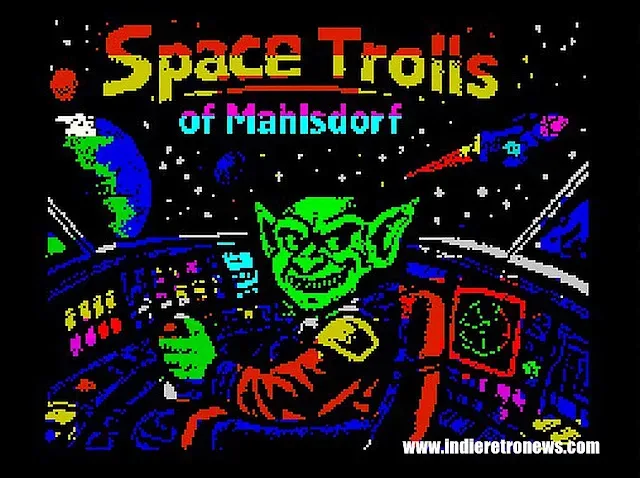
Space Trolls of Mahlsdorf is a new shoot 'em up developed for the ZX Spectrum by Papi & Sohn. The project is described as a fully featured entry in the long-running Spectrum homebrew scene, built with a collection of development, art, music, and assembly tools that bridge the machine's original limitations with the workflows available to creators today.
The game has been tested across several ways of experiencing Spectrum software: an original ZX 128 Toastrack, a Spectrum Next, and the Speccy Emulator. It also supports both the standard ULA palette and ULA+, giving players with compatible hardware or emulation setups a choice in how its visuals are presented.
While the available development notes do not outline the game's stages, mechanics, enemy designs, release plans, or distribution method, the name and genre establish a clear promise: an arcade-minded science-fiction battle designed for one of home computing's most enduring 8-bit systems. For Spectrum enthusiasts, the technical details are a useful reminder that new software for the platform continues to be made, tested, and tailored for real machines rather than treated solely as an emulation curiosity.
A Shoot 'Em Up for an 8-Bit Institution
The ZX Spectrum remains one of the most recognisable home computers in European gaming history. Its distinctive visual constraints, compact controls, and enormous original library made it a natural home for arcade games, including scrolling action titles and fixed-screen shooters. New projects such as Space Trolls of Mahlsdorf continue that tradition while benefiting from decades of accumulated community knowledge.
For useful background on this topic, read Joan of Arc: Deus Contra Machinam Brings Factory Rebellion to Commodore 64.
Shoot 'em ups are particularly well suited to the appeal of retro development. Their basic vocabulary is instantly understandable: a player-controlled craft or character, hostile forces, projectiles, patterns, hazards, score chasing, and escalating pressure. Yet those familiar ingredients leave considerable room for personality. The unusual title, Space Trolls of Mahlsdorf, suggests a premise with more character than a purely generic interstellar conflict, even though further story details have not been provided.
On the Spectrum, a shooter must make careful use of the machine's memory, display capabilities, processing time, and sound options. The system's famous colour attributes can create visual challenges when multiple moving objects occupy the same regions of the screen. Those constraints are not simply obstacles; they are part of the creative identity of Spectrum games. Developers often turn them into a recognizable look through strong sprite work, deliberate colour placement, bold backdrops, and fast, readable action.
Tools Behind Space Trolls of Mahlsdorf
Papi & Sohn used several tools during the game's production. The listed toolkit includes ZX-Paintbrush, SjASMPlus, MPAGD, and MPAGD Musicizer 2.1. Together, those utilities cover important parts of the development process, from visual asset preparation and assembly to game construction and music integration.
MPAGD is among the tools used for the project, alongside Shmupkit. The latter name is especially notable in the context of a shoot 'em up, as it indicates a development approach built around the needs of the genre. Rather than starting with only a blank technical foundation, developers can use specialised frameworks and tools to focus more closely on the game's action, presentation, balancing, and content.
SjASMPlus was also used. It is an assembler associated with Z80 development, fitting naturally with software intended for the Spectrum's processor family. Assembly work remains a major part of the retro-development landscape, whether used for an entire game or for performance-sensitive features. A shooter can demand frequent updates to player movement, enemy movement, bullets, collisions, animation, sound, and display data, making efficient code a key consideration.
For visuals, the team used ZX-Paintbrush. Creating graphics for Spectrum software is rarely only a matter of drawing a sprite and placing it on screen. Artists must also consider the platform's screen layout and colour rules, especially when designing scenes that need to remain legible during fast action. The art workflow is therefore closely tied to gameplay: enemies and shots need to stand out, the player must be easy to identify, and the playfield needs to communicate danger at a glance.
MPAGD Musicizer 2.1, created by David Saphier, was used for the game's music work. Audio is one of the areas where new Spectrum productions can meaningfully vary depending on the target machine and supported hardware. The presence of a dedicated music tool in the project's workflow points to music being an intentional part of the package rather than an afterthought.
Music From Multiple Contributors
The soundtrack credits list tracks by DJ SerG, Nik-O, DJ Max, Bell, and Wally. A multi-artist music lineup can give an arcade game a broader sonic identity, with separate pieces potentially supporting different gameplay situations, menus, stages, or other portions of the experience. The precise allocation of each track has not been detailed, but the credited names underline the collaborative nature of the project.
Music has always played an important role in how Spectrum games are remembered. Whether heard through the machine's familiar beeper-style audio or through expanded configurations, a memorable melody can add momentum to an action game and give it an identity beyond its score table or visual palette. For a shoot 'em up, that role is especially valuable: music can maintain energy through repeated runs while helping moments of danger or progress feel more dramatic.
The inclusion of several composers also reflects a wider strength of the contemporary retro scene. Many new games are not isolated hobby experiments in the narrowest sense. They are collaborative productions drawing on programmers, artists, musicians, testers, and tool creators, each contributing expertise shaped by years of interest in the platform.
Tested on Original Hardware, Next, and Emulator
Space Trolls of Mahlsdorf was tested on a ZX 128 Toastrack owned by the developer, on the developer's son's Spectrum Next, and through the Speccy Emulator. That testing spread matters because each route represents a different way players may approach Spectrum software.
Testing on a ZX 128 Toastrack is particularly significant for anyone who prefers original hardware. It confirms that the development process included a real ZX Spectrum 128 system rather than relying exclusively on emulation. Original machines can reveal practical issues that may not be immediately apparent in a modern software environment, from timing and loading behaviour to display and audio expectations.
The Spectrum Next test is also notable. The Next is a modern continuation of the Spectrum concept, designed to retain compatibility with a huge body of older software while offering substantially expanded capabilities for projects that choose to use them. In this case, the testing information establishes that Space Trolls of Mahlsdorf was tried on the platform, though the provided details do not say that it is a Spectrum Next-exclusive production or identify any Next-specific features.
Finally, testing in the Speccy Emulator acknowledges the reality that emulation remains one of the most accessible ways for audiences to experience Spectrum software. Emulators help preserve the machine's catalogue, make development easier to iterate on, and allow players without vintage hardware to explore new releases. Compatibility checks across original equipment, modern hardware, and emulation can help a game reach the broadest practical Spectrum audience.
Standard ULA and ULA+ Palette Support
The game supports both the standard ULA palette and the ULA+ palette. Standard ULA support is important because it keeps the game aligned with the familiar visual environment of the original Spectrum. ULA+ support, meanwhile, offers a richer colour option for compatible setups.
This dual approach is a sensible fit for modern retro software. Players using a traditional configuration can experience the game without requiring expanded palette support, while those with ULA+-capable hardware or suitable emulation can use the enhanced palette option. It is a way of respecting the baseline hardware identity of the Spectrum while recognising that many enthusiasts enjoy the visual possibilities offered by later extensions.
Crucially, palette support alone does not reveal how the game uses those colours. No specific screenshots, level descriptions, or visual comparisons have been detailed here. Still, the option signals that presentation has been considered across more than one Spectrum display configuration.
A Continuing Spectrum Development Tradition
Space Trolls of Mahlsdorf joins a continuing wave of software built for classic systems long after their commercial heyday. Such projects preserve more than a piece of hardware. They preserve a design language: concise controls, immediate starts, technical ingenuity, and games that invite players to learn through repetition.
For Papi & Sohn, the development notes show a project shaped by both family involvement and a network of contributors. From the tools used to construct the game, to the music supplied by five credited artists, to testing on a ZX 128 Toastrack, a Spectrum Next, and an emulator, the production reflects the many ways Spectrum development exists in 2026.
More information on Space Trolls of Mahlsdorf's gameplay, release timing, price, and distribution has not been specified. What is clear is that the ZX Spectrum is still receiving new shoot 'em ups, and that the people making them continue to build with an eye toward authentic hardware, modern compatibility, and the enduring appeal of 8-bit arcade action.
Community
Discussion
Start the conversation.
No comments have been posted yet.