

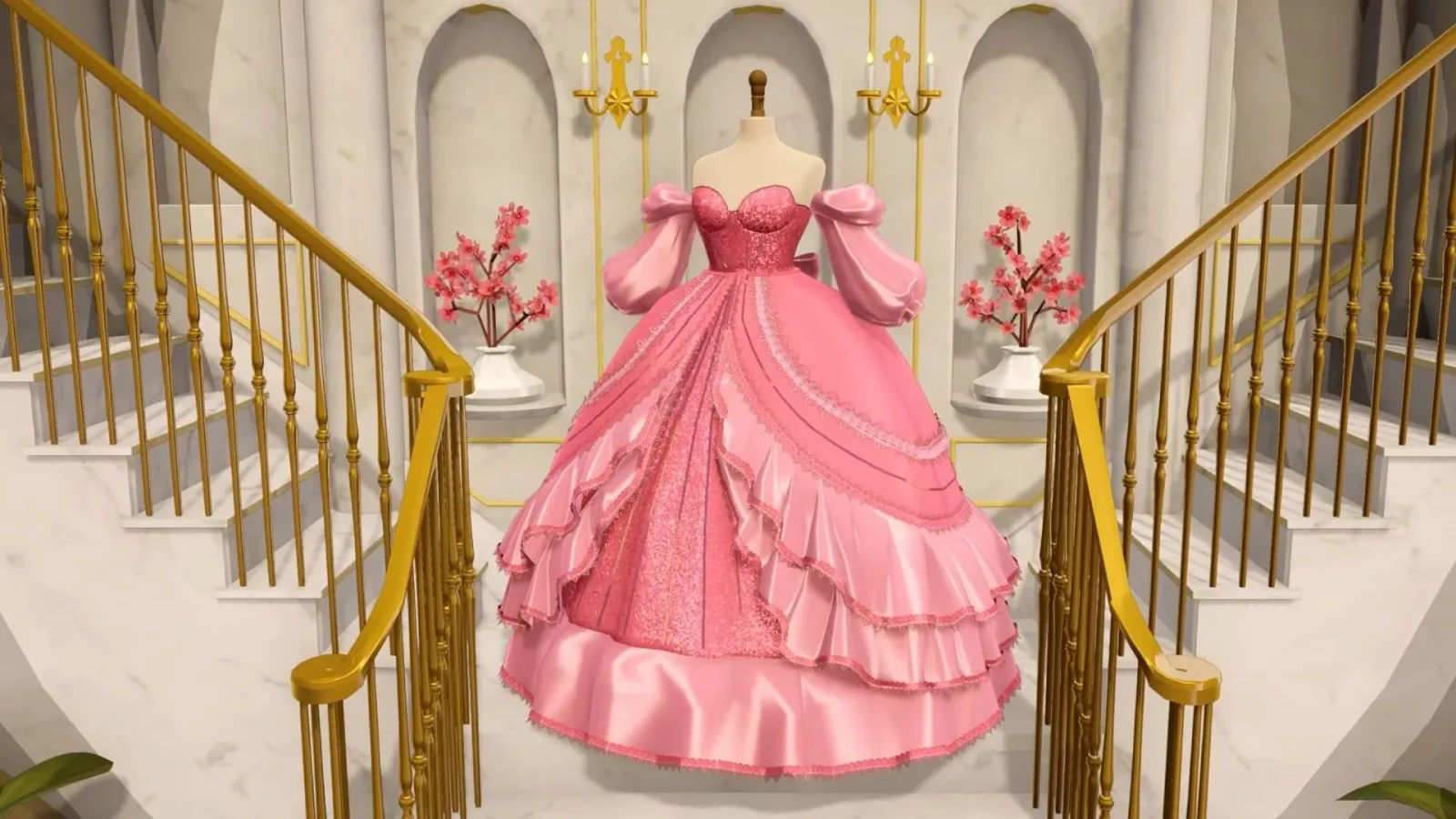
Dressmaker, the cozy simulation game centered on designing and sewing custom gowns, has rapidly become one of Steam's standout indie successes. Released only last week, the game has accumulated a 98% positive user-review score on the platform while continuing to set new records for concurrent players.
The game's latest recorded high stands at 35,650 concurrent Steam players, reached the day before the figures were discussed. That is a substantial leap beyond an earlier chart shared by developer Ruan Rothmann, which showed the game cresting just above 25,000 simultaneous players. More than 28,000 people were still playing during the middle of a working day, suggesting the audience was not merely a brief launch-week spike.
For a game devoted to fabric selection, pattern cutting, trims, pins, and the careful assembly of formal dresses, Dressmaker's momentum is an unusually striking result. It also underlines Steam's continuing capacity to turn a focused, unconventional idea into a major word-of-mouth hit when it gives players a satisfying creative space.
A breakout built around creativity
Dressmaker's premise is direct, but its appeal appears to come from the freedom it gives players within that premise. Rather than treating dressmaking as a lightweight minigame or a narrow progression system, it allows users to select fabrics, work from patterns, and construct bespoke gowns with considerable room for experimentation.
For useful background on this topic, read Fortnite's Five Nights at Freddy's Reveal Becomes Its Most-Liked Post Ever.
That emphasis on hands-on creation places it comfortably within the broader cozy-game audience, while also appealing to players who enjoy designing, customizing, and sharing the results of their work. Games that offer a strong creative toolset can build unusually committed communities, particularly when individual player creations become part of the conversation surrounding the game.
The swift improvement in its Steam reception is another notable part of the story. Dressmaker had already reached an Overwhelmingly Positive status after launch, with 96% positive reviews noted earlier in its run. That number has since climbed to 98% positive. Maintaining, let alone increasing, a review ratio after attracting a much larger audience is a strong indication that the game is connecting with players beyond its first wave of enthusiasts.
Steam user ratings are not a complete measure of a game's quality or commercial performance, but they remain highly visible to potential buyers. In an increasingly busy simulation and cozy-game market, an exceptionally positive rating can help a smaller project remain discoverable as more people investigate why it has suddenly appeared among the platform's most-played titles.
Ruan Rothmann reflects on an unexpected milestone
Rothmann, who worked as a programmer on Dressmaker, marked the game's growth with a characteristically candid reaction. He said he had once worried that he had reached his creative high point too early, only to find himself wondering whether a dressmaking game might ultimately be that peak. He also said he could not be more proud of Dressmaker.
The response has extra context because Rothmann previously worked on Broforce, the side-scrolling run-and-gun game, and the gladiatorial virtual-reality combat title Gorn. Those projects have very different tones and subject matter from a gentle game about constructing elegant clothing. Dressmaker's success therefore represents not just another positive launch, but a reminder that creative careers can take rewarding turns in unexpected genres.
There is a tendency to view a developer's earlier, louder success as the defining moment of their career. A game like Dressmaker complicates that assumption. It is smaller in premise than many action releases, but its popularity demonstrates that a clear fantasy, delivered with enough depth and polish, can attract an enormous audience regardless of whether the core activity involves combat, competition, farming, management, or fashion.
"I used to be worried that I peaked way too early in my career. Now it seems I may have peaked with a dressmaking game."
That sentiment has resonated because it captures the surprise around the game's performance. Dressmaker is not attempting to disguise its concept behind a more conventional hook. Its name and gameplay proposition are exactly what they sound like: players make dresses. In a market where games are often pitched through sprawling feature lists or genre combinations, that clarity may be part of its strength.
The numbers are still moving
The 35,650-player record is especially noteworthy because it surpassed the peak in Rothmann's shared screenshot so quickly. Concurrent-player figures naturally fluctuate throughout the day, across regions, and around weekends, updates, and social-media attention. They should not be treated as a direct count of total owners or sales. Still, they are a useful indication of the scale of activity surrounding a Steam release at a given moment.
For Dressmaker, the important detail is the direction of travel. The game was still attracting more than 28,000 active players after its new record had been set. That leaves open the possibility of another peak if momentum continues, though no future player-count milestone can be guaranteed.
The fact that a specialized simulation can sustain that kind of active audience is a compelling signal for the genre. Cozy games are often discussed as though they must be broad lifestyle simulators with farming, relationships, exploration, crafting, and dozens of interconnected systems. Dressmaker's early reception instead suggests there is still room for titles that center one craft and make the process itself engaging.
That does not mean every narrowly focused game will follow the same path. Viral growth depends on a mix of design quality, timing, visibility, player enthusiasm, and the ease with which a game's appeal can be understood at a glance. But Dressmaker's launch offers a powerful example of how a specific activity can support a much wider audience when players feel the experience delivers on its promise.
A small quality-of-life update is already planned
While the game's player totals have dominated the immediate discussion, its developers are continuing to address practical player feedback. Rothmann noted that the next update will hide pins belonging to other trims when a trim is selected.
It is a modest adjustment, but it speaks to the type of refinement that matters in a detailed design game. When players are arranging small components and trying to achieve a particular visual result, screen clarity can make a real difference. Reducing overlapping visual information should make it easier to focus on the trim currently being edited.
Early post-launch updates are often crucial for games that depend on long play sessions and careful creative work. A seemingly minor interface improvement can have an outsized effect when players repeatedly use the same tools to test materials, alter patterns, and fine-tune decorative details. Dressmaker's audience has arrived quickly, giving the team a large and engaged pool of people who can identify where the experience could become smoother.
No horse game clues from the studio
The success of Dressmaker has naturally prompted curiosity about what may come next. Rothmann did not offer hints about the studio's future game plans. He did, however, rule out one fan suggestion in a humorous exchange: a "girly horse game." His reason was simple--he does not trust horses or horse people.
It is not a formal announcement of any kind, and it does not reveal a future project. Still, the exchange reflects the playful atmosphere around Dressmaker's sudden rise. Players are engaging not only with the garments they create, but also with the developers behind a game that has turned a seemingly niche concept into a major Steam conversation.
Why Dressmaker's launch matters
Dressmaker's rise is encouraging for players who want more games built around specific interests rather than familiar genre templates. Fashion and garment construction have appeared in games before, usually as character customization, a side activity, or a limited crafting system. Here, they are the main event.
That commitment appears to be paying off. The game has rapidly earned a near-unanimous positive review score, moved beyond 35,000 concurrent players, and inspired confidence from a developer whose earlier work includes some well-known indie action games. Its performance also reinforces a simple lesson: an idea does not need to be traditionally "big" to create a big response.
For now, the key question is how high Dressmaker's player count can climb and how the developers will shape the experience through updates. With its review rating sitting at 98% positive and its active player base remaining substantial after a new peak, the dressmaking sim has already secured a remarkable opening chapter.
Community
Discussion
Start the conversation.
No comments have been posted yet.