

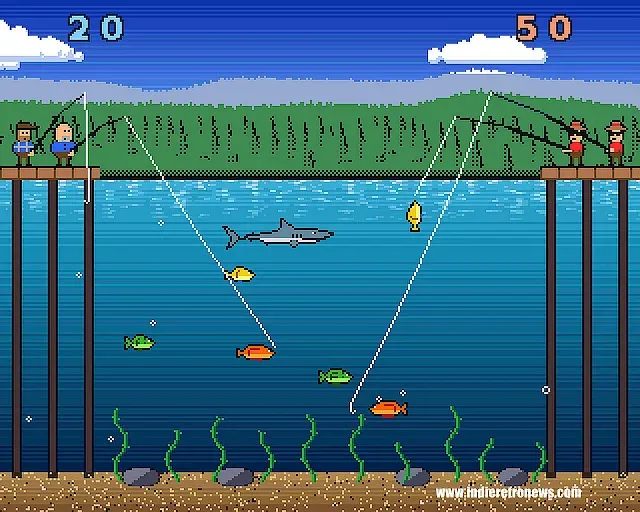
Fishing Derby - Amiga Edition is a new Commodore Amiga remake of Activision's 1980 Atari 2600 game, rebuilding the deceptively competitive fishing contest for classic hardware. Developed by AmigaLive, the project aims to retain the straightforward rules and tense risk-reward decisions that defined the original while giving the game a more elaborate audiovisual presentation suited to the Amiga.
The remake has been written entirely in native 68000 assembly language, with AI used during its development. It is designed to run on Amiga systems equipped with a standard 68000 processor and 512K of chip RAM. AmigaLive also states that the game has frame time left over even during four-player play, an important technical detail for a title built around rapid reactions and competing actions around the same lake.
A classic fishing rivalry returns
Fishing Derby is built on an immediately understandable premise: anglers stand on opposite piers, cast their lines into the water, hook fish as they pass by, and attempt to reel in enough weight to win. The Amiga edition supports as many as four players, turning that simple setup into a local contest where every catch matters and every delay can be costly.
The fundamental objective remains faithful to the Atari 2600 original. Players, either individually or in teams, race to reach a total of 99 pounds of fish. The challenge is not simply finding something to catch. Anglers need to choose what kind of fish is worth pursuing, judge how much time it will take to land it, and remain alert to the lake's most dangerous resident.
For useful background on this topic, read Star Trek: Judgment Rites Finally Becomes Playable on Amiga Through New Interpreter.
Near the surface, smaller sunfish can be caught and brought in quickly. Each is worth 2 pounds, making them a dependable way to keep the score rising. Farther down, players can pursue snapper worth 6 pounds apiece. That larger catch carries an obvious appeal, especially when an opponent is close to the finish line, but the extended trip from the lake bed leaves more time for a problem to emerge.
The shark is more than scenery
A great white shark patrols the water and can steal a fish before an angler gets it safely to the pier. This threat gives Fishing Derby its personality and makes the act of reeling in more than a matter of holding a direction. A player who has hooked a valuable fish is not guaranteed to score; they must bring it home before the shark reaches the line.
That hazard is especially significant in a multiplayer match. Choosing a 6-pound snapper may be the best route to a comeback, but it can also produce a painful reversal if the shark takes the prize. Conversely, repeatedly catching 2-pound fish may feel cautious, yet it lets a player add weight in smaller, faster increments. The score target means these decisions can change as a round develops. What is a sensible opening strategy may not be the best plan once another pier is only a few pounds away from victory.
The shark also moves between the competing sides of the lake, rather than serving as a passive obstacle that affects everyone equally at the same moment. That creates opportunities as well as danger. When it is troubling an opposing pier, another player may have a clearer chance to reel in a larger catch. When it turns toward their own line, urgency becomes the priority.
Amiga-focused visual upgrades
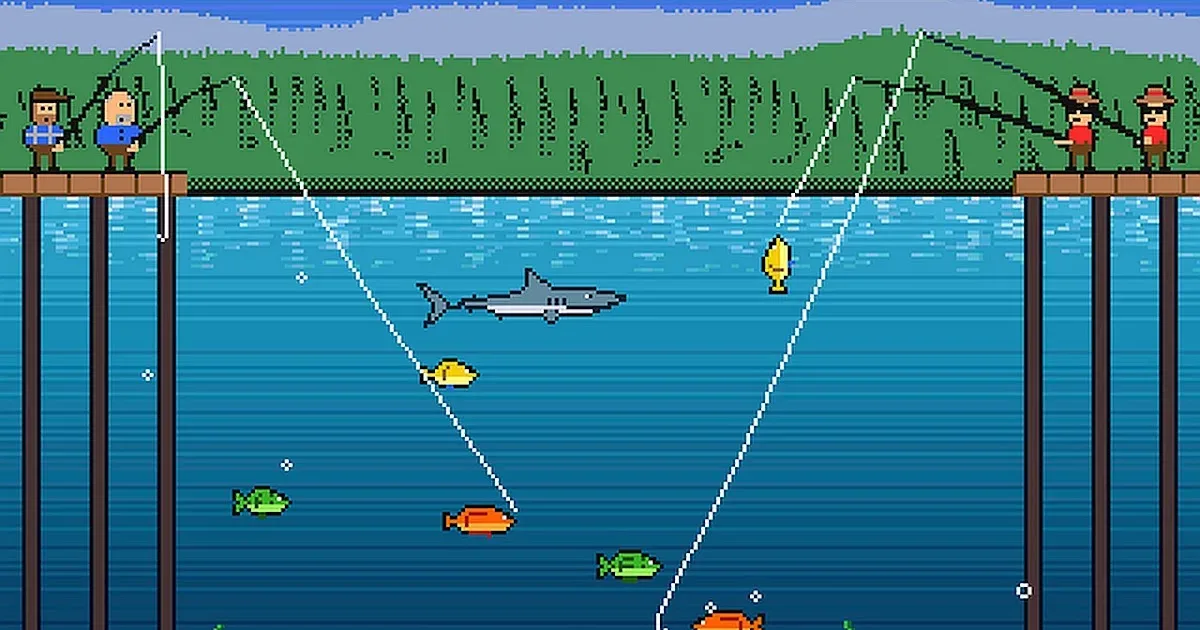
While the play structure stays close to the 1980 release, the Amiga edition expands the presentation considerably. Its sky uses a dithered gradient and includes drifting clouds, helping establish a fuller lakeside scene around the competition. The water has visible ripples and bubbles rise beneath the surface, bringing movement to a setting that is central to every moment of play.
The characters and shark have also received animation touches that go beyond simply moving a sprite around the screen. Fishermen visibly crank their reels as they try to secure a catch. When the shark manages to take a fish, it bites and chews the stolen meal before swimming away, eventually heading off to menace the opposite pier.
Those details preserve the original game's playful rivalry while giving the action more readable personality. A shark theft is still a setback, but the animated response helps sell it as a dramatic event in the match rather than a purely mechanical interruption. Likewise, the anglers' reeling motions make the contest feel more physical, reinforcing the sense that every successful catch has been worked for.
Built close to the metal
Fishing Derby - Amiga Edition's native 68000 assembly-language foundation is a notable part of the release. The Motorola 68000 CPU is at the heart of many classic Amiga machines, and building directly for it fits the game's focus on broad compatibility with modest specifications. The stated baseline of a plain 68000 and 512K chip RAM means the remake is targeting a very accessible level of original Amiga hardware rather than requiring an accelerated system.
Four-player performance is particularly relevant to a remake of this kind. Supporting more people at the piers increases the amount happening at once: multiple lines can be active, fish need to travel through the lake, the shark continues to patrol, and the game must keep its visual effects and animations responsive. The developer says the title still has frame time to spare in that mode, suggesting the project has been designed with performance headroom rather than merely reaching a minimum functional result.
The game is also described as returning cleanly to Workbench or the Command Line Interface when the player quits. That may sound like a small implementation detail, but it matters to Amiga users who regularly launch software from different environments and expect a program to exit without leaving them at an inconvenient dead end.
A remake that understands the original's appeal
Many early console games were built around a small number of inputs and goals, but the strongest among them found depth through opposition, timing, and pressure. Fishing Derby's enduring idea is that fishing is not presented as a quiet solo pastime. It is a race, and the lake itself actively pushes back against the competitors.
The Amiga version appears to respect that structure rather than burying it under unnecessary complexity. There is still a clear target of 99 pounds. There are still small, quick catches and bigger fish that take longer to bring in. There is still a shark capable of ruining an otherwise successful moment. The enhancements are concentrated on visual atmosphere, animation, multiplayer scale, and a hardware-conscious implementation.
That approach makes sense for a retro remake. The goal is not necessarily to transform a compact 1980 design into a completely different fishing game. Instead, it is to give the same contest a new home on Commodore Amiga, where smoother scene detail, livelier character work, and up to four participants can add fresh energy to an already proven format.
What players can expect
- Enhanced Commodore Amiga remake of Activision's 1980 Atari 2600 game.
- Support for up to four players in a lakeside fishing competition.
- A race to collect 99 pounds of fish before rival players or teams.
- 2-pound sunfish near the surface and 6-pound snapper at the lake bed.
- A patrolling great white shark that can steal fish from hooked lines.
- Dithered sky gradients, drifting clouds, water ripples, and rising bubbles.
- Animated fishermen and shark-feeding sequences.
- Native 68000 assembly code, with a stated requirement of 512K chip RAM on a standard 68000 Amiga.
- Clean exit support back to Workbench or the CLI.
Fishing Derby - Amiga Edition offers a focused revival for players interested in both Atari-era game design and Commodore Amiga homebrew. Its rules are easy to explain, but its fishing choices, shark interruptions, and multiplayer competition give each session room for reversals. For a game about landing fish, the most memorable moments may still be the ones where a shark gets there first.
Community
Discussion
Start the conversation.
No comments have been posted yet.