

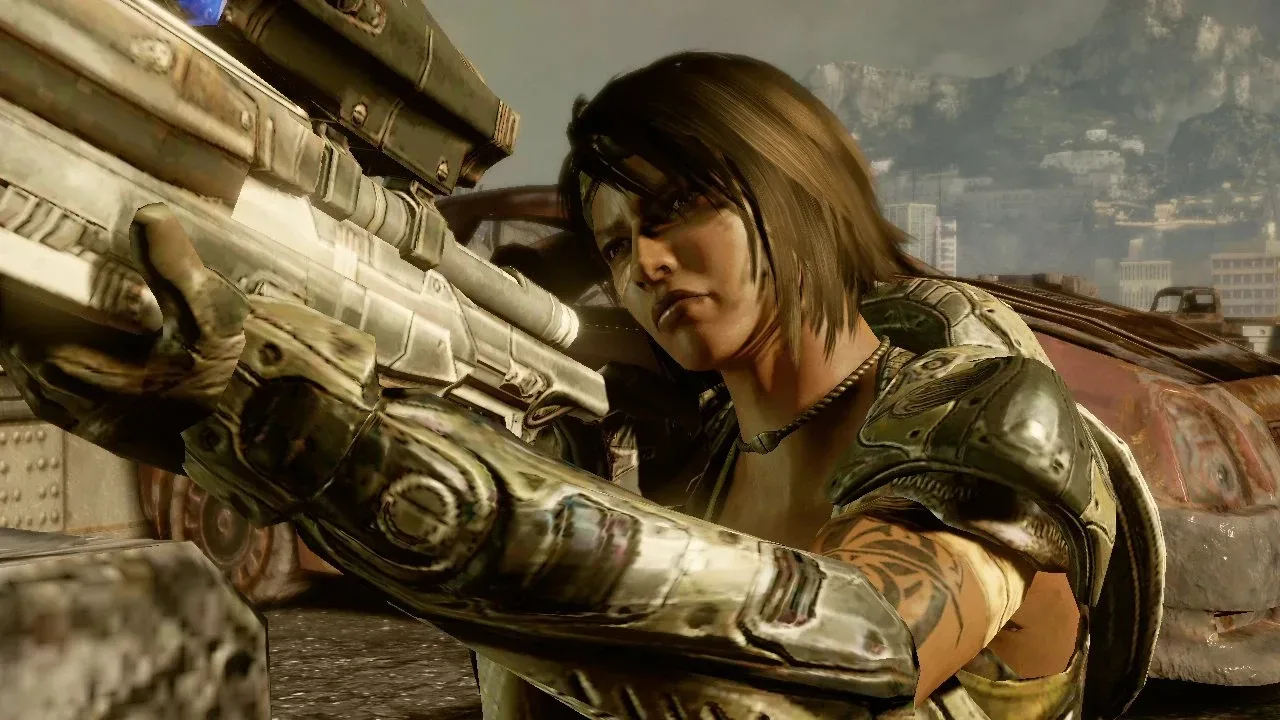
The latest arguments over Gears of War: E-Day have revived a claim that does not hold up against the series' own history: that women serving as commanders and soldiers are some kind of new, "modern" addition to the long-running Xbox shooter franchise. They are not. Women have been part of Gears of War from the beginning, occupying important roles across its military, political, scientific, and antagonistic sides.
Some online criticism aimed at E-Day has centered on a tough female commander who issues orders during missions. Other posts have inaccurately framed Mags, a Black gay woman who joins the squad, as the game's main character rather than Marcus Fenix or Dominic Santiago. Those complaints turn familiar elements of the Gears universe into evidence of a supposed abrupt change, even though the games have featured women in positions of authority and women fighting alongside male soldiers for nearly the entire life of the franchise.
That does not mean every Gears game has handled every female character flawlessly. The series has often leaned hard into a particular brand of macho military action, and some women were initially given more limited roles than their male counterparts. But the difference between a franchise having room to improve and a franchise having no historical precedent for women in meaningful roles is substantial. On the latter point, Gears of War's record is clear.
Anya Stroud was there from the start
The most immediate example is Anya Stroud. In the original Gears of War, released on Xbox 360, Anya serves as a key COG voice communicating with Marcus and Delta Squad. Her early duties largely place her in command-and-control and communications work rather than in the field with a Lancer. That portrayal is also one of the reasons players can reasonably argue the original trilogy did not always give its women as much on-screen agency as it could have.
For useful background on this topic, read Battlefield 6 Leads Xbox Game Pass' October 2026 Lineup.
Still, Anya was never a random background presence. She was central to the mission structure, a continuing character through the original trilogy, and an important figure in the wider fiction. By Gears of War 3, she takes a more direct role in the fight, donning armor, carrying a weapon, and joining the front lines. Her evolution reflects an aspect of the series that is easily missed when the conversation is reduced to screenshots or isolated clips: women were already embedded in the COG and its war effort, even if the games did not always foreground them in the same way.
Anya's family history reinforces that point. Her mother, Helena Stroud, was herself associated with the COG's military legacy. The Stroud name is not an E-Day-era invention designed to retrofit women into Sera's armed forces. It is part of the series' established foundation.
Women have shaped both sides of the war
Gears of War has also featured one of its most significant antagonists as a woman. Queen Myrrah, the human leader of the Locust Horde, was introduced in the first game and developed throughout the trilogy. Her presence was crucial not only because she commanded the Locust, but because her identity and history tied into the larger mysteries surrounding the conflict.
That legacy extends into the later games through Kait Diaz and her mother. These characters are deeply connected to Myrrah and the Locust storyline, making women central to the franchise's mythology rather than simply members of a supporting cast. The newer Gears stories did not suddenly discover that women could have stakes in Sera's future; they expanded threads that had been in the fiction for years.
Even at the level of rank-and-file warfare, the premise that women were absent until a later entry does not survive scrutiny. There is an unnamed female COG soldier working as a field medic in Gears of War 2. That might be a small detail compared with Anya or Myrrah, but it matters because it demonstrates that women were visibly serving beside the infantry before Gears of War 3 arrived.
Gears of War 3 made the wider COG more visible
Gears of War 3 gave several female soldiers clearer roles in the action. Beyond Anya's move to the front lines, the game introduced and expanded other women who were plainly capable combatants rather than passive observers.
Bernadette "Bernie" Mataki is among the most memorable. A hardened veteran, Bernie helps Marcus and his allies during the battle to defend a key fort later in the campaign. She is not presented as someone needing to be protected from the war. She is one of the people doing the protecting, and her experience gives her an authority that fits comfortably within Gears' world of scarred survivors and exhausted soldiers.
Samantha "Sam" Byrne is another major example. Sam fights alongside Augustus Cole and Damon Baird through much of Gears of War 3, and she continues to appear in Gears of War 4. Her inclusion was not framed as an unusual exception to the COG's makeup. She belongs to the team, participates in the campaign's battles, and shares the same blunt, high-pressure environment as the rest of the cast.
The series also includes Alicia, a member of Zeta-Six whose fate is shown in a Gears of War 3 downloadable story. She is killed by General RAAM, but her appearance is still relevant to the broader timeline. The story is set before or during the events surrounding the first Gears of War, placing another woman within the COG's active military forces during the era critics sometimes portray as exclusively male.
Prequel-era stories make the timeline even clearer
The chronology of Gears material further undercuts the idea that female soldiers are a recent alteration. Gears of War: Judgment, a game set before the original Gears of War, includes Sofia Hendrick as a playable character. Sofia is a member of the COG's elite Onyx Guard, an organization associated with discipline, status, and some of the military's most demanding work.
Her presence establishes on screen that women held positions in high-level COG military units well before Marcus Fenix's first game. That is especially important in a debate focused on E-Day, whose setting naturally invites questions about the origins and makeup of the COG during an earlier phase of the Locust War. The answer was available long before E-Day: the COG had women in uniform.
Similarly, the Gears of War 3 DLC story involving Alicia does more than add a single character to a side narrative. It provides another depiction of women participating in the conflict's early-period operations. When prequel material and mainline games both show women serving across different units and jobs, treating a female commander in E-Day as a continuity-breaking surprise becomes difficult to justify.
Tactics also broadened the roster
Gears Tactics continued the pattern. The strategy game includes Dr. Mikayla Dorn, while also allowing players to recruit women among their COG soldiers. Its perspective on the war differs from the cover-shooter campaigns, focusing more on squads, deployments, and tactical decisions, but it reaches the same conclusion: the COG is not an all-male institution.
This is useful context because it moves beyond a handful of named characters. Gears Tactics depicts women as part of the force players build and direct. They are not merely exceptional figures whose existence needs special explanation. They are soldiers within the larger war machine, just as the franchise's lore and prior games had already suggested.
Representation and criticism are not mutually exclusive
There is room for a more thoughtful discussion about how Gears of War has portrayed women over time. Anya's earlier role, for instance, was heavily tied to supporting Marcus and his squad remotely before the later games allowed her to become an active combatant. Like many action series that began in the mid-2000s, Gears was shaped by genre conventions that frequently prioritized a narrow set of male heroes.
But acknowledging those limitations should not erase the women who were already there. Anya, Myrrah, Bernie, Sam, Sofia, Alicia, Mikayla Dorn, Kait Diaz, and others each occupy different places in Gears history. Some lead. Some command. Some fight. Some shape the central mystery. Some appear in roles that are smaller but still demonstrate the COG's makeup across the war.
That broader view is more useful than treating E-Day's characters as a referendum on whether women are allowed in a fictional military. The franchise has answered that question repeatedly over roughly two decades. Women have long been part of Sera's conflicts, from battlefield communications and medical work to elite units, frontline combat, leadership, and the highest levels of the enemy command structure.
As Gears of War: E-Day adds its own chapter to that history, a woman giving orders and another serving in the squad should be understood as continuity with the series' past, not a sudden departure from it. The characters may be new, but the idea behind them is not.
Community
Discussion
Start the conversation.
No comments have been posted yet.