

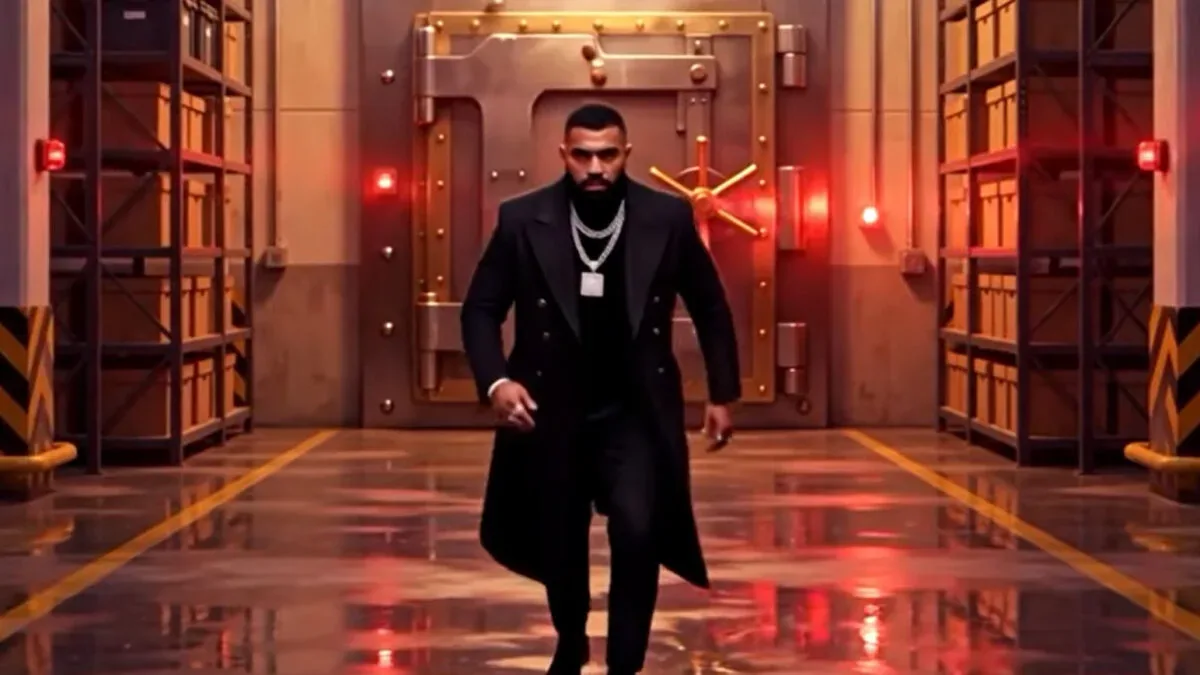
Ginuwine has entered video games with an unusually direct premise: breaking into Sony Music headquarters to take back his master recordings. My Ride: The Ginuwine Story Game is a beat-'em-up brawler that turns a long-running concern for musicians--who controls the master tapes and recordings behind their work--into a heightened, arcade-like revenge fantasy.
The '90s R&B star shared the game with fans during the week of November 28, 2026, encouraging people to try it while he was away. He described its goal plainly: players must help him get his masters back from his label, live freely, and reclaim what he believes he is owed after more than three decades in music.
It is a striking subject for a celebrity game. Rather than attaching a recognizable musician to a generic racing game, rhythm title, or management sim, My Ride centers its entire story on ownership, contracts, and the emotional weight of a catalog an artist helped create. The result, at least in concept, is less a traditional licensed tie-in than an interactive expression of frustration over the music business.
A raid on Sony Music, framed as a side-scrolling brawl
Players control Ginuwine as he makes his way through Sony Music's headquarters in search of the master tapes. Sony bought Epic Records in the late 1980s, tying the fictionalized mission to the corporate history surrounding his recording career. The game imagines that history as a physical obstacle course of guarded offices, alarms, and vault-like spaces that must be fought through to reach the prize.
For useful background on this topic, read Channing Tatum Thinks His Gambit May Be Too Old for Marvel's New X-Men.
The basic action follows familiar beat-'em-up rules. Ginuwine punches and kicks security guards while sirens sound around him, pushing forward through locations intended to represent the label's building and its deeper archive spaces. There is no indication that the game is presenting an actual plan or real-world event; its central raid is an overtly fantastical scenario built around a very real and complicated conversation about artistic control.
That distinction matters. Masters disputes have become increasingly visible in popular music, with artists and listeners paying closer attention to the difference between owning songs as compositions and owning the underlying recordings. A game about storming a corporate office is an exaggerated way to communicate that conflict, but the theme itself is recognizable: performers can spend years building a career while key rights remain elsewhere.
Ginuwine's framing makes the project personal. His message is not just that the game is about a celebrity escaping a fictional villain. It is specifically about a musician trying to retrieve work that represents decades of his life. In that light, the brawler format becomes an unusually blunt metaphor for the sense that artists often need to fight to maintain or regain agency over their own legacy.
Supafriendz collaborators appear in AI-created form
Between combat sequences, Ginuwine visits a recording studio populated by AI-generated likenesses of fellow Supafriendz collaborators. Missy Elliott and Timbaland appear, alongside Magoo, Static Major, and Aaliyah, who are deceased. In the game, the group offers encouragement as Ginuwine pursues the master tapes.
The inclusion of those figures immediately makes the project more emotionally complicated than a simple novelty release. Ginuwine's career is closely connected with an influential circle of R&B and hip-hop artists and producers, and their presence gives the game's studio scenes the feeling of a tribute to that creative era. At the same time, using AI-rendered versions of deceased performers is likely to make some players uncomfortable, particularly given broader concerns over consent, digital likenesses, and how generative technology is used to recreate people who cannot weigh in themselves.
Ginuwine credited Anderson Westfield for creating the game. Westfield has been open about using AI in its development, placing My Ride squarely inside one of gaming's most contentious current debates. Generative AI has been discussed across the industry in relation to labor, authorship, training data, environmental costs, creative quality, and the possibility of flooding storefronts and social platforms with quickly produced material.
Those concerns do not disappear because the project is small, strange, or celebrity-backed. If anything, they are unusually visible here. My Ride is not attempting to hide its AI origins behind a polished corporate rollout. Its rough presentation and conspicuous artificiality are a major part of what has drawn attention to it.
An unpolished game with unmistakable AI artifacts
The game's look and behavior reportedly display many of the familiar visual oddities associated with AI-assisted production. Environments can appear to lose track of ordinary spatial logic. Even the deepest areas of Sony's imagined vaults are marked by fresh-looking rain puddles, an incongruous environmental detail that makes the building feel less like a coherent place and more like a sequence of generated images stitched together.
Ginuwine's character model also seems to float slightly above the floor, producing an eerie movement style rather than the grounded walk cycle expected in a conventional brawler. Dialogue is delivered with a stilted, promotional cadence, further distancing the experience from polished voice acting. These traits may be unintentional technical shortcomings, but they also give the game a strange atmosphere that is difficult to separate from its premise.
Even the victory sequence leans into that dreamlike inconsistency. After succeeding, Ginuwine dances in front of a sold-out venue. Yet the audience is positioned both in front of and behind the stage, creating a spatially impossible concert setting. It is the kind of error that would normally be edited out of a commercial game, but in My Ride it contributes to an almost accidental surrealism.
There is a history of low-budget games becoming memorable because of their awkwardness, whether through bizarre physics, unusual voice work, or technical bugs that turn ordinary scenes into unintentional comedy. My Ride appears poised to attract that kind of curiosity. Its appeal is unlikely to rest on combat depth or visual fidelity. Instead, it comes from the collision of an earnest personal grievance, celebrity culture, AI experimentation, and game design that seems only loosely tethered to reality.
A fantasy of ownership in an AI-heavy moment
The game arrives at a moment when AI is causing anxiety across creative industries. Developers, performers, artists, writers, and players have all raised questions about whether the technology is being used to replace work, undermine consent, or prioritize speed over craft. Many AI-generated projects have also faced criticism for feeling visually incoherent or emotionally hollow.
My Ride: The Ginuwine Story Game does not offer a convincing answer to those concerns. Its use of AI-generated performers, including deceased artists, is likely to intensify them. Its apparent technical limitations likewise make it difficult to present as evidence that AI can match the deliberate craft of experienced game teams.
But it does demonstrate another side of the conversation: generative tools can enable people to transform an extremely specific thought into a playable artifact with unusual speed. The thought in this case is almost comically literal. What if a recording artist could walk into the offices of the corporation associated with his catalog, beat up the guards, enter the vault, and take the masters back himself?
It is not difficult to see why that fantasy would resonate in an era when fans routinely discuss corporate ownership of music, film, games, and other creative work. The game translates the feeling of being locked out of one's own history into the language of an old-school brawler: there is a guarded path, a set of enemies, a final objective, and a celebratory ending after the obstacle has been overcome.
For some players, the oddity of the project will be the main draw. For others, its AI-created imagery and depictions of real people may be a reason to avoid it altogether. Either response is understandable. What is clear is that Ginuwine has made a game that is difficult to mistake for anything else: a strange, blunt, digitally unstable music-industry heist starring the artist himself.
Whether it becomes a lasting curiosity or a brief viral footnote, My Ride is an example of how quickly celebrity expression, personal rights disputes, and experimental game creation can now converge. It may not resemble the genre's most accomplished brawlers, but its premise has a specificity that polished games often lack. Ginuwine is not merely borrowing gaming imagery for promotion. He has turned a grievance about ownership into the game's entire win condition.
Community
Discussion
Start the conversation.
No comments have been posted yet.