

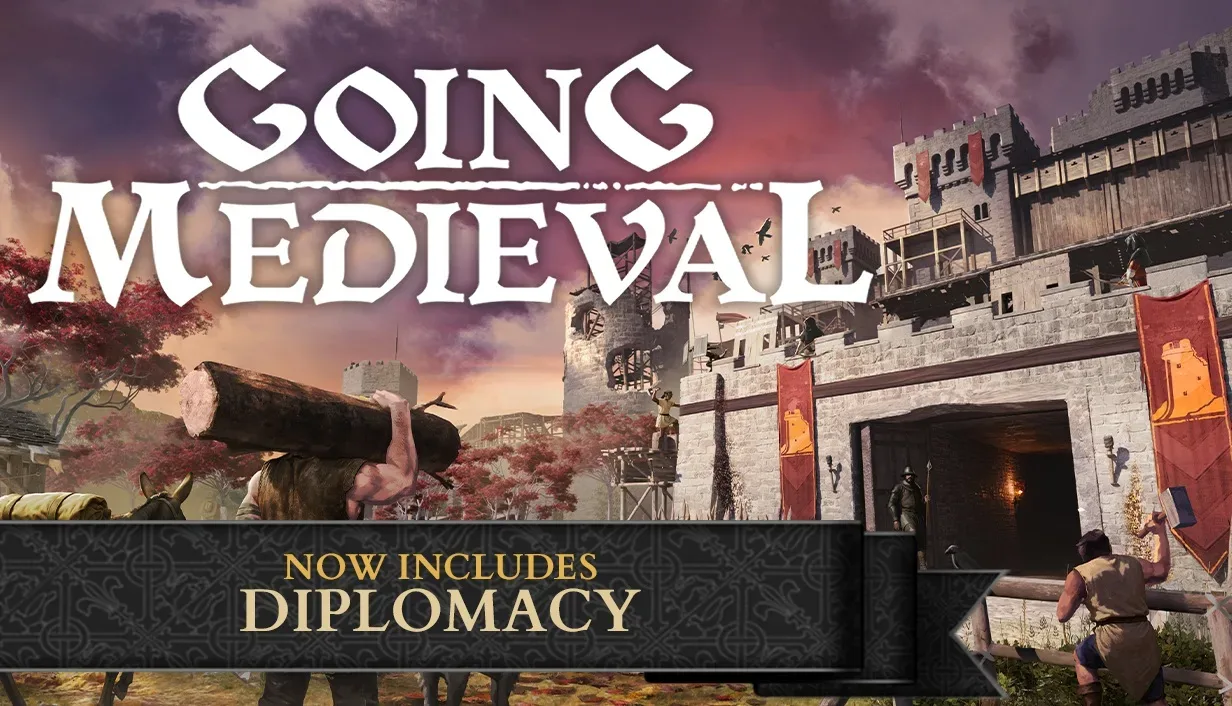
Going Medieval has expanded its post-calamity settlement-building world with the Diplomacy Update, a substantial content update that introduces a new way to deal with the people beyond a player's castle walls. Available now for the PC version through Steam, Epic Games Store and GOG, the update adds a full Diplomacy System, 12 NPC factions, revamped trade, recruitable mercenaries, new employment options, events and further quality-of-life changes.
For a game built around surviving an unstable medieval world, the update shifts some attention from the familiar pressures inside a settlement--food, labor, construction, defenses and the wellbeing of individual settlers--to the larger political landscape surrounding it. Players can now decide whether neighboring groups become valued allies, convenient trading partners, reluctant rivals or immediate enemies.
The new systems arrive as another layer on top of Going Medieval's core premise: rebuilding civilization after a devastating calamity has left the world lawless and dangerous. Building upward and downward remains central to the game, as players establish multi-level castles, organize communities and prepare for assaults. The Diplomacy Update makes the choices made outside those walls increasingly important to what happens within them.
Caravans Open the Door to Diplomacy
At the center of the release is the new Diplomacy System. Players can send caravans to neighboring settlements and use those journeys to manage relationships with factions across the map. These expeditions are not solely commercial trips. They can be used to attempt to form alliances, issue demands or offer peaceful favors.
For useful background on this topic, read VRChat Community Pushes Back as AI Content Flood Raises Discovery Concerns.
That gives players more agency in defining the position of their settlement in the region. A fortified community can seek friends and stability through cooperation, but it can also pursue a more aggressive path by putting pressure on nearby powers. Neither route is guaranteed to be simple. The factions encountered may have different priorities and temperaments, with some willing to engage constructively while others may prove difficult, suspicious or openly hostile.
The caravan feature should also make travel decisions more meaningful. Sending people and goods away from the safety of home carries a practical cost, while the potential reward is a stronger diplomatic bond, a useful agreement or access to an economic opportunity. Conversely, a failed effort or an antagonistic action could leave a settlement facing a more dangerous future.
Diplomacy therefore is not presented as a separate, abstract menu system detached from the colony simulation. It is tied directly to caravans, resources, security and the state of nearby communities. Building a relationship can require commitment, and the outcome of that relationship may influence the resources and military support available when trouble reaches the gates.
Twelve Factions Bring More Regional Pressure
The update introduces 12 NPC factions for players to work with or oppose. Their presence is intended to make the surrounding world feel more economically and politically active, rather than limiting interactions beyond the settlement to occasional threats or basic transactions.
Managing these relationships will involve balancing pacts, trade and general standing. A faction that becomes a dependable ally may help support the long-term growth of a settlement, while damaged relations can create risks that players must account for in their defense planning. The system encourages a broader view of survival: a thriving city is not only one with enough food stores and strong battlements, but also one that understands where it stands among its neighbors.
Importantly, peaceful play is not being framed as the only viable response. Going Medieval continues to be set in a harsh world, and the update acknowledges that not every group will be receptive to overtures. Some factions may be uncooperative from the start, while others may become enemies through the player's decisions. That tension gives diplomacy stakes beyond simply finding the most profitable trade route.
For players who prefer strategic planning, the 12-faction setup offers more variables to monitor over the course of a campaign. Each relationship can affect the calculation behind expansion, trading and military readiness. A settlement that specializes in a particular type of production may need connections to groups that can provide missing materials, while a settlement surrounded by unfriendly neighbors may have to place greater emphasis on deterrence and armed preparedness.
Trade Overhaul Gives Factions Economic Identities
The Diplomacy Update also reworks trade through faction-specific resources. These materials are designed to give each faction a more distinctive economic role and create stronger reasons to diversify production and exchange goods instead of relying on a narrow internal economy.
In practical terms, this means trade can become a more deliberate part of settlement development. Rather than treating every external community as an interchangeable market, players will need to consider what a specific faction can offer and what it may value in return. That should make caravans, relationships and production chains feel more connected.
The change may be especially relevant for established settlements that have already mastered their immediate needs. Once a community has stable food, shelter and defenses, specialized trade can offer a new reason to refine workshops, assign labor carefully and build a surplus. It can also create tough decisions: should a valuable resource be kept for construction and local industry, or exchanged to improve a relationship and acquire something unavailable at home?
Faction-specific resources also reinforce the update's overall goal of making the world beyond a player's territory matter more. The map is no longer simply a location from which raids may emerge. It is home to groups with their own identities and economic importance, and players are being asked to decide how deeply they want to engage with them.
Hire Specialists or Bring in Mercenary Muscle
Two new recruitment-focused options give settlement leaders additional ways to react to their changing circumstances. Job postings at neighboring locations can now be used to hire specialized workers, including miners, scholars and smiths.
These hires could be especially useful when a growing settlement has a labor shortage in a crucial field or needs help developing a particular part of its economy. A miner may support a resource-heavy expansion plan, a scholar may be valuable to a community pursuing knowledge-related tasks, and a smith can strengthen industrial output. The system offers an alternative to waiting for the right workforce mix to emerge naturally, while still tying recruitment to the surrounding world.
The update also lets players recruit mercenaries to bolster their defenses against hostile encampments. This is a notable addition for moments when a settlement's permanent population is not enough to handle a threat comfortably. Mercenaries can provide extra muscle when the stakes rise, helping bridge the gap between an ambitious city-building plan and the immediate need to survive an attack.
That flexibility may prove useful for different play styles. Players focused on economic expansion can bring in armed assistance rather than converting every available resident into a dedicated fighter. More militarily minded players, meanwhile, gain another tool for responding to hostile forces and defending a large or vulnerable territory.
Mercenary support also fits naturally with the new diplomatic and trade layers. In a world where alliances can change and nearby factions may be hostile, maintaining a stronghold is not only about stone walls and carefully placed defensive positions. It is also about knowing when outside support is necessary.
Events and Quality-of-Life Changes Round Out the Release
Beyond its headline diplomacy features, the update includes new game events and additional quality-of-life improvements. Specific details on every interface and gameplay refinement have not been outlined, but their inclusion suggests the update is intended to improve both the strategic scope of the game and the everyday experience of running a settlement.
New events should help reinforce the unpredictability of a recovering world in which outside relationships, local needs and threats can overlap. For players returning after time away, the combination of new events, factions and trade considerations could make a familiar settlement feel less isolated and more reactive to a living region.
A developer playthrough has also been released alongside the update, offering a closer look at how the new systems function in play. It provides an opportunity to see the caravan interactions, faction mechanics and other additions operating within the broader settlement-management experience.
A Bigger Role for Choices Beyond the Walls
The Diplomacy Update gives Going Medieval's settlements a wider strategic horizon. Castle design, resource management and raid defense remain fundamental, but the survival of a community can now be shaped more directly by the choices it makes with neighboring societies. Players can pursue friendship, leverage commerce, recruit expertise, hire military support or create new enemies through their actions.
For Foxy Voxel's medieval colony builder, that is a meaningful expansion of the rebuilding fantasy. Civilization is not restored by constructing a keep in isolation. It also depends on the relationships formed, the goods exchanged, the workers welcomed in and the conflicts a settlement chooses to avoid--or ignite.
Going Medieval's Diplomacy Update is available now on PC via Steam, Epic Games Store and GOG.
Community
Discussion
Start the conversation.
No comments have been posted yet.