

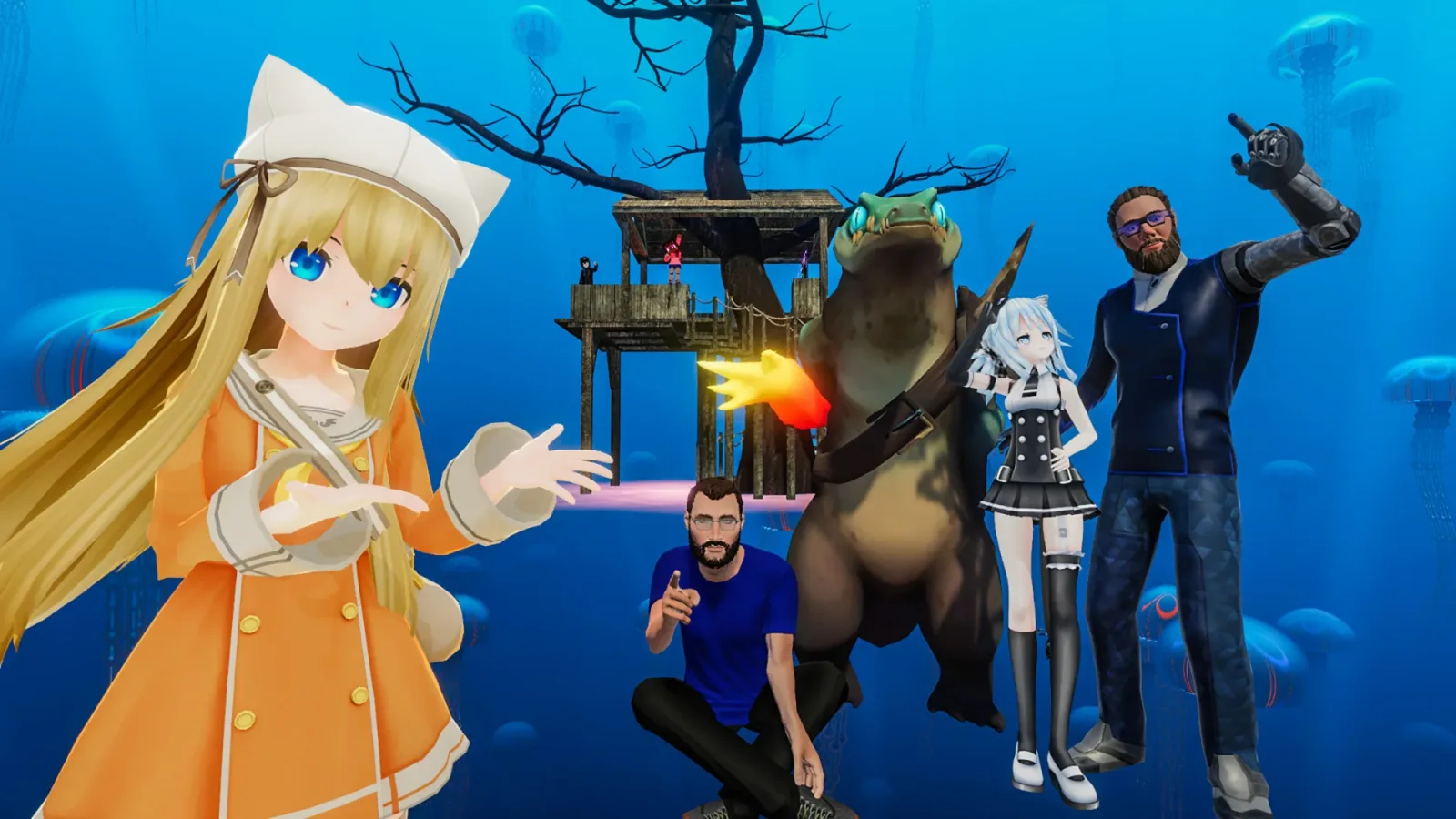
VRChat is facing a major community debate over generative AI after prominent volunteer contributor Patroll announced they were stepping away from community work in protest of what they described as a growing flood of AI-generated material across the social platform. The dispute has quickly grown beyond a disagreement about individual tools. It now centers on whether creators and players can still reliably find handcrafted worlds, whether thumbnails can be trusted, and what obligations VRChat has when a user-driven platform begins filling with work that is perceived as low effort or misleading.
In response to the backlash, VRChat has opened a community consultation intended to shape a future policy on AI use. The company has already taken one immediate action: deceptive thumbnails made with generative AI are now prohibited. It is also asking users where the boundaries should sit for AI-assisted development, AI-created assets, interactive AI features, labels, and possible restrictions on worlds built substantially with the technology.
The conversation is especially significant because VRChat is not simply a game with a fixed catalog of developer-made content. It is a large social and creative space built around player-created worlds, avatars, events, tools, and communities. People use it to meet friends, join niche interest groups, share art, attend virtual concerts and events, or create entirely new experiences for others. That community-made foundation has also supported an economy of commissions, avatar clothing, useful free tools, subscriptions, and in-app purchases.
Embedded X/Twitter post
For many participants, then, the AI dispute is about the health of that creative ecosystem as much as it is about the technology itself.
For useful background on this topic, read Valor Mortis review: A Stylish Soulslike With a Brutal Opening.
A protest centered on visibility and trust
Patroll is known within VRChat's community for contributing to the fan-run wiki and helping with testing and translation work. Their decision to halt those activities put a visible face to frustrations that had been building around AI-generated worlds and imagery. One key complaint concerns search thumbnails: generated images can present a more polished, elaborate, or simply different experience than the world players actually enter.
That issue strikes directly at discoverability. A thumbnail is often the first thing a player sees when browsing for somewhere new to visit. If it is attractive but does not accurately reflect a world's quality or contents, players may spend their limited browsing time opening places that do not meet expectations. Meanwhile, projects made by creators who carefully build environments, optimize experiences, and produce truthful promotional art can be pushed further down the results.
Patroll called for stronger tools to help people filter AI material and for developers to make their stance clearer. Their requests included banners declaring that a creator's work did not use AI, along with broader action to reduce AI use within VRChat itself. The protest gained support from other users, and banners associated with the campaign appeared in a number of popular worlds.
For another perspective on this story, read VRChat's AI Debate Puts Thumbnails, Discovery and Community Trust at the Center of a New Policy Fight.
The response illustrates a recurring problem for platforms driven by user uploads: a huge increase in content does not necessarily mean an increase in useful, original, or trustworthy content. Generative systems can make it easier to produce a large volume of images, assets, concepts, and even more complete projects. But creators worried about the trend argue that volume can overwhelm curation and make it harder for players to locate the communities and experiences they actually want.
VRChat acknowledges an "uncomfortable crossroads"
VRChat's public response recognizes the tension. The company said it is at an "uncomfortable crossroads" between the potential practical benefits of AI and the risk of a stream of low-quality material undermining human connection. That framing is important because VRChat is not treating all AI use as identical.
Some uses are being accepted under the immediate approach. These include translation assistance, coding help such as using Copilot to write code, AI-powered functions inside creation software including Blender or Unity, and tools made for a creator's personal use. In other words, AI used as background assistance during development is being treated differently from AI that becomes a prominent, player-facing component of a published world.
The less settled category includes worlds that use AI for things such as game logic or physics, projects using AI-generated assets, and worlds generated more extensively through AI systems. VRChat has said there is uncertainty around how far these uses should be permitted, and it is asking the community for input on whether they should be labeled, limited, or prohibited.
That distinction will likely be difficult to enforce in practice. Modern creative workflows are rarely cleanly divided between fully manual work and automated help. A creator might use a coding assistant to solve a technical issue, a translation tool to make an experience accessible to more players, and procedural or AI-enhanced functions in a development package. Another creator may rely on generated artwork or build a world around player-facing AI interaction. A policy that is too broad could penalize ordinary workflow assistance, while one that is too narrow may fail to address the concerns that prompted the protest.
Why labels have become a flashpoint
Labeling is one of the most contentious proposals in the consultation. Some users see an AI label and a filter as an obvious middle ground: creators who want to use generative tools could continue doing so, while people who do not want that material could avoid it. Others believe labels need to be mandatory to be meaningful, particularly when AI use is substantial or forms a visible part of the finished experience.
VRChat has not committed to full labeling. The company has pointed to the risks of mislabeling and the difficulty of policing declarations across an enormous range of community projects. Those concerns are not trivial. A label can be evaded, misunderstood, weaponized in disputes, or applied inconsistently when creators disagree about what counts as AI-generated. Moderating claims about every image, texture, line of code, or model in a world would require rules that are clear enough to administer fairly.
Still, critics of the cautious approach argue that those challenges do not erase the need for player choice. If discovery is already being affected by generated thumbnails and a growing quantity of AI-influenced uploads, they contend that users need a practical way to identify and filter what they see. For those players, a label is not necessarily a declaration that every AI-assisted project is bad. It is a tool for deciding what kind of creative work they want to spend time with.
There is also a trust question. The ban on misleading AI thumbnails is a direct response to the clearest form of deception, but it does not settle whether thumbnails should disclose their method of creation when they are technically representative. Nor does it resolve how to handle worlds where generated assets are mixed with conventional work. The policy discussion therefore has to address both outright misrepresentation and more subjective concerns about authorship, effort, and artistic value.
Search quality may matter as much as moderation
VRChat has also promised improvements to search intended to prioritize higher-quality discovery and reduce the prominence of content players dismiss as "slop." That may prove to be the most consequential part of the response. A platform can ban a specific deceptive practice, but creators' and players' day-to-day experiences are shaped by what rises to the top of search results and recommendations.
If well-maintained worlds, trusted communities, and accurately represented experiences are easier to find, the platform may be able to reduce some of the pressure created by mass-produced uploads without trying to judge every project solely by the tools used to make it. But search ranking is itself a form of policy. Decisions about quality signals, engagement, recency, creator reputation, and player behavior can elevate some kinds of work while leaving others hard to find.
Patroll has called for the company to go further by enabling players to construct their own discovery systems. That idea reflects the decentralized character of VRChat's community. Rather than depending only on a central ranking algorithm, users could potentially rely more heavily on creator lists, community-led recommendations, themed directories, trusted curators, and filters that better reflect their own standards.
Such approaches would not make the disagreement disappear. Supporters of generative AI may see it as a useful way to lower technical barriers, speed up development, or help people who otherwise could not create. Opponents may object to how training data is obtained, fear the displacement of artists and developers, or simply prefer spaces built through direct human authorship. The platform's challenge is to set rules that protect users from deception and preserve meaningful discovery without pretending that every creator shares the same values.
What happens next
The consultation is set to continue for the next week, after which VRChat plans to share its findings and introduce AI policies moving forward. The result will be watched closely by a community whose identity is tied to making and sharing things with other people.
For now, the clearest policy change is the ban on deceptive AI-generated thumbnails. The harder decisions remain open: how AI-heavy worlds should be treated, whether disclosure should be required, how much filtering control players should receive, and how discovery can reward quality rather than sheer volume.
VRChat's debate is ultimately a test of governance in a creative online space. The question is not only whether generative AI can be useful. It is whether a social platform built on community labor can adopt those tools without making human-made work harder to find, harder to trust, and less rewarding to create.
Community
Discussion
Start the conversation.
No comments have been posted yet.