

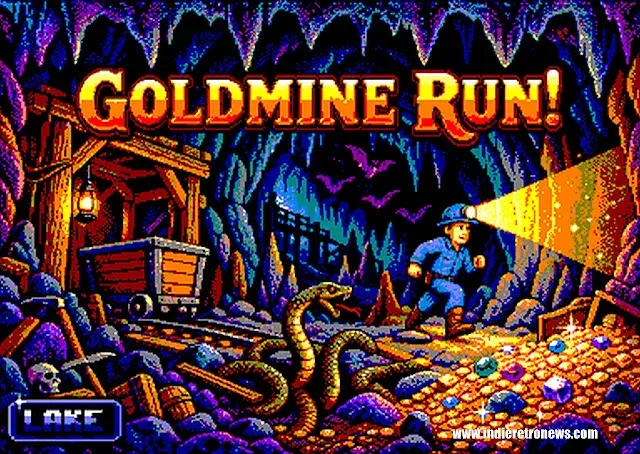
Gold Mine Run! is shaping up as a tense new action game for the Amstrad CPC 6128, built around a wonderfully immediate premise: enter a dark mine, grab every bag of gold, and find a way out before the light vanishes. Developed by Asic28 as a work in progress, the game's currently available shareware demo presents the opening portion of an underground adventure where navigation, item management and swift decisions all matter as much as avoiding the creatures roaming each cavern.
The project has been coded through a combination of C and Z80 assembly, targeting the 128K Amstrad CPC hardware. It is an encouraging sight for the platform: a purpose-built game that uses a simple, readable objective as the basis for mounting pressure. Gold Mine Run! does not ask players to solve an abstract mystery before it becomes dangerous. The danger is clear from the moment a stage begins. Darkness limits what can be seen, enemies make routes unsafe, and every second brings the player closer to a forced end.
A gold rush with the clock built into the torch
At the center of Gold Mine Run! is the objective of clearing caverns of their gold bags. That sounds straightforward, but the mines are not open, brightly lit spaces designed for leisurely exploration. They are pitch-black tunnels in which the player has only a limited halo of illumination. This circle of light steadily shrinks, turning the game's torch into both a visual tool and a strict time limit.
The mechanic creates a natural tension that should be familiar to fans of compact arcade-style games. Players need light to understand their surroundings and chart a path, but light is also constantly being lost. Standing still to assess a room wastes precious visibility. Moving too quickly, meanwhile, can lead directly into danger or send a player past an item that would have made the next section manageable.
For useful background on this topic, read Skool Daze Brings Classroom Chaos to Commodore Plus/4.
Once the torch burns out completely, the Time Monster arrives and ends the run. That consequence gives the darkness a concrete threat rather than making it a mere visual effect. The diminishing glow is effectively a warning that is always present on screen: the cavern is not waiting for the player to become comfortable.
Success, then, depends on treating every stage as a route-planning problem. Gold bags must be collected, yet the most direct path may be blocked or exposed. Extra torches can extend a run, while pickaxes and keys can open possibilities within the mine. Locked doors mean that progression is not only about finding gold; it can require locating the right resource at the right moment, then deciding whether the detour was worth the light it consumed.
The mines have more than darkness to fear
The underground setting is populated by threats that actively complicate the treasure hunt. Skeletons, bats, aggressive snakes and renegade old miners patrol the depths. Their presence ensures that the shrinking torch is only one half of the game's pressure. Even a player who has found an efficient route still needs to navigate around enemies that can make narrow passages and cramped rooms far more hazardous.
That enemy lineup gives Gold Mine Run! an appropriately pulpy mine-adventure character. Skeletons and bats fit naturally into the shadowy setting, while snakes add another animal threat to watch for amid the tunnels. The old miners are particularly evocative: instead of being friendly guides or background figures, they are renegades that stand in the way of the gold haul.
With darkness obscuring the wider layout, enemy encounters should carry additional uncertainty. Players cannot simply study the entire cavern from a safe distance and plan around every patrol. They need to push the edge of the torchlight forward, react to what emerges from it, and preserve enough time to make use of what they discover. In that sense, the limited visibility makes each map feel less like a static board and more like a place that must be uncovered under pressure.
Demo stages offer three ways to face the descent
The present shareware demo contains five stages from the game's first world. It also includes three difficulty options: Easy, Normal and Hardcore. That range is important for a game whose central idea is deliberately stressful. An easier setting can give newcomers room to learn how light, items, locked doors and enemy placement interact, while Normal provides the expected challenge for players ready to commit to a run.
Hardcore mode is described as a severe test that demands memorization of the layouts before darkness shuts everything down. That suggests the mode is aimed at repeat players who have already learned the opening world and want to convert that knowledge into sharper execution. On older hardware, map familiarity has long been a satisfying part of mastery-focused design, especially when a game is built around short, replayable stages. Gold Mine Run! appears ready to lean into that tradition rather than treating failure as the end of the experience.
For players interested in the demo, the five-stage sample is more than a technical teaser. It represents a first chance to learn the game's rhythm: move, reveal, collect, avoid, resupply, unlock, and keep moving. The three difficulties should also make it easier to see how much the challenge changes when there is less room for hesitation.
A larger six-world journey is planned
The work-in-progress build points toward a substantially bigger final release. The intended full game is planned to include six distinct worlds and 30 action-oriented stages. If that structure is retained, the five levels in the shareware version will form only the first portion of a much longer descent through increasingly varied environments.
No final release date is attached to that plan, and the game remains in development. Still, the proposed scope fits the concept well. A 30-stage campaign would give the design room to introduce new arrangements of tunnels, doors, items and enemies while asking players to refine their relationship with the light mechanic. The strongest levels in this kind of game are often those where a familiar rule is combined with a new spatial problem: a torch is visible but risky to reach, a key is available on the wrong side of a threat, or an apparently quick route becomes a trap when enemies close in.
Six worlds could also help preserve the sense of discovery that a darkness-driven game needs. Players may eventually memorize individual stages, particularly in Hardcore mode, but fresh worlds can restore uncertainty and force them to read the mine again rather than relying on habit alone.
Built for the CPC, with presentation to match
Gold Mine Run! is being developed specifically for the Amstrad CPC 6128, rather than being framed as a modern game merely styled after the machine. The CPC's 128K configuration provides the target hardware for this release, and the technical approach blends C with Z80 assembly. That combination underlines the active development scene still creating original software for classic computers decades after their commercial era.
The project also includes an overscan title screen, custom music and sound effects. These elements matter because the game is designed around atmosphere as much as raw challenge. Before a player even enters a cavern, an expanded title presentation can establish its personality, while bespoke music and audio cues can reinforce the feeling of being pursued by time in the tunnels below.
Sound is especially useful in a game where visibility is limited. While the available details do not specify how individual effects are used, custom audio can make collecting a valuable item, encountering an enemy or reaching a dangerous moment feel more immediate. In a dark mine, every piece of feedback contributes to the sense that the player is operating under pressure rather than simply clearing a checklist.
An old-school idea that still feels urgent
Gold Mine Run! draws inspiration from Gold Mine Run by Juan J. Martinez, while developing its own Amstrad CPC 6128-focused take on the concept. Its appeal comes from the clarity of the setup and the potential depth created by its systems. Collect the gold is an easy goal to understand. Managing a shrinking radius of safety, choosing when to chase items, negotiating locked doors and surviving hostile patrols are the elements that turn that goal into a demanding run.
The preview suggests a game for players who enjoy learning a level through repetition, improving routes and surviving a little longer with each attempt. It also looks suited to anyone who appreciates new productions that respect the identity of vintage hardware rather than treating it as a novelty. The CPC is not simply the place where Gold Mine Run! happens to run; its focused screens, immediate dangers and replay-driven structure feel built around the strengths of a classic computer game.
With five stages and three difficulties already available in its shareware demo, Asic28's project has established a solid opening challenge. The road to six worlds and 30 stages remains ahead, but the core hook is already easy to grasp: down in these tunnels, gold is valuable, keys and torches are vital, and darkness is never just darkness.
Community
Discussion
Start the conversation.
No comments have been posted yet.