

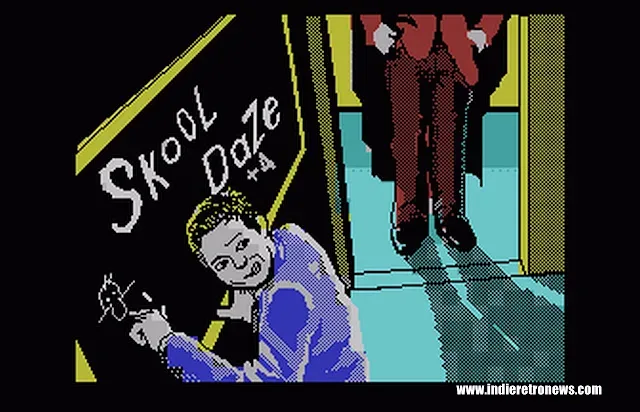
Skool Daze, the much-loved 1980s school mischief simulator, has made an unofficial debut on the Commodore Plus/4. Created by Proky and Csabo, the new adaptation brings one of British home-computing's most memorable school games to another classic Commodore machine, while updating its audiovisual presentation for the platform.
Originally released by Microsphere for the ZX Spectrum before later arriving on Commodore 64, Skool Daze has retained a reputation as a landmark of computer-game design. Its school setting is immediately understandable, its protagonist is deliberately unruly, and its goals are simple to state but difficult to achieve amid the unpredictable routines of teachers and pupils. Beneath that approachable premise is a notably open structure for its era: players are given a place full of characters following their own behaviours and are left to create opportunities for mischief.
The Plus/4 version returns players to that familiar school building as Eric, a pupil with a distinctly poor report card and an urgent reason to change it. His ultimate objective is to get into the staff room safe and alter the report, but reaching that point requires considerably more than merely finding the right room. Eric must survive lessons, stay out of trouble when possible, cause trouble when useful, and work around the watchful adults who are ready to hand out punishment lines.
A classic built around freedom and consequences
At first glance, Skool Daze is a game about childish rebellion. Eric carries a catapult, can irritate classmates, and has plenty of chances to disrupt the order of the school day. Yet the game's appeal comes from the way those actions exist within a larger system. Teachers, the headmaster and students are not simply fixed obstacles waiting at obvious points. The computer controls the inhabitants of the school, creating an active environment that continues to function as Eric attempts to pursue his own plan.
For useful background on this topic, read Analogue Pocket SNES Core Developer Rejects AI-Generated 50,000-Line Contribution.
That design creates a distinctive tension between routine and chaos. A player may need to be in class, but may also need to take a calculated risk to move closer to the safe. A well-timed act of mischief can create a useful distraction, while a poorly timed one can bring punishment and make the broader task harder. The school is therefore not just a backdrop for individual screens or isolated challenges; it is a shared space where timing, observation and improvisation matter.
For a game originating in the 1980s, that sense of a living setting is a major reason Skool Daze is often viewed as an early open-world sandbox pioneer. The term means something different in modern games with enormous maps, elaborate quest logs and cinematic presentation, but the core idea is recognizable. Players are not simply led from one prescribed encounter to the next. They are given a simulated location, a cast with behavioural rules, a central aim and the freedom to make a mess while figuring out how to reach it.
Eric's route to the staff room safe depends on more than navigation: it means handling lessons, faculty scrutiny, classmates and the escalating cost of punishment lines.
A new home for the Plus/4
The Commodore Plus/4 occupies a different place in the history of 8-bit computing from the Commodore 64, despite the obvious family connection. That makes a dedicated adaptation of a game so closely associated with the Spectrum and C64 especially welcome for enthusiasts who continue to explore the machine's library. Rather than simply treating the Plus/4 as an afterthought, this release is presented as a refreshed take on the school adventure.
Proky and Csabo's version features completely renewed graphics, an updated musical score and lively sound effects. Those changes are important because the audiovisual character of Skool Daze has always been part of its personality. The setting depends on players instantly reading corridors, classrooms and the movement of the people within them. A new visual treatment can make the school easier to appreciate on Plus/4 hardware while still preserving the comic tension of Eric's escapades.
The revised music and sound also give the conversion its own identity. Retro adaptations can fall into the trap of reproducing a remembered version of a game without considering the strengths or personality of the target system. A renewed score and new sound effects suggest an effort to modernize the experience within the boundaries of the original concept, rather than replace what made it memorable in the first place.
Crucially, the premise remains intact. This is still a game about an audacious student trying to turn a terrible report card around by the least conventional means imaginable. Eric does not gain a grand arsenal or an easy route through the school. His tools are his catapult, his awareness of the building and the player's ability to exploit the brief gaps that emerge as daily school life unfolds around him.
Why the school remains memorable
There are countless games built around fantasy kingdoms, battlefields, race tracks and distant galaxies. Skool Daze stands apart because it transforms a much more familiar institution into a playground for systems-driven comedy. The school is full of rules, schedules and authority figures, which means even a small act of disobedience can become meaningful. Throwing something, wandering away from where Eric should be or provoking the wrong person has consequences.
That structure gives the game a special kind of humour. Players are not merely watching a joke unfold; they are deciding when to take a risk and then dealing with the result. The accumulating punishment lines are especially effective because they make the cost of failure feel rooted in the setting. In a different game, lost health or a generic game-over screen might be the penalty. Here, discipline itself becomes a gameplay system, fitting the game's world while pressuring the player to think carefully about every stunt.
The result is an experience that balances disorder with strategy. Eric can stir up classroom anarchy, but mindless disruption alone will not accomplish the larger objective. The player needs to learn the rhythms of the school and recognize when to attend a lesson, when to evade an angry teacher and when to create the exact distraction needed. The school's inhabitants make the plan feel unstable, and that instability is central to the game's charm.
An unofficial adaptation with a clear purpose
The Plus/4 release arrives decades after Skool Daze first made its name, demonstrating the continued enthusiasm surrounding classic 8-bit games and the communities that keep older machines active. Unofficial projects such as this can give established games a meaningful second life by bringing them to hardware that did not previously receive the same treatment, or by reimagining how they look and sound while respecting their essential design.
For longtime players, the new adaptation offers another reason to revisit one of the era's defining school games. They can return to the familiar pursuit of the staff room safe, the tension of avoiding faculty attention and the satisfaction of getting away with a precisely timed piece of mischief. For Plus/4 owners encountering the game in this form, it is an opportunity to see why Eric's schoolday rebellion has endured for so long.
Its legacy is not solely about nostalgia. Skool Daze remains interesting because its central ideas still translate: a compact but reactive location, characters governed by their own routines, goals that encourage experimentation, and failure states that emerge naturally from the world. The game asks players to understand a place before they can truly master it. That is a principle seen across many later sandbox games, even if their scale and technology are vastly different.
With refreshed graphics, updated music and energetic sound effects, the Commodore Plus/4 version gives that design a new presentation without abandoning the schoolyard spirit at its heart. Eric is still in trouble, the teachers are still furious, and the report card still needs changing. The only difference is that another classic computer now gets to host the mayhem.
Community
Discussion
Start the conversation.
No comments have been posted yet.