

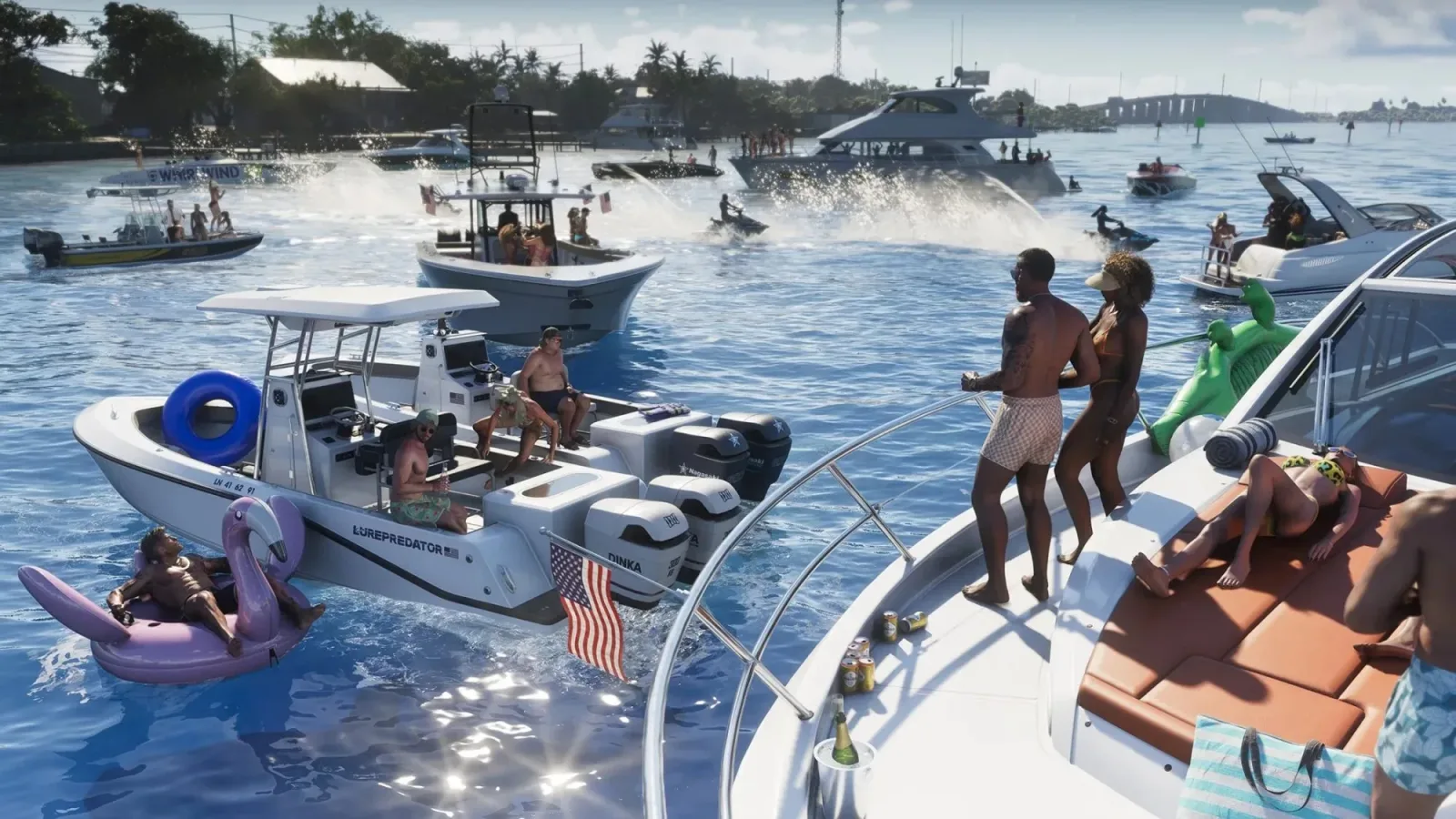
Grand Theft Auto 6 is aiming for a more reactive version of Vice City and the wider state of Leonida, with Rockstar outlining a dynamic weather system designed to affect far more than the scenery. Storms will move through the world, wind will alter water and vegetation, aircraft can be battered by turbulence, and civilians will look for cover when conditions become dangerous.
In comments shared during a major cover feature, Rockstar co-studio head Aaron Garbut described the system as substantially more detailed than the simple sunny-or-rainy states commonly associated with open-world games. The goal appears to be weather that does not merely change the skybox or add puddles, but creates interconnected conditions that players must read and react to as they travel around Leonida.
That approach suits a game set in a fictional state heavily inspired by Florida, where water, coastal life and severe storms are central parts of the setting's identity. GTA 6's version of Vice City is expected to offer city streets, shorelines, islands and open water, making the behavior of rain, wind and waves potentially meaningful whether players are driving, boating, flying or simply walking through town.
Storms will develop and move across the world
One of the most notable details is that cloud formations in GTA 6 will operate independently rather than behaving as one uniform weather layer spread over the entire map. This means players may be able to see storms gathering at a distance before they roll into their current location, changing the atmosphere gradually instead of switching immediately from clear conditions to rain.
For useful background on this topic, read Thronefall Leads a Packed November Wave for Xbox Game Pass.
That distinction could make a considerable difference to how the world feels. A distant storm on the horizon can establish a sense of place long before the first rain reaches the player. Darker skies, changing light, growing winds and approaching cloud cover can turn a routine journey into a moment of anticipation. In a game built around free-form movement, those transitions could also make the same roads, beaches and waterways feel different from one visit to the next.
Rockstar also says surfaces will not all dry at the same speed once a storm has passed. Rather than treating rainfall as a single blanket effect that disappears at once, the game will account for differing conditions across the environment. Areas that receive more direct sunlight may dry faster, while shaded places or locations with different materials may retain visible wetness for longer.
It is a small environmental detail, but it reflects the broader ambition behind the weather simulation. Long after the rain stops, the world may still show evidence that it happened. That kind of persistence can help make a large open world feel less like a series of resettable gameplay spaces and more like a place where changing conditions leave a temporary mark.
Wind will matter on land and at sea
Wind is another major part of the system. Garbut explained that it will pass through Vice City, moving trees and producing waves on the water. Those familiar visual effects are only the beginning, however. Rockstar is also accounting for the way physical features in the environment can disrupt or redirect the force of the wind.
Islands and buildings are expected to intercept wind, changing how it reaches nearby areas. For players on the water, that can alter how a boat behaves along a shoreline. A craft anchored near land may bob and sway differently depending on its position, the direction of the wind and the protection or exposure created by surrounding geography.
GTA has long made boats an important part of its coastal settings, but the new details suggest GTA 6 will give water travel a stronger connection to local environmental conditions. A journey that is calm in a protected area may become rougher after moving into open water. The shape of the coast could matter, and the same vessel may handle differently as the weather shifts.
Even where the player sits in relation to the waves will reportedly influence the experience. Garbut noted that being positioned differently in a boat can determine whether it skips over rough water or gets heavily rocked by it. That is a particularly granular detail because it shifts the focus from weather as a broad visual effect to weather as something that can change the handling and feel of a vehicle moment by moment.
For players, this may create a new reason to pay attention to the forecast-like cues in the world. A boat chase, escape route or casual trip along the coast could play out differently when winds rise and the water becomes more aggressive. Rockstar has not detailed the exact mechanical consequences for every kind of vessel, but the stated focus on wave behavior indicates that marine travel will be more than a simple route across a flat surface.
Flying into severe weather can carry a cost
Aircraft will not be immune to Leonida's more extreme conditions. Rockstar says pilots flying planes or helicopters into stormy skies can encounter turbulence. Remaining in severe weather for too long may also cause light damage.
That creates a possible risk-reward calculation for anyone taking to the air. Flying can be one of the fastest ways to cross an open-world map or reach remote areas, but a direct route through a storm may no longer be entirely carefree. Pilots may need to consider whether to go around bad weather, descend, land, or accept the possibility of a rougher journey.
The detail is especially fitting for a game where vehicles are central to both structured missions and spontaneous player activity. Turbulence could make an otherwise ordinary helicopter ride feel tense, while the prospect of damage may discourage players from treating storm clouds as purely cosmetic. At the same time, it could create memorable unscripted moments: a difficult flight at night, an emergency attempt to reach a destination before conditions worsen, or a pursuit complicated by the weather.
Rockstar has only specified potential light damage from extended exposure to severe storms, so it remains unclear how far the system will go in terms of aircraft control, repairs, visibility or mission-specific rules. Still, the basic concept points to weather having practical consequences across multiple forms of transportation rather than being limited to driving in the rain.
Leonida's residents will react to dangerous conditions
The environmental simulation will extend to NPC behavior as well. Citizens of Leonida will seek shelter when severe weather moves through the area. This should allow the population of Vice City and its surrounding locations to respond to the same conditions affecting players, instead of continuing their routines as if a storm were not happening.
That response could be one of the most visible ways GTA 6 sells the idea of a living world. Streets that are busy in clear weather may change when the skies become threatening. Beachgoers, pedestrians and other residents may disperse or move indoors, leaving the player to experience a noticeably different atmosphere as the storm arrives.
It also supports Rockstar's interest in making the game's setting feel cohesive. If wind affects the trees and water, surfaces remain wet after rain, boats move differently near the coast, and people take cover from severe conditions, then each layer reinforces the others. The weather is not simply an isolated graphical showcase; it becomes a shared event for the environment, vehicles and inhabitants of the world.
Garbut summarized the philosophy by emphasizing that the individual granular details interact. That is the key idea behind the newly discussed features. The value is not solely in clouds moving independently, or in trees swaying, or in boats responding to waves. It is in the combination of those systems, with each one helping the others make Leonida feel more reactive.
A technical showcase with gameplay potential
Grand Theft Auto games have historically used weather to establish mood, from sunlit coastal streets to nighttime rain and dramatic thunderstorms. GTA 6 appears positioned to push that role further, using more sophisticated simulation to shape travel, ambience and civilian activity. The announcement does not promise that every storm will radically change every activity, but it does show Rockstar targeting a level of environmental specificity that could be noticed throughout ordinary play.
For a setting modeled around the culture and geography of Florida, the emphasis on wind, water and shelter makes particular sense. Tropical storms are not just a visual backdrop in that kind of place; they influence how people move through it. GTA 6's weather systems seem intended to capture some of that character, whether the player is watching clouds advance over the skyline, trying to keep a boat stable near the shore, or guiding an aircraft through turbulent skies.
Grand Theft Auto 6 is scheduled to launch on November 19. Rockstar has not provided further specifics here on the full range of weather states or how frequently severe storms will occur, but the details already discussed suggest that Leonida's climate will be one of the game's most important tools for making Vice City feel unpredictable, active and alive.
Community
Discussion
Start the conversation.
No comments have been posted yet.