

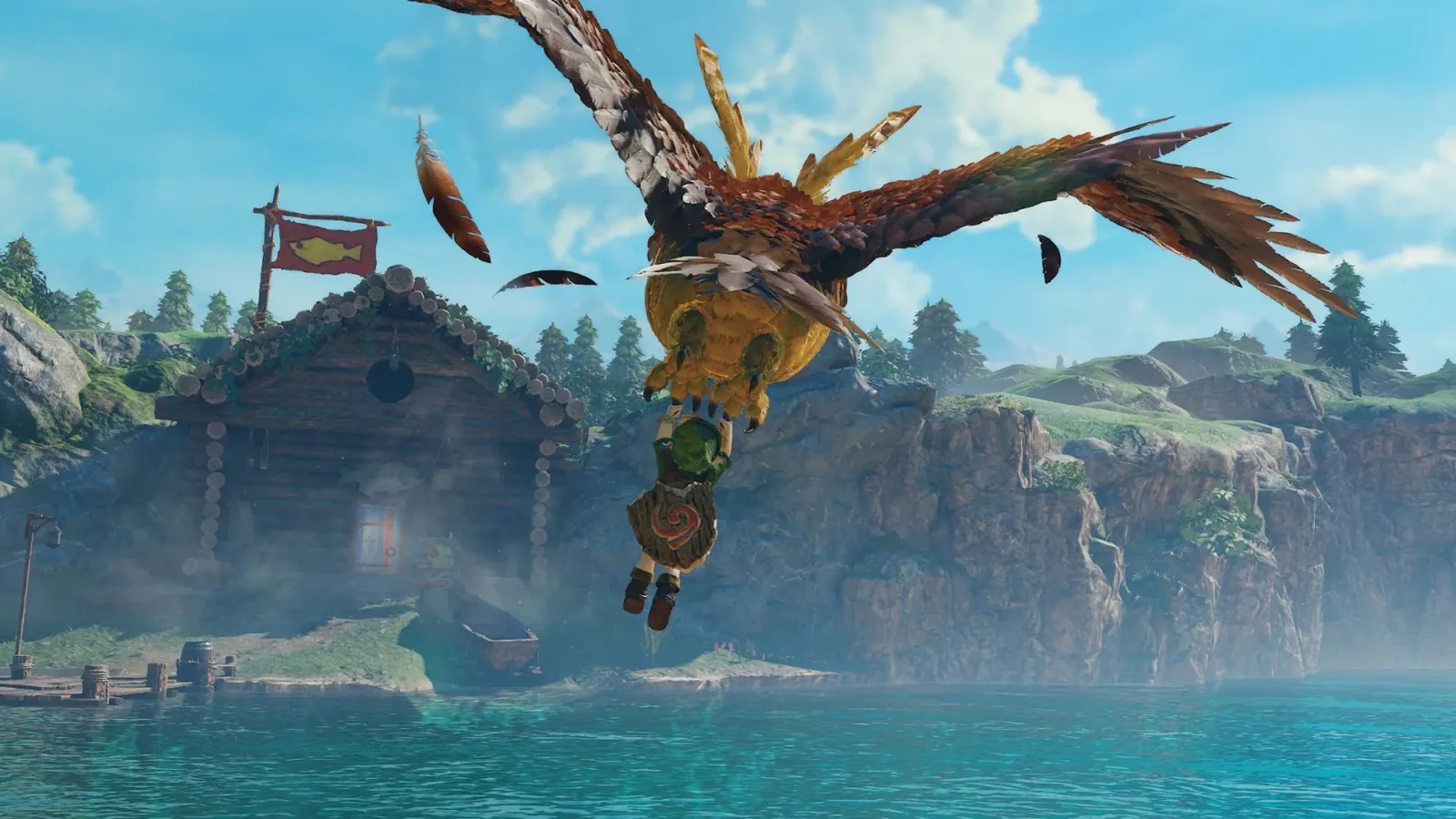
The Legend of Zelda has endured for decades partly because Nintendo has rarely treated it as a series that must follow one permanent template. Its landmarks are unmistakable: Link, Zelda, Ganon or Ganondorf, the Master Sword, dungeons, exploration, music, and a world in need of saving. But the shape around those pillars has changed repeatedly, from the open-ended adventure of the NES original to the time-traveling structure of Ocarina of Time, the stylized sailing of The Wind Waker, and the vast systemic worlds of Breath of the Wild and Tears of the Kingdom.
Hidemaro Fujibayashi, one of the key creative figures behind several of those transformations, has made it clear that he does not believe future entries should simply reuse the series' greatest ideas. In comments shared during an interview with Polygon, Fujibayashi described Zelda as a foundation for developers to explore new concepts rather than an existing catalogue to be repeated.
That philosophy matters because the franchise is at an especially interesting crossroads. Breath of the Wild reshaped expectations for modern Zelda with a broad open world, physics-driven problem solving, a more flexible approach to progression, and player-led discovery. Tears of the Kingdom expanded that framework with its building systems and layered version of Hyrule. It would be easy to assume that the next major Zelda game will take those tools and add more land, more abilities, and more things to construct.
Fujibayashi's perspective suggests Nintendo may be less interested in treating that outcome as inevitable.
For useful background on this topic, read Zelda: Ocarina of Time Happy Mask Shop Guide: Every Trade and Reward.
Zelda as a place for experimentation
Fujibayashi's career gives his view particular weight. Before joining Nintendo, he directed Capcom's Zelda projects Oracle of Seasons and Oracle of Ages, as well as The Minish Cap. At Nintendo, his work has included Skyward Sword, Breath of the Wild, and Tears of the Kingdom. He has been involved with Zelda through 2D handheld adventures, more traditional 3D structures, motion-control-focused design, and the modern open-air direction.
Rather than presenting those games as parts of one fixed evolution, Fujibayashi characterized individual features as ideas that the developers of a particular era believed would be enjoyable. In his view, Zelda provides an arena in which teams can take those creative "nuggets" and turn them into a complete game.
That is a useful way to understand why the series can appear so different from one installment to the next. A Zelda game does not necessarily begin with a demand to reproduce every feature people liked last time. It can begin with a concept--sailing between islands, manipulating time, becoming tiny, transforming into a wolf, flying among sky islands, or combining objects--and ask whether that concept supports a compelling adventure.
The result is a franchise that has often been willing to trade familiarity for a new kind of player experience. That approach can be risky. Every major shift brings debate about dungeons, combat, item progression, storytelling, exploration, and what players consider essential to Zelda. Yet it is also the reason the series has remained capable of surprising audiences across generations.
The question Fujibayashi asks younger developers
Fujibayashi said a question he frequently brings to younger members of the development team is simple: "Is that going to be fun?" The question may sound basic, but it gets at the difference between inspiration and imitation.
A proposal can be technically impressive, visually striking, or connected to a beloved past game and still fail to offer something exciting for the player to do. For a long-running franchise, that distinction becomes even more important. Developers have a huge archive of successful mechanics, locations, enemies, and story structures available to them. The temptation to pull something familiar from that archive is understandable.
Fujibayashi explained that he may identify when an idea has already been explored in games such as Breath of the Wild or Ocarina of Time. The point is not to dismiss younger staff members for unknowingly approaching familiar territory. Instead, those moments become part of a discussion intended to keep the team from feeling that it must draw only from concepts the series has already established.
That creative environment could be essential for Zelda's next phase. New staff naturally arrive with different experiences, different favorite games, and different ideas about adventure design. If they are encouraged to contribute without treating past entries as an inflexible rulebook, Nintendo has a better chance of discovering the next defining feature of the series.
It also explains why knowledge of Zelda's history is useful without needing to be a barrier. Understanding the past can help a team recognize what has been tried before, what worked, and where an old concept might be reimagined. But historical knowledge is not the same as a requirement to recreate history.
Lessons from an Ocarina of Time remake team
Fujibayashi's comments arrive alongside discussion of the The Legend of Zelda: Ocarina of Time remake. Not every developer on that project had played the Nintendo 64 original. Eiji Aonuma has said that working on the remake served in part as an exercise for team members without firsthand experience of the original, allowing them to see what insights came from engaging with it directly.
That detail highlights a tension that every legacy series must manage. Ocarina of Time remains one of Zelda's most influential games, and its impact on 3D action-adventure design is difficult to overstate. At the same time, a newer developer who did not grow up with it may identify different strengths, weaknesses, or possibilities than someone who sees it primarily through nostalgia.
A remake can therefore be more than a visual update or a way to introduce an older game to a current audience. It can also be a learning tool for the people who will eventually build something new. They can examine the design decisions that made a past Zelda adventure memorable while considering which elements are tied to its time and which remain broadly useful.
Fujibayashi's stance indicates that Nintendo's goal is not for those lessons to produce a copy of Ocarina of Time, just as it is not to make every future game a copy of Breath of the Wild. The value lies in understanding why ideas worked, then allowing a new team to find its own answer.
What this could mean for the next Zelda
Nintendo has not confirmed what form the next major Zelda game will take. There is no announced release date, no confirmed setting, and no official indication of whether the next adventure will retain the exact open-world structure established by Breath of the Wild and expanded by Tears of the Kingdom.
Those two games set a formidable standard, so elements of their influence would not be surprising. Their emphasis on exploration, freedom, and emergent solutions has become closely associated with contemporary Zelda. But influence does not require duplication. A future game could preserve a sense of discovery while changing the world structure, progression model, combat systems, tools, narrative framing, or the relationship between puzzles and exploration.
It could also take inspiration from other corners of Zelda's past without attempting a direct return. The series has used compact overworlds, tightly connected dungeons, unusual companions, transformation mechanics, seafaring, parallel worlds, and more directed stories. Fujibayashi's remarks leave room for all of those possibilities, as well as ideas that have not appeared in a Zelda game at all.
What seems less likely, if his creative philosophy guides the project, is a sequel designed solely around repeating recognizable beats. Returning to Hyrule, revisiting a familiar mechanic, or using a classic character would need to serve a fresh play experience rather than function as nostalgia for its own sake.
Reinvention is part of Zelda's identity
For fans hoping to predict Zelda's future, Fujibayashi's comments may not provide a clear answer. In a way, that uncertainty is the answer. The series has always had recurring traditions, but it has also repeatedly found new ways to interpret them.
Breath of the Wild and Tears of the Kingdom demonstrated how far Zelda could move while still feeling recognizably like Zelda. Fujibayashi's comments suggest that Nintendo does not see those games as a final destination. They are examples of what happens when a development team is given room to pursue ideas it believes will be fun.
The next entry may build on some of that legacy, reject parts of it, or head in a direction few players currently expect. Until Nintendo reveals more, the strongest clue is Fujibayashi's belief that the series works best when creators are not confined to an already-charted pool of ideas. For Zelda, reinvention is not a break from tradition. It is one of the franchise's most enduring traditions.
Community
Discussion
Start the conversation.
No comments have been posted yet.